


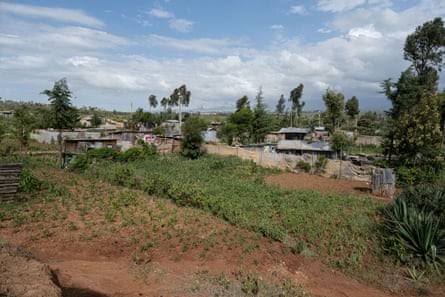
Farm workers and families in Timau, a horticultural centre in Kenya’s Meru County, are seeking to join a court petition over alleged pesticide exposure that they say has contributed to serious illnesses, bringing renewed scrutiny to chemical safety, labour protections and environmental oversight in a sector that supplies domestic and international markets. The case, reported by The Guardian on November 3, involves 87 applicants whose scientists reported paraquat and glyphosate levels above reference limits, as questions grow over how Kenya regulates hazardous agricultural chemicals and protects workers in commercial farming.
According to The Guardian, the applicants are seeking to join a 2022 legal petition against the Kenyan government and five agrochemical companies. Among them is Reuben Muriki, a former pesticide sprayer who says his health deteriorated after years of working with agricultural chemicals and who is now unable to walk independently. The allegations remain before the courts, and the reported test results do not by themselves establish that pesticide exposure caused the illnesses.

The case places occupational health at the centre of Kenya’s horticultural production system, where farms rely on chemical inputs to manage pests and maintain crop quality. Workers involved in spraying and handling pesticides can face exposure through inhalation, skin contact or inadequate protective equipment. The risks depend on the chemical involved, the concentration, frequency of exposure, application practices and the availability of safety measures.
The Guardian reported that researchers identified paraquat and glyphosate levels above reference limits among all 87 applicants, with particularly high results in Muriki’s case. Workers described neurological, respiratory and skin problems they associated with pesticide use. However, the companies named in the case dispute the allegations, while the regulator declined to comment because the matter is before the court.
The findings raise questions about the distinction between regulatory approval and workplace safety. Pesticides may be registered for particular uses, but their safe application depends on training, protective equipment, storage, handling, monitoring and compliance with product instructions. Where these safeguards are weak, workers may face risks even when chemicals are used within a regulated agricultural system.
Kenya’s horticultural sector is an important source of export earnings, employment and rural economic activity. Commercial farms produce vegetables, flowers and other crops for domestic consumers and international buyers, including European markets. The sector supports workers, transport operators, packhouses, exporters and small businesses connected to agricultural supply chains. Its competitiveness depends not only on yields and market access but also on compliance with food safety, labour and environmental requirements.
The pesticide case therefore has implications beyond the health of individual workers. If chemical handling practices are found to be unsafe, farms may face higher costs associated with worker protection, monitoring, legal claims and changes in production methods. Exporters could also face greater scrutiny from buyers seeking evidence that agricultural products are produced under acceptable environmental and labour conditions.
The Guardian reported that researchers estimated nearly half of Kenya’s registered pesticide ingredients were highly hazardous, while some chemicals used in the country are banned in the European Union. The report also highlighted the export of pesticides restricted in European markets to Kenya. The difference between chemical rules in producing and importing countries raises questions about how regulatory standards, commercial interests and worker protections interact across international agricultural supply chains.
For Kenya, the issue is particularly relevant as horticultural exports depend on access to markets with increasingly demanding food safety and sustainability requirements. European pesticide controls can affect the chemicals available to Kenyan farmers, while residue monitoring and export inspections influence whether products meet destination market standards. The reported decline in Kenyan vegetable exports following pesticide interceptions illustrates how chemical compliance can affect trade as well as public health.
However, export standards and worker safety are not identical. A crop may meet residue limits at the point of sale while workers involved in pesticide application remain exposed during handling. Protecting agricultural workers therefore requires measures that extend beyond testing harvested produce, including workplace inspections, exposure monitoring, training and access to appropriate protective equipment.
The economic burden of occupational illness can also extend to households and communities. Workers who become unable to continue farming or other physical employment may lose income, while families can face additional costs for treatment and care. In rural areas where livelihoods depend on seasonal agricultural work, prolonged illness can affect household financial stability and reduce the availability of experienced labour.
These risks are relevant to the broader sustainability of agricultural production in Africa. Commercial farming can support employment, export revenues and food supply, but the benefits depend partly on whether production systems protect the people who work within them. Labour conditions, chemical management and environmental compliance increasingly form part of the operational and reputational risks faced by producers and exporters.
The legal case also raises questions about the responsibilities of agrochemical companies, farm operators and public regulators. Product manufacturers are responsible for providing appropriate safety information and complying with applicable rules, while employers must manage workplace risks and ensure that chemicals are handled safely. Regulators are responsible for registration, monitoring and enforcement. The court proceedings will help determine the claims brought by the applicants and the responsibilities of the parties involved.
The regulator’s response will be important in assessing whether existing controls are adequate and consistently enforced. Effective oversight requires reliable information on pesticide use, inspections, exposure incidents and compliance with safety requirements. Where workers lack access to training or protective equipment, enforcement alone may not be sufficient without practical support for farms and agricultural workers to adopt safer methods.
The case also highlights the need to consider alternatives to highly hazardous pesticides where technically and economically feasible. Integrated pest management, crop monitoring, biological controls and improved application methods can reduce reliance on certain chemicals, although their effectiveness varies by crop, pest and farm conditions. Adoption may require training, investment and access to suitable products, particularly for smaller producers operating with limited resources.
For Kenya and other African agricultural economies, the challenge is to strengthen worker protection without undermining the livelihoods and market access that horticulture provides. That requires a regulatory approach that considers occupational health, environmental impacts, food safety and the commercial realities of production. Clear standards and effective enforcement can help reduce uncertainty for farmers and exporters while protecting workers from avoidable risks.

The Timau proceedings remain unresolved, and the reported exposure findings do not establish a final legal or medical conclusion. Their significance lies in the questions they raise about how agricultural chemicals are managed across Kenya’s horticultural supply chains. The outcome could influence how regulators assess hazardous products, how farms manage worker exposure and how exporters demonstrate compliance with labour and sustainability expectations. For the sector, maintaining market access and productive employment will depend in part on whether environmental and occupational safeguards are treated as core operating requirements rather than separate compliance obligations.


