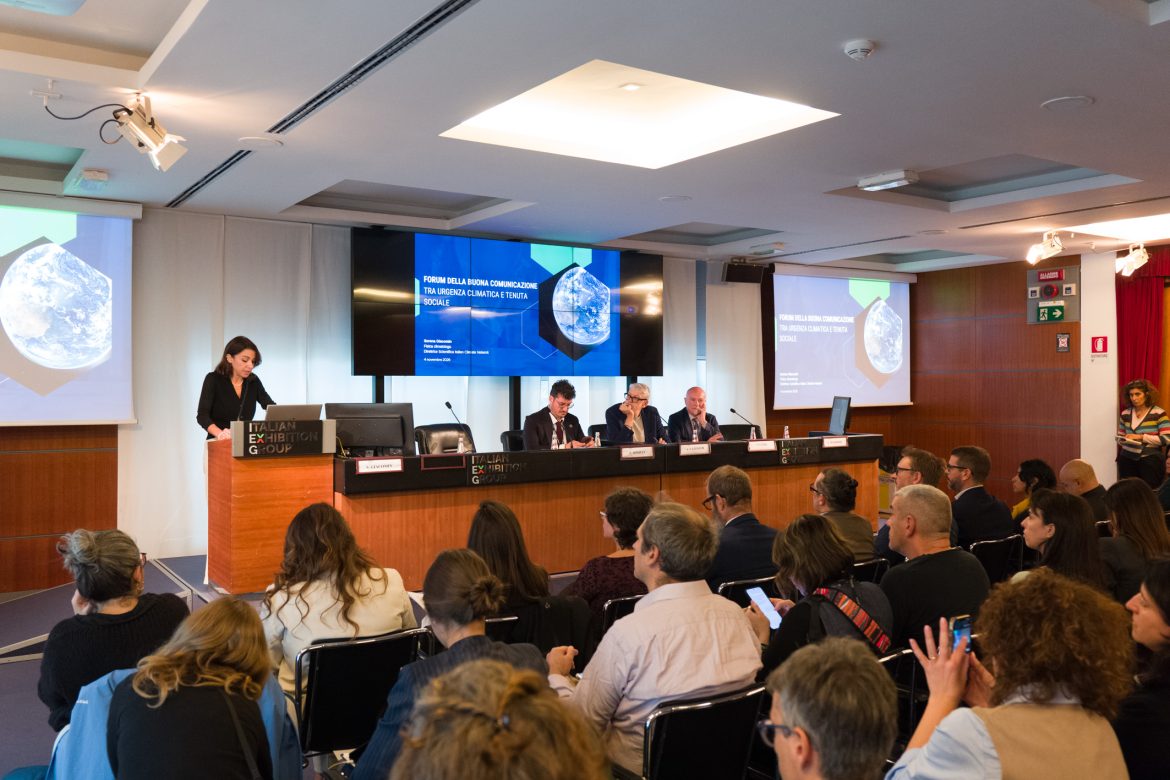
Italy’s Mattei Plan for Africa, sustainable water management and investment opportunities in the continent’s agricultural sector took centre stage at the sixth Africa Green Growth Forum, held during Ecomondo 2026. The forum brought together public institutions, international organisations and private-sector representatives to examine how cooperation between Italy and African countries could support sustainable development, with particular attention to water infrastructure, productive agriculture and private investment.
The event was organised in collaboration with the Task Force for the Implementation of the Mattei Plan at the Italian Prime Minister’s Office, Confindustria Assafrica & Mediterraneo and RES4Africa. Discussions focused on the role of the Mattei Plan in developing cooperation models that connect institutions, international organisations and businesses while increasing the contribution of private investment to Africa’s green growth.
The proceedings were opened by Professor Fabio Fava, President of Ecomondo’s Technical Scientific Committee; Fabio Massimo Ballerini, a member of the Mattei Plan Task Force at the Italian Prime Minister’s Office; and Francesco Corvaro, Special Envoy for Climate Change at Italy’s Ministry for the Environment, Energy and Energy Security. A panel discussion subsequently examined the challenges and opportunities for private investment under the Water Forward Initiative, alongside case studies on water management for productive uses.

Water infrastructure remains closely linked to Africa’s agricultural development and economic resilience. Reliable access to water influences agricultural productivity, food systems and the ability of businesses to sustain operations, particularly in areas exposed to changing rainfall patterns and water stress. The forum’s focus on productive water use placed investment and cooperation at the centre of discussions about how infrastructure can support economic activity.
The emphasis on private investment also reflects the financing requirements associated with expanding water systems and improving their efficiency. Public institutions and development partners can help establish policy frameworks and investment priorities, while private-sector participation can contribute capital, technology and operational expertise. The effectiveness of such partnerships will depend on the ability to structure projects that are financially viable and aligned with the development needs of participating countries.
Alongside the Africa-focused discussions, Ecomondo examined the regulatory and industrial changes shaping Europe’s packaging sector. The Paper District GDO & Grocery Summit addressed the requirements of the European Union’s Packaging and Packaging Waste Regulation (PPWR), focusing on eco-design, recyclability, recycled and bio-based materials, and closer cooperation between packaging manufacturers and large-scale retail businesses.
The discussions considered regulatory compliance relating to substances contained in packaging, recyclability requirements and supply-chain innovation. Participants also examined the potential of polymers derived from carbon dioxide and the importance of improving circular efficiency across the full product life cycle.
Organised by Ecomondo in collaboration with Largo Consumo and the Italian Paper and Graphics Federation, the summit opened with remarks from Mauro Delle Fratte, Exhibition Manager at Ecomondo, and a presentation by Micol Bertoni of Assografici. Two round-table discussions brought together representatives from companies in the retail sector and large-scale retail organisations.
The packaging debate reflects growing pressure on manufacturers and retailers to reconsider how materials are sourced, designed, used and recovered. Regulatory requirements are influencing investment decisions across the value chain, with businesses expected to address recyclability and material composition while maintaining product performance and commercial efficiency. Greater coordination between manufacturers and retailers could help improve material recovery and reduce inefficiencies in packaging systems.
Climate transition planning was another focus of the event, with discussions examining how businesses and investors can use transition plans to manage environmental, social and governance risks and guide financial decisions. The session, titled “Climate transition plans for managing ESG risks: what role for businesses and investors?”, brought together representatives from the financial sector, business community and sustainable finance organisations.
Chaired by Francesco Bicciato, Director-General of the Forum for Sustainable Finance, which helped organise the event, the discussion included representatives from the European Investment Bank, the Green Climate Fund, Eurosif and the Hera Group. A central message was that credible climate transition plans must move beyond long-term environmental commitments and translate objectives into practical strategies supported by funded investments. For businesses, this means connecting climate targets with operational decisions, capital allocation and risk management. For investors, reliable and comparable information is necessary to assess whether companies have credible pathways for managing climate-related risks and delivering their stated objectives.
The discussion also highlighted the role of capital markets and financial intermediaries in directing investment and credit towards transition activities. Public and private resources can support implementation, but the credibility of corporate plans remains important in determining whether financing reaches projects capable of delivering measurable progress.
The relationship between resource security and industrial competitiveness emerged in a separate discussion on the circular economy and defence. The conference, titled “Circular Economy and Defence: Italian and European industry between challenges and opportunities”, examined how supply-chain fragmentation and dependence on foreign sources of critical raw materials affect the strategic autonomy of Italy and the wider European defence industry.
Participants discussed the importance of developing domestic industrial capabilities for recovering, processing and reusing critical materials. Resource recovery alone may not be sufficient to reduce external dependence if the industrial expertise and infrastructure needed to process recovered materials remain limited. Building these capabilities could strengthen supply-chain resilience while supporting the wider transition towards more circular production systems.
The conference was chaired by Fabio Fava, President of Ecomondo’s Technical Scientific Committee, and Lucia Leonessi of Cisambiente Confindustria. It brought together representatives from Italy’s Ministry of Defence, the Air Force, the Navy and industry. Discussions also explored dual-use technologies, highlighting the role of research, innovation and collaborative design in developing solutions that can serve both civilian and defence applications. This approach places circular economy principles within a wider industrial policy discussion, where material efficiency, technology development and supply security intersect.
Innovation was further recognised through the Lorenzo Cagnoni Green Innovation Award, which honours businesses and start-ups translating research, technology and creativity into solutions for the ecological transition. Named after Italian Exhibition Group’s long-standing president, the award was presented to ten projects, comprising six exhibitors and four start-ups from Ecomondo’s Innovation District.
The six awarded exhibitors were Idro Group in Bioenergy and Agriculture; Sumus Italia in Circular and Regenerative Bio-Economy; Planetek Italia in Earth Observation and Environmental Monitoring; Idealservice Soc. Coop. in Sites and Soil Restoration; D.E.S.O.T.E.C. International N.V. in Water Cycle and Blue Economy; and Circular Materials in Waste as a Resource.
The four recognised start-ups were Rarearth, Nemoris S.R.L., Flugantia Lab and Limenet S.R.L. The awards ceremony was opened by Italian Exhibition Group President Maurizio Ermeti, who presented the plaques alongside Alessandra Astolfi, Global Exhibition Director of IEG’s Green and Tech division, and Mauro Delle Fratte, Ecomondo’s Exhibition Manager.

The projects reflect the range of technologies and business models being developed across the environmental innovation landscape, from water management and ecological monitoring to material recovery and bio-based economic activities. Recognition of both established exhibitors and emerging ventures also highlights the role of research commercialisation and enterprise development in advancing the ecological transition.
Taken together, the discussions at Ecomondo connected several dimensions of the sustainability agenda: Africa’s investment and development priorities, European packaging regulation, corporate climate transition planning, industrial resource security and green innovation. The Africa Green Growth Forum placed international cooperation and private investment at the centre of discussions on water and agricultural development, while the other sessions examined how regulation, finance and technology are influencing industrial transformation.
For African economies, the forum’s focus on the Mattei Plan and the Water Forward Initiative raises important questions about how international cooperation can translate into investment that supports productive sectors. The long-term value of such partnerships will depend on the quality of projects, the participation of local institutions and businesses, and the ability to connect financing with measurable development outcomes. As sustainability priorities increasingly influence trade, investment and industrial policy, cooperation between African and international actors will remain important in shaping the continent’s access to technology, capital and resilient infrastructure.