


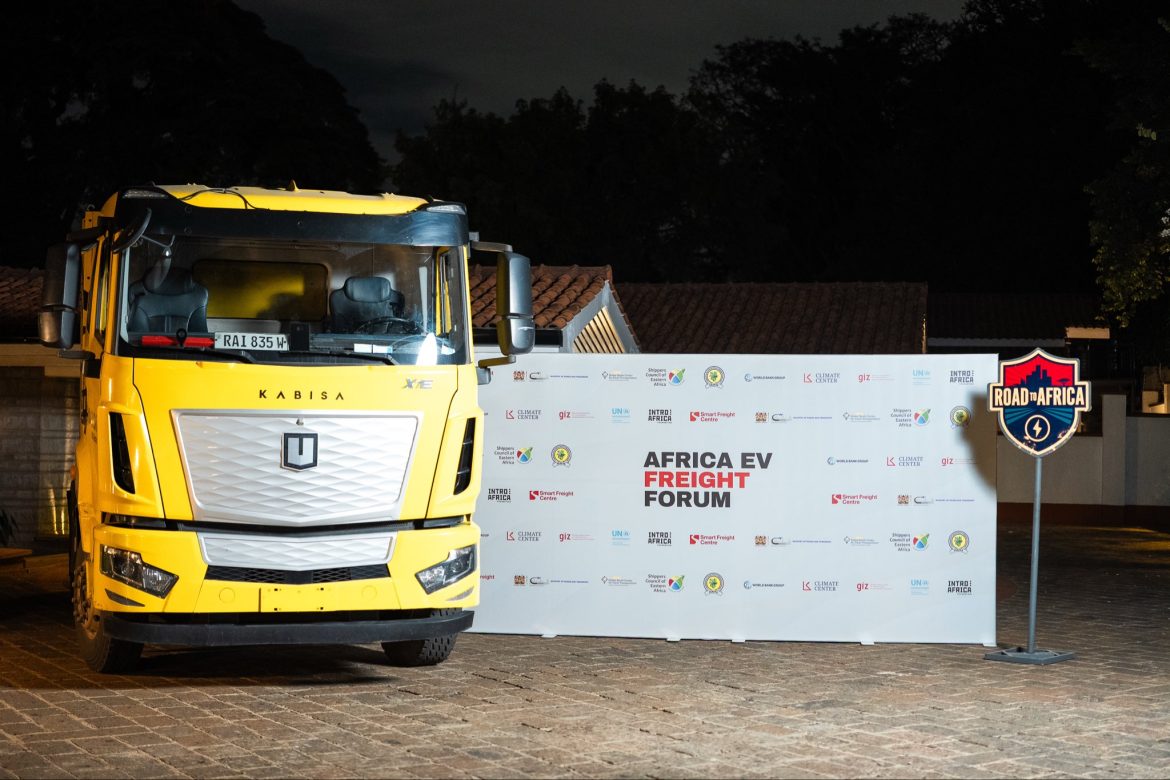
Electric freight is gaining a foothold in Kenya as vehicle manufacturers introduce battery-powered commercial models, charging providers extend infrastructure beyond Nairobi and financial institutions develop lending products for electric mobility. However, turning these developments into a commercially viable freight network across East Africa will depend on whether charging infrastructure, electricity supply, financing and regional transport systems can support heavy-duty vehicles operating over long distances.
The challenge was a central focus of the inaugural Africa EV Freight Forum, held in Nairobi on 22–23 September 2026. Organised by Smart Freight Centre and Intro Africa in partnership with Kenya’s Ministry of Roads and Transport, the two-day meeting brought together government representatives, transport operators, financiers, development institutions and technology providers to examine how zero-emission freight can move beyond demonstrations towards routine commercial deployment.
A 1,600-kilometre electric vehicle expedition from Addis Ababa to Nairobi, known as Road to Nairobi, provided a practical reference point for the discussions. The journey retraced a corridor covered in the opposite direction during an earlier expedition in October 2025, offering an opportunity to assess progress in charging infrastructure and the operational conditions facing electric vehicles on cross-border trade routes.

The expedition highlighted the difference between demonstrating that an electric vehicle can complete a long-distance journey and establishing that it can operate reliably as part of a commercial freight fleet. Freight operators must account for vehicle range under load, charging time, electricity costs, delivery schedules and the availability of technical support along the route. These factors become particularly important when vehicles carry goods across national borders, where delays and inconsistent infrastructure can affect operating costs.
Kenya’s commercial electric vehicle market is beginning to develop around these requirements. Manufacturers including Foton, JAC Motors and Tata Motors have introduced electric commercial vehicle models, covering light trucks, pickups and other vehicle categories. Reported specifications vary in terms of payload capacity and driving range, reflecting the different operating requirements of businesses considering fleet electrification.
One example is Foton’s reported 4.5-tonne payload electric truck, priced at approximately KSh11 million in July 2026. The price illustrates the substantial upfront capital required to acquire electric commercial vehicles, particularly for small and medium-sized transport businesses comparing them with established diesel alternatives. For fleet operators, the purchase decision must consider not only the initial vehicle cost but also expected energy savings, maintenance, financing costs and the ability to keep vehicles in productive use.
Charging infrastructure is another part of the market’s expansion. BasiGo and Rubis Energy Kenya established a charging facility at Sabaki in Athi River, equipped with 100-kilowatt direct-current fast chargers supporting CCS2 and GB/T connectors. Their partnership also identified additional charging locations in Meru, Nanyuki and Nyeri, extending the potential reach of electric mobility beyond Nairobi.
The network is intended to serve electric buses, vans, trucks, passenger vehicles and other compatible models. However, infrastructure that supports passenger vehicles and buses does not automatically meet the requirements of heavy-duty freight. Trucks carrying substantial payloads may require higher charging capacity, larger battery systems and charging arrangements that fit within tightly scheduled delivery operations. The location of charging facilities also matters, particularly where freight routes extend beyond major urban centres.
The Addis Ababa–Nairobi expedition brought these infrastructure questions into focus. Cross-border electric freight requires coordination between charging locations, electricity providers, road authorities and border agencies. A charging station in one town does not necessarily establish that a truck can complete a commercial journey efficiently, especially when vehicle payload, energy consumption and delivery deadlines are considered.
Border congestion adds another operational constraint. Reporting by The Star following the expedition highlighted queues at some crossings extending to 10 kilometres or more. For freight operators, prolonged waiting periods can disrupt delivery schedules and reduce vehicle utilisation. Electric vehicles must also account for energy consumption during delays and whether suitable charging facilities are available when journeys take longer than planned.
The wider charging network offers some indication of Kenya’s progress, although national infrastructure totals do not necessarily reflect freight readiness. A United Nations Economic Commission for Africa survey cited in September 2026 reporting counted 235 electric vehicle charging stations in Kenya in 2025, placing the country second in Africa behind Egypt, which had 300. Ethiopia had 100 stations, while Rwanda had 40.
The figures provide a measure of the broader electric mobility market but do not establish how many charging facilities can accommodate heavy-duty vehicles or deliver the power required by commercial truck fleets. Freight operators need charging infrastructure located around logistics centres, industrial areas, depots and major transport corridors, with sufficient electricity capacity to avoid extended interruptions.
Electricity pricing and grid reliability will also influence the economics of freight electrification. In September 2026, the Energy and Petroleum Regulatory Authority (EPRA) adjusted Kenya’s e-mobility tariff framework by removing the previous monthly consumption ceiling of 15,000 kilowatt-hours and introducing an Energy Consumption Threshold mechanism. The change addresses the consumption patterns of commercial charging and battery-swapping operators as their networks expand.
Kenya Power’s electric mobility charging business provides another indication of the market’s development. The utility reported cumulative electric vehicle charging revenue of KSh382 million over the 34 months to April 2026, with monthly revenue reaching KSh35 million in February. These figures cover the utility’s wider electric mobility charging activities and should not be interpreted as revenue generated by electric freight alone.
For freight operators, the financial case will depend on the relationship between electricity tariffs, charging availability and vehicle utilisation. Charging facilities require investment in grid connections, transformers, high-capacity equipment and suitable sites. The electricity system must be able to support these facilities where commercial vehicles need to recharge, including locations outside major urban centres.
Financing presents a further challenge. Kenya’s banking sector has begun developing products for electric commercial vehicles, but much of the activity reported in 2026 has focused on public transport rather than heavy-duty freight. NCBA and BasiGo announced a KSh2 billion electric mobility financing arrangement in August 2026, targeting electric vehicle acquisition. The programme provides financing of up to 90% of asset value for qualifying established public service vehicle savings and credit cooperatives and companies over 60 months. Individual Sacco members are eligible for financing of up to 80% over 48 months.
Co-operative Bank announced a separate KSh1.5 billion commitment on 15 November 2026 to finance electric public service vehicles over 12 months. The facility offers financing of up to 90% of purchase costs to qualifying Saccos and also covers charging infrastructure and digital fare collection. Two 16-seater electric vans supplied by BasiGo had been delivered to Enabled Mashariki Sacco under the programme.
Read also:Co-operative Bank commits ksh1.5 billion to finance electric matatu fleets in Kenya
These arrangements demonstrate that lenders are beginning to structure financing around electric mobility assets and their supporting infrastructure. However, they do not establish that equivalent credit facilities are available to freight companies acquiring heavy-duty electric trucks. The risks and repayment requirements can differ considerably between passenger transport and goods movement.
A lender assessing a freight vehicle must consider its acquisition price, expected payload, daily utilisation, battery performance, maintenance arrangements and the revenue generated through deliveries. Access to spare parts, warranties and technical support is also important, particularly as operators adopt vehicle technologies with which local maintenance networks may have limited experience.
Charging infrastructure introduces additional capital requirements. Companies operating private depots may need to finance charging equipment and electricity connections alongside vehicle purchases. Those relying on public charging networks must account for the availability, location and cost of charging when calculating delivery expenses.
Double Feather Partners, which participated in the Nairobi forum, highlighted the need for financing models that reflect the operating realities of electric freight. The commercial calculation extends beyond the purchase price of a truck to include energy, maintenance, financing, charging infrastructure and potential revenue losses caused by downtime. For lenders, the ability of projected operating savings and vehicle utilisation to support loan repayments will be central to assessing the viability of these investments.
Government policy is another part of the enabling environment. Opening the forum on behalf of Principal Secretary Mohamed Daghar, Director of Road and Rail Transport Paul Kingori emphasised collaboration between public institutions and private-sector participants in developing cleaner and more efficient transport systems. He also highlighted Kenya’s efforts to strengthen its policy, legal and institutional framework for electric mobility.
Susan Kamau, Principal Road Transport Officer in the State Department for Transport, outlined the government’s coordinated approach across five areas: policy and regulation, energy, innovation, skills and financing. She also discussed reviews of the legal framework governing road transport to accommodate electric mobility and intelligent transport systems.
For freight operators, predictable regulation will be important in areas covering vehicle registration, road safety, commercial operations and cross-border movement. The forum also considered alternative transport technologies, including hydrogen, as part of wider national transport planning. Kenya’s industrial ambitions provide further context for the development of the electric mobility market. In October 2026, the government and Endelevu Enterprise Corporation signed a memorandum of understanding for a proposed US$3 billion electric mobility programme, equivalent to approximately KSh390 billion. The proposal includes two vehicle assembly facilities with combined annual production capacity of 150,000 vehicles, 1,000 solar-powered charging hubs and a digital platform intended to support up to 100,000 electric vehicles.
The proposed manufacturing capacity covers 50,000 four-wheel vehicles and 100,000 two-wheelers and light-mobility vehicles. The programme remains a proposed investment under a memorandum of understanding rather than a completed manufacturing and infrastructure development. Its eventual contribution to freight electrification will depend on implementation, the vehicle categories produced, charging capacity and the locations selected for the proposed facilities.
Solar generation and battery storage could also support charging infrastructure, particularly where grid capacity is constrained. However, the contribution of renewable energy to freight operations will depend on installed generation capacity, grid connections and the proportion of electricity actually supplied from renewable sources. The proposed charging hubs should not be treated as an existing network of heavy-duty truck charging facilities.
The transition will also require investment in technical skills. Electric commercial vehicles rely on high-voltage systems, battery management technology and specialised components that require trained technicians and appropriate maintenance facilities. Fleet operators need access to reliable servicing and replacement parts to minimise downtime and maintain delivery schedules.
The regional dimension makes these requirements particularly important. The Northern Corridor, which connects the Port of Mombasa to inland markets, is a major trade route for East and Central Africa. Its ability to accommodate electric freight will depend on charging infrastructure, electricity supply, border efficiency and coordination between the countries and institutions responsible for transport operations.

The Africa EV Freight Forum brought together organisations involved in these areas, including the World Bank Group, the United Nations Environment Programme, the Shippers Council of Eastern Africa, Kenya Power, the Kenya Transporters Association and the Northern Corridor Transit and Transport Coordination Authority. Their participation reflected the range of institutions required to support a transition that extends beyond vehicle manufacturing and charging technology.
The Nordic-Africa EV Summit, held in Addis Ababa from 14–16 September 2026, also formed part of wider regional engagement on electric mobility. Discussions at a reception hosted by Norwegian Ambassador Siv Cathrine Moe in Nairobi brought together African and Nordic participants to consider how experience from Nordic electric vehicle markets could inform solutions suited to African operating conditions.
For East African freight companies, the immediate commercial question is whether electric trucks can move goods reliably at a cost that competes with conventional transport. The answer will depend on vehicle prices, financing terms, electricity tariffs, charging availability, payload performance and the time required to complete deliveries.
Kenya has begun developing several parts of the electric mobility market, from commercial vehicle supply and charging services to financing products and regulatory adjustments. Extending these developments into heavy-duty cross-border freight will require investment designed around the demands of logistics operators and regional trade corridors. The success of electric freight will ultimately be measured not by the number of vehicles completing demonstration journeys, but by their ability to deliver goods consistently, meet operating schedules and sustain commercially viable transport services.