


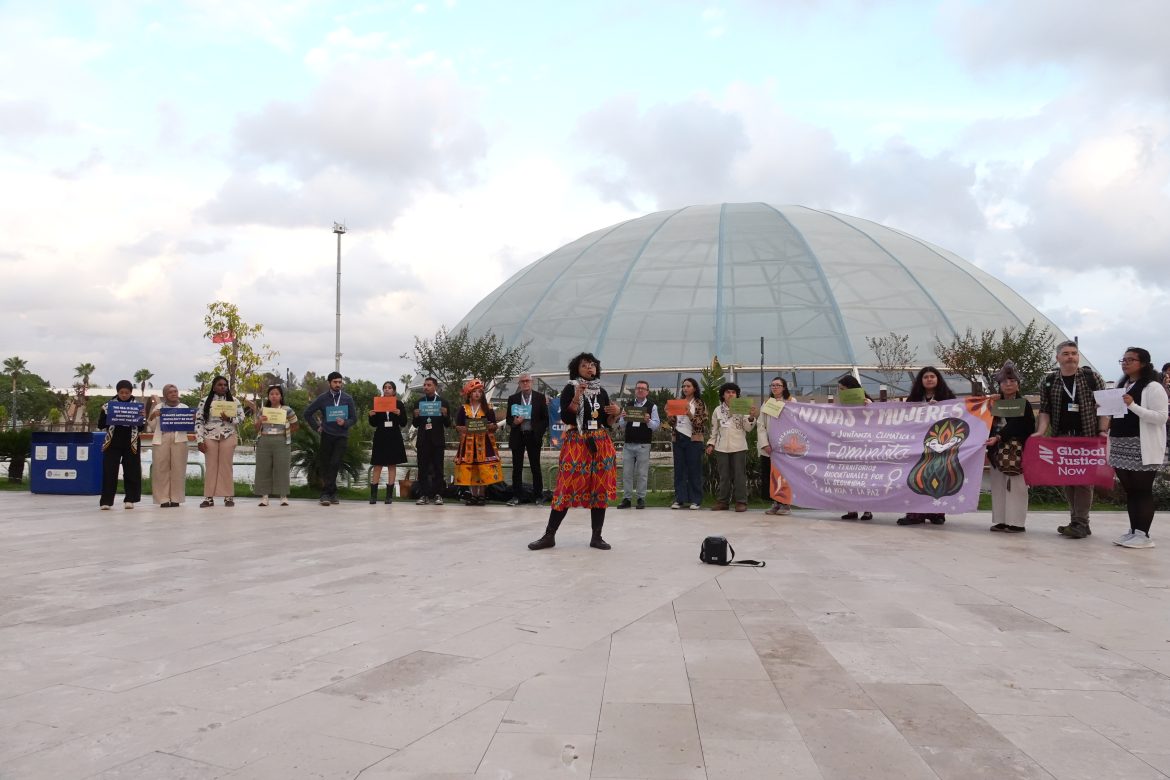
Youth representatives from the Global South demonstrated inside the United Nations climate conference venue in Antalya on Wednesday, urging governments to preserve language calling for accelerated action to phase out fossil fuels as negotiators entered the final 48 hours of COP31 with major divisions over energy, finance and transition technologies still unresolved.
The demonstration brought together young people from Latin America, the Caribbean and Southeast Asia, including Indigenous, Afro-descendant, peasant and urban representatives, the organizations involved. The participants opposed the use of carbon capture and storage, hydraulic fracturing and nuclear power as substitutes for reducing emissions from coal, oil and gas.
The protest followed the publication on Monday of the first draft of the COP31 political decision. The text calls for “accelerated action to phase out fossil fuels”, including an immediate transition away from fossil fuels in energy systems. It must still secure the approval of nearly 200 countries before the conference closes on Friday, leaving negotiators to reconcile sharply different national positions on energy security, economic development and responsibility for historic emissions
“This draft opened a door we have been asking to open for years,” Juan David Amaya, founder of Life of Pachamama and a co-organizer of the demonstration, said in the statement. “What we are asking negotiators is not to close it in the final hours.”

The dispute over the draft is particularly significant for Africa, where governments face the dual pressure of expanding access to reliable energy and limiting exposure to a global transition away from carbon-intensive assets. A final agreement that accelerates the decline of fossil fuels without providing adequate finance could increase the cost of replacing coal-fired generation, strengthening electricity grids and developing renewable-energy capacity in countries already carrying high levels of public debt.
It could also affect African economies that depend on oil and gas revenues, export earnings or planned hydrocarbon projects. Governments including those of Angola, Algeria, Nigeria, Mozambique, Senegal and Tanzania have viewed oil and gas resources as potential sources of foreign exchange, fiscal revenue and industrial development. Faster changes in global demand, lending standards and investor expectations would increase the need for these countries to manage the risk of stranded infrastructure while diversifying their economies and protecting public finances.
At the same time, many African countries remain highly exposed to climate-related losses despite contributing a relatively small share of accumulated global emissions. Drought, flooding and extreme heat are already affecting agricultural production, hydropower, transport networks and government budgets. The continent’s negotiating position therefore extends beyond whether fossil fuels should be phased out to who will pay for the infrastructure, social protection and economic adjustment required to make that transition feasible.
The draft decision calls on developed countries to provide at least $120 billion for adaptation in developing economies, according to reports from Antalya. The figure remains subject to negotiation and sits at the centre of a longstanding dispute over whether climate finance should be delivered as grants, concessional funding or loans.
For African governments, the composition of that finance is as important as its headline value. Additional borrowing can worsen debt-service pressures and leave less public money available for hospitals, schools, water systems and climate-resilient infrastructure. Grant-based and highly concessional financing would offer more fiscal room, particularly for adaptation projects that protect communities and public assets but do not always generate the commercial returns sought by private investors.
Participants in the Antalya action called for new public, grant-based funding for Global South countries, including effective financing for loss and damage. They also demanded a transition plan with defined dates, measurable interim targets and greater participation by women, young people, Indigenous peoples and communities directly affected by energy and extraction projects.
Their rejection of carbon capture and nuclear power also reflects a wider argument over how transition capital should be allocated. Supporters of carbon capture say it may be needed to reduce emissions from difficult-to-abate industries such as cement, steel and chemicals. Critics question whether deploying the technology at scale could divert public finance from renewable power, storage, transmission networks and energy efficiency while allowing continued fossil-fuel production.
That debate carries practical consequences for Africa. Carbon capture projects require substantial capital, transport infrastructure, storage capacity and long-term regulatory oversight. Those demands could place additional pressure on countries with constrained public budgets and relatively shallow domestic capital markets. Nuclear plants, meanwhile, can provide low-carbon electricity but typically involve high initial costs, long construction periods and complex requirements for financing, safety regulation and waste management.

African countries are unlikely to adopt a single approach. South Africa already operates the continent’s only commercial nuclear power station, while several governments are considering nuclear energy as part of plans to expand electricity supply. Others are concentrating on solar, wind, geothermal and hydropower, supported by regional power pools and new transmission infrastructure. The central policy question is whether each investment can provide reliable and affordable energy without creating unsustainable fiscal liabilities or delaying lower-cost alternatives.
The final COP31 text will determine whether the reference to an accelerated fossil-fuel phase-out survives negotiations and whether it is accompanied by credible provisions on adaptation, transition finance and implementation. Without those elements, African countries could face stronger expectations to transform their energy systems without receiving sufficient capital to manage the economic and social costs.
For the continent, the outcome will be measured less by the strength of its diplomatic language than by whether it expands access to affordable finance, helps governments build resilient infrastructure and gives energy-poor economies a workable route through the global transition. The remaining negotiations in Antalya will show whether the proposed phase-out language can be matched by the financial and institutional arrangements required to implement it.


