


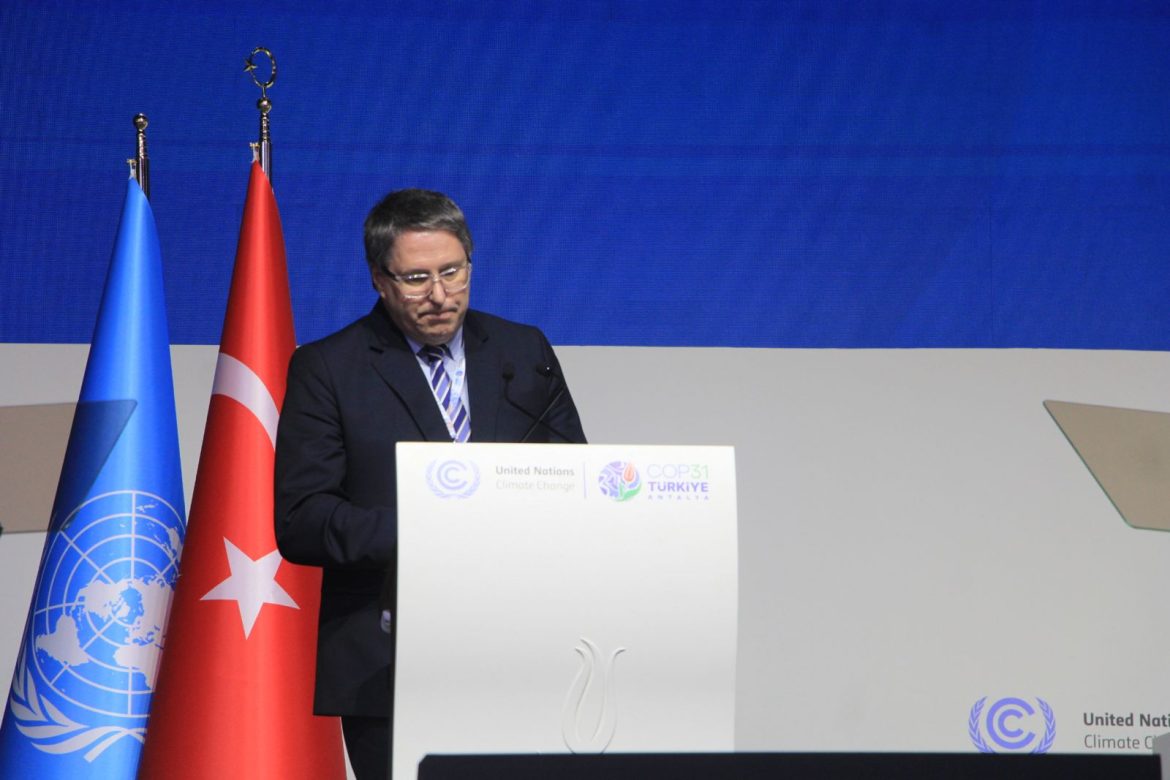
South Africa will require more than $15.6 billion, or R250 billion, in climate finance to implement its adaptation measures between 2026 and 2035, according to Environment Minister David Maynier, sharpening the focus on the widening gap between Africa’s climate risks and the funding available to protect economies, infrastructure and communities.
Maynier presented the estimate on November 17 at the COP31 climate conference in Antalya, Türkiye, where governments are negotiating how to mobilise more predictable support for developing countries already confronting floods, droughts, heatwaves and mounting pressure on food and water systems. The funding would support measures across water management, agriculture, public health, human settlements, infrastructure, energy, mining and coastal protection.
“In accordance with our second Biennial Transparency Report, which we will submit this year, South Africa needs investments and provision of climate finance of over R250 billion, about $15.6 billion, to fully implement adaptation actions between 2026 and 2035,” Maynier said, according to reports of the minister’s address.
The estimate translates into an average requirement of more than $1.5 billion a year over the decade, although expenditure is unlikely to be distributed evenly. Large water-storage, drainage, transport and coastal-protection projects typically require significant upfront capital, while maintaining early-warning services, public-health surveillance and agricultural support creates continuing demands on government budgets.

The figure represents only one part of South Africa’s wider climate financing requirement. The country is estimated to need about R3.7 trillion, or $213 billion, to respond to climate change and shift towards a lower-carbon economy. Pretoria has reported approximately $14.36 billion in commitments towards its carbon-neutrality objectives, but some of that support is structured through loans, guarantees and private investment rather than grants or direct public funding.
That distinction is important for South Africa and other African economies. A financing commitment does not necessarily amount to immediately available capital, while loans for projects that do not generate direct revenue can increase pressure on public debt. Adaptation infrastructure, including stormwater drainage, public-health systems and protections for vulnerable settlements, produces substantial economic and social benefits but often lacks the predictable cash flows required by commercial investors.
Maynier said the widening adaptation gap was a concern and called for a benchmark to triple adaptation finance by 2035. South Africa is also seeking predictable replenishment of multilateral climate funds and completion of arrangements allowing the Adaptation Fund to serve the Paris Agreement, including through a share of proceeds generated under the agreement’s Article 6.4 carbon-market mechanism.
The country has been implementing its Climate Change Act and National Adaptation Strategy across different levels of government, while economic sectors develop their own adaptation plans. These include strategies covering agriculture and food security, water resources, health, infrastructure, human settlements and coastal zones. The challenge is moving from policies and sector plans to financed projects that can withstand increasingly severe climate hazards.
For households and businesses, the consequences are practical. Damage to roads and railways raises transport and insurance costs. Water shortages disrupt mining, manufacturing and agriculture. Extreme heat affects labour productivity, public health and electricity demand, while floods impose reconstruction costs on municipalities that frequently lack sufficient resources to maintain existing infrastructure.
South Africa must finance those protective measures while managing an energy system in which coal still accounts for about 75% of electricity generation. Reducing that dependence requires investment in renewable generation, transmission networks and energy storage, but the transition must also maintain grid reliability and address employment and municipal-revenue risks in coal-producing regions.
The country’s Just Energy Transition Investment Plan, covering 2023 to 2027, has estimated funding requirements of R1.48 trillion. Yet the adaptation requirement shows that climate policy cannot be confined to replacing coal-fired generation. It must also finance stronger water systems, climate-resilient agriculture, heat-prepared health services and infrastructure capable of operating under more volatile weather conditions.
South Africa’s updated climate contribution includes a target to reduce annual emissions to between 320 million and 380 million tonnes of carbon-dioxide equivalent by 2035, compared with a 2030 range of 350 million to 420 million tonnes. Maynier said opportunities in electricity, electric vehicles and emerging fuels such as green hydrogen could support that progression.
The financing structure will determine how quickly those opportunities translate into investment. Germany announced a €200 million package in April to support electricity networks, renewable energy and technical cooperation, while the United Kingdom extended a $1 billion climate-finance guarantee for South Africa. Such instruments can help reduce investment risks but guarantees and concessional loans do not carry the same fiscal implications as grants, particularly when funding public infrastructure that does not produce commercial returns.
South Africa’s estimate also carries wider significance for Africa. Previous analysis contained found that the continent needs almost $70 billion annually for adaptation but receives only about $14 billion. A joint assessment by the Global Center on Adaptation and Climate Policy Initiative put tracked adaptation finance to Africa at $14.8 billion in 2023, with more than half of that financing arriving as loans.

The imbalance means African governments often finance climate responses from national budgets already constrained by debt service, infrastructure deficits and competing demands for health, education and energy access. When preventive investment is delayed, treasuries frequently face larger emergency-relief and reconstruction bills after disasters, while families absorb losses through damaged homes, interrupted incomes, higher food prices and reduced access to public services.
South Africa’s $15.6 billion estimate therefore provides more than a national funding target. It offers a measure of the scale at which African governments must integrate adaptation into fiscal planning, infrastructure procurement and development finance. The principal test after COP31 will be whether international commitments produce affordable and accessible capital, rather than adding another layer of pledges to projects that remain unfunded.


