


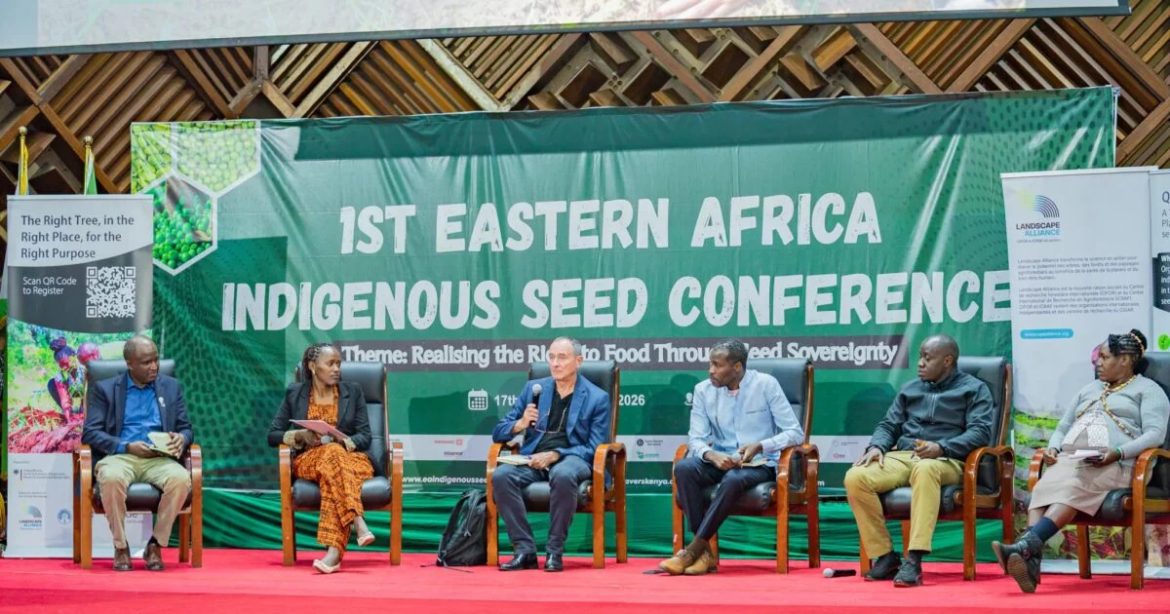
Landscape restoration across Eastern Africa is increasingly facing a seed-sourcing challenge as shifting rainfall patterns, rising temperatures and changing ecological conditions raise questions about whether trees planted today will survive t Catholic University of Eastern Africahe climates of coming decades. Researchers, restoration practitioners and community seed enterprises are calling for greater investment in quality indigenous tree seeds, climate-informed species selection and farmer participation in seed production to strengthen restoration outcomes.
The issue was discussed at the first Eastern Africa Indigenous Seed Conference, held from November 17–20 at the Catholic University of Eastern Africa in Nairobi, where farmers, researchers, policymakers, seed custodians and development partners convened to strengthen farmer-managed seed systems and regional cooperation. The conference, organised under the theme “Realizing the Right to Food through Seed Sovereignty”, also provided a platform for discussions on biodiversity, climate resilience, community conservation and indigenous seed enterprises.
Sammy Carsan, Agroforestry Specialist at Landscape Alliance, said selecting appropriate seed sources was central to ensuring trees planted through restoration programmes could withstand changing environmental conditions. He argued that planting decisions needed to account for the climatic conditions trees would face over their lifetime rather than relying solely on the conditions prevailing when planting takes place.
“The tree you plant today has to survive the climate of future years. And that depends on the seed you choose today,” Carsan said.

Restoration programmes across the region are increasingly being implemented alongside national commitments to restore degraded landscapes, expand tree cover, improve soil health and strengthen climate resilience. However, the survival and ecological value of planting initiatives can depend on the quality of planting material, species suitability, seed provenance and the environmental conditions of the restoration site.
Selecting tree species without considering local ecological characteristics and projected climate changes can expose restoration investments to risks. Trees may struggle to establish where rainfall patterns change, temperatures rise or soil conditions differ from those in the locations where seed sources were collected. Restoration practitioners therefore increasingly need to evaluate species and seed sources against both present and anticipated environmental conditions.
Roeland Kindt, Senior Ecologist at Landscape Alliance, highlighted the role of research and digital tools in supporting more informed tree species selection and seed sourcing. He presented the Global Useful Native Trees (GlobUNT) database, a resource designed to help restoration practitioners, landscape managers and development professionals identify useful native tree species and assess their suitability for different locations.
“The underlying principle is simple. We need to have the right tree in the right place, using the right seed source. And digital tools are helping us to do that,” Kindt said.
The GlobUNT database provides information on 14,014 useful tree species and their natural distributions across 242 countries and territories. It combines species distribution information with documented human uses, helping users identify native tree species that can contribute to biodiversity recovery, environmental restoration and local livelihoods. The resource also links users to other tree and agroforestry databases to support further assessment of species selection and planting combinations.
The use of such tools reflects a growing emphasis on evidence-based restoration planning. While indigenous species are generally important for maintaining ecological integrity and supporting local biodiversity, their suitability can vary across landscapes. Differences in soil, altitude, rainfall, temperature and ecological zones mean that restoration practitioners may need to assess both the species and the provenance of planting material before establishing restoration sites.
Beyond ecological considerations, indigenous tree seed production is also emerging as a potential livelihood opportunity for rural communities. Seed collection, propagation, nursery management and seedling supply can provide income-generating activities for farmers, community groups and small enterprises while supporting the availability of planting material for restoration programmes.
Paul Mwanza, Chief Executive Officer and co-founder of Palma Mukuyuni Tree Nursery, highlighted the commercial potential of indigenous tree enterprises, arguing that conservation and income generation need not be separate objectives.
“You can generate income and create a business with indigenous trees, so it is something we should embrace,” Mwanza said.
Community participation in tree seed systems can extend across several stages, including seed collection, identification of suitable mother trees, conservation, propagation, nursery production and distribution. Strengthening these activities could help improve access to quality planting material while creating opportunities for communities to participate in restoration supply chains.
The discussion also reflects broader efforts to strengthen native tree seed systems in Africa. The Right Tree, Right Place, Right Purpose – Seed (RTRP-Seed) project, coordinated through partners including Botanic Gardens Conservation International, is working in Kenya, Ethiopia, Rwanda and Uganda, with smaller activities in Burkina Faso, to improve the supply of high-quality native tree seeds and seedlings for landscape restoration. The initiative is addressing policy gaps, strengthening technical capacity, supporting seed mobilisation and promoting knowledge exchange.
In Kenya, recent efforts have also focused on strengthening native tree seed supply and demand systems, including stakeholder engagement on developing a national native tree seed strategy. These initiatives reflect the growing recognition that restoration targets require reliable supply chains for suitable planting material, rather than relying solely on planting campaigns and numerical targets.
The role of farmers and communities was also central to discussions at the Eastern Africa Indigenous Seed Conference. Organisers and participants highlighted the importance of farmer-managed seed systems, community seed banks, indigenous knowledge and local networks in maintaining agricultural and biological diversity. The conference sought to strengthen regional collaboration and build a community of practice around seed conservation, farmer-led innovation and resilience.

For landscape restoration, this participation could have implications for the distribution of economic benefits and the sustainability of seed supply. Community-based seed enterprises may help reduce reliance on centralised or distant suppliers, improve access to locally adapted planting material and support livelihoods in areas where restoration initiatives are being implemented. However, developing reliable seed businesses will also require technical capacity, market access, quality assurance and sustained demand from restoration programmes.
The conference discussions underscore the need to connect scientific research, traditional knowledge and practical restoration activities. Digital species-selection tools can provide valuable information, but their application will depend on the availability of locally relevant data, the quality of seed sources and the involvement of people familiar with the ecological and livelihood conditions of individual landscapes.
As Eastern African countries continue to pursue forest landscape restoration, the quality, origin and suitability of tree seeds are likely to become increasingly important in determining the durability of investments. The challenge is shifting from how many trees are planted to whether planting material, ecological conditions, community participation and long-term management are aligned to ensure trees survive and contribute to resilient landscapes.