

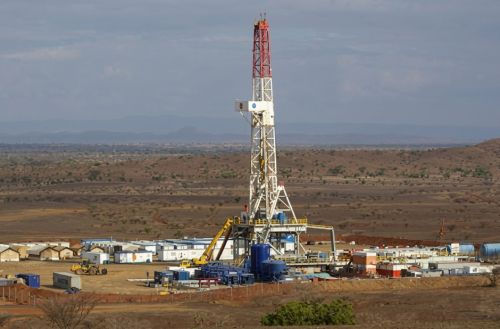
Gulf Energy has begun drilling the Amosing 1 well in Kenya’s South Lokichar Basin, advancing the country’s long-delayed oil development towards an initial production target of 20,000 barrels per day (bpd) from December 1, 2026, as the company prepares a multibillion-dollar investment in the Turkana oil fields.
The drilling operation commenced on November 20 in Turkana County, with Energy and Petroleum Cabinet Secretary Opiyo Wandayi attending the launch ceremony. The development covers blocks T6 and T7 in the South Lokichar Basin under production-sharing agreements with the Kenyan government, with the initial programme targeting the Ngamia and Amosing fields.
Gulf Energy’s first development phase is expected to involve 48 wells, comprising 24 production wells and 24 injection wells. The programme is designed to support the initial development of the oil fields and establish production infrastructure for crude extraction in northwestern Kenya.The company’s development plan outlines an initial production target of 20,000 barrels per day, although actual output will depend on the commissioning of infrastructure, drilling progress and the operational performance of the wells. The December 1 production target represents a planned milestone rather than confirmed commercial production.

The South Lokichar development forms part of a nearly US$6 billion investment programme announced by Gulf Energy in February. The development plan submitted to Parliament estimates upstream capital expenditure at approximately US$5.7 billion, covering the initial development programme and broader production infrastructure.
Oil discoveries in the South Lokichar Basin date back to 2012, but the project has faced prolonged delays over commercial viability, infrastructure requirements, financing and the development arrangements needed to advance production. The assets were previously operated by Tullow Oil, which had spent more than a decade developing the project before exiting Kenya.
Tullow completed the sale of its Kenyan assets in September 2025 to Auron Energy E&P, a Gulf Energy affiliate, for a minimum consideration of US$120 million. The transfer marked a change in ownership of the South Lokichar project, with Gulf Energy subsequently advancing plans for development and production.
The initial production phase will rely on road transport to move crude oil from Turkana to Mombasa, where Kenya Petroleum Refineries Limited is expected to provide storage facilities. The development plan provides for a fleet of approximately 600 trucks to transport crude from the oil fields to the coast.
The road-based logistics arrangement will form an important component of the initial production system, allowing crude oil to be transported while longer-term infrastructure requirements are addressed. The scale of the planned fleet also highlights the logistical demands of moving oil from a remote production area in northwestern Kenya to export and storage facilities on the coast.
Gulf Energy expects to begin exporting crude oil in March 2027, according to country manager Frankline Juma, cited by the state-owned Kenya News Agency. The export target follows the planned December commencement of initial production, with the intervening period expected to support the development of transport, storage and export arrangements.

Beyond the initial phase, Gulf Energy’s development plan includes additional fields in the South Lokichar Basin, including Twiga, Ekales, Agete and Etom. The second development phase is intended to increase production capacity to 50,000 barrels per day, expanding the project beyond the initial Ngamia and Amosing development.
The longer-term production target will depend on additional investment, drilling, infrastructure development and the operational performance of the fields. The company has outlined the second phase as part of its broader development ambitions, rather than an already established production capacity.
The South Lokichar project represents a significant development in Kenya’s petroleum sector after more than a decade of exploration and planning. The transition from drilling and development to production will require the completion of infrastructure, operational systems and logistics arrangements to support crude extraction, storage and export.
With drilling at Amosing 1 now underway, the immediate focus is on whether Gulf Energy can meet its December production target and advance the planned export timetable for 2027. The subsequent expansion to 50,000 barrels per day will depend on the implementation of the wider development programme across the South Lokichar fields, marking the next stage in Kenya’s effort to establish an oil-producing industry.