


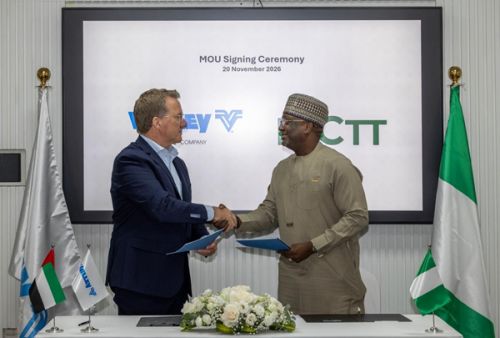
Nigeria has signed a memorandum of understanding (MoU) with US irrigation equipment manufacturer Valmont Industries to establish a domestic manufacturing facility, as the government seeks to expand mechanised irrigation, strengthen technology transfer and reduce dependence on imported agricultural equipment.
The agreement, announced on November 22, brings Valmont, through its Valley Irrigation brand, into the federal government’s Irrigate Nigeria Programme. The proposed factory will be developed in partnership with the National Agency for Science and Engineering Infrastructure (NASENI), while a separate pilot programme is expected to cover 40,000 hectares of farmland in Adamawa State.
The agreement was signed by Dahiru Muhammed, chairman of Nigeria’s Presidential Implementation Committee on Technology Transfer (PICTT), and Kalle Autto, Valmont’s regional vice-president for the Middle East and Africa. The initiative is intended to combine irrigation infrastructure development with local manufacturing capabilities, technical training and the transfer of expertise.

The proposed facility comes as Nigeria seeks to expand agricultural production through greater access to irrigation. The country’s agricultural sector remains heavily exposed to rainfall variability, with irrigation infrastructure viewed as one avenue for supporting production beyond seasonal rainfall patterns and improving water management.
Under the agreement, NASENI will partner with Valmont to establish the irrigation equipment production plant, supporting efforts to develop domestic expertise in mechanised irrigation technology. The arrangement is intended to reduce reliance on imported systems while strengthening local capacity to manufacture, operate and maintain irrigation equipment.
However, the memorandum does not yet establish the scale of the proposed manufacturing investment. The government and Valmont have not disclosed the factory’s location, investment value, planned production capacity or construction timeline. Details of the equipment to be manufactured locally and the extent of the technology transfer programme have also not been publicly outlined.
The agreement also provides for a 40,000-hectare irrigation pilot in Adamawa State. The programme is expected to be implemented in collaboration with the Nigeria Incentive-Based Risk Sharing System for Agricultural Lending (NIRSAL) and the National Agricultural Development Fund (NADF).
The pilot is expected to test the development of mechanised irrigation infrastructure at a scale that could inform further expansion under the Irrigate Nigeria Programme. The 40,000 hectares represent a planned programme area rather than farmland already equipped or operating under irrigation.
The government’s broader ambition is to expand Nigeria’s irrigated area to 500,000 hectares by 2030. Data from the United Nations Food and Agriculture Organization (FAO) indicate that approximately 331,150 hectares were equipped for irrigation in 2023, highlighting the scale of additional infrastructure required to reach the target.
The proposed factory could contribute to equipment availability as the country seeks to expand irrigation systems, although the extent of its contribution will depend on production capacity, costs, access to financing, installation services and the ability to maintain equipment over its operating life.
Valmont brings an established irrigation equipment business to the partnership. Through its Valley Irrigation brand, the company manufactures centre-pivot systems used to irrigate farmland through mechanised sprinkler technology. Its African operations include a manufacturing and distribution facility in Nigel, Gauteng, South Africa, which has been operating since 1999.
The company has supplied irrigation equipment to agricultural projects across several African markets. In Zimbabwe, Valmont entered into a US$172 million agreement with the government in July 2024 to supply centre-pivot irrigation systems covering 23,000 hectares. In Sudan, the company partnered with Zadna International in 2022 on irrigated agricultural projects involving the supply and installation of 1,450 centre-pivot systems, technical training, maintenance support and assistance with financing arrangements.
Valmont has also established a distribution network across the continent, with company figures published in 2021 indicating more than 20,000 centre-pivot systems installed in Africa and 38 distributors operating across the region. Those figures provide historical context for the company’s regional footprint rather than a current installation total.
The Nigerian partnership comes alongside broader efforts to rehabilitate and modernise existing irrigation infrastructure. In November 2026, authorities initiated a contractor prequalification process for rehabilitation and modernisation works at six irrigation schemes under the Sustainable Power and Irrigation for Nigeria (SPIN) project, financed by the World Bank.
The SPIN project, which has a financing commitment of US$500 million, is intended to strengthen water resource management, improve dam safety and support irrigation development. Its investments form part of a wider effort to improve agricultural water infrastructure and strengthen the management of resources for productive use.

The proposed Valmont factory and Adamawa pilot are separate components of Nigeria’s irrigation expansion efforts, but their eventual contribution to national targets will depend on how effectively manufacturing, infrastructure development, agricultural financing and water management are coordinated.
For the manufacturing partnership, the next steps will include defining the investment requirements, factory development timetable, production capacity and implementation arrangements. For the Adamawa pilot, access to reliable water sources, financing, land preparation, maintenance and farmer participation will be central to translating the announced programme into operational irrigation infrastructure.
The agreement establishes a framework for cooperation between Nigeria and Valmont, but the pace and scale of implementation remain to be determined. Its significance will ultimately depend on whether the proposed local production facility and irrigation programme deliver equipment, infrastructure and technical capacity at a scale that supports the country’s 2030 irrigation expansion ambitions.