


Strengthening water resilience could unlock an estimated US$200 billion in annual economic value across Africa, according to a new report by Boston Consulting Group (BCG), which argues that investments in water security, sanitation and climate adaptation could deliver economic gains while addressing infrastructure deficits affecting hundreds of millions of people.
Published on November 25, 2026, the report, From Crisis to Resilience: Turning Africa’s Water Risk into a Sustainable Growth Opportunity, positions water security as a critical economic investment rather than solely a public service or development priority. It links access to reliable water systems with productivity, industrial competitiveness, public health, workforce participation and climate resilience, as African economies face increasing pressure from urbanisation, industrial expansion and climate-related extremes.
More than 400 million people across Africa lack access to safe drinking water, while approximately 800 million lack basic hygiene services, according to the report. The deficits continue to impose economic costs through illness, lost productivity, constrained enterprise development and inadequate service delivery, particularly in communities where infrastructure investment has not kept pace with population growth.

BCG estimates that inadequate sanitation alone costs African economies approximately US$200 billion annually. At the same time, achieving universal access to water, sanitation and hygiene services could generate economic benefits equivalent to around 5% of the continent’s gross domestic product, through improved health, higher productivity, stronger workforce participation and greater resilience.
The analysis estimates that approximately US$50 billion in annual investment in water, sanitation and hygiene infrastructure will be required by 2030 to meet Africa’s Sustainable Development Goal 6 targets. The scale of the financing requirement highlights the gap between existing infrastructure and the services needed to support growing populations, economic activity and climate adaptation.
Dean Muruven, associate director at BCG in Johannesburg and co-author of the report, said reliable water services influence economic performance across sectors, including agriculture, industry, education, healthcare and climate resilience. He argued that strengthening water security would create conditions for broader economic growth rather than addressing an isolated infrastructure challenge.
The report’s economic case is reinforced by the growing costs associated with climate-related water risks. In 2024, severe flooding affected an estimated 11 million people across Africa and resulted in approximately 2,500 fatalities. Meanwhile, prolonged drought conditions continue to disrupt agricultural production, livelihoods and economic activity in several regions.
BCG estimates that African economies spend between 2% and 5% of GDP annually responding to climate extremes. These costs reflect the economic burden of disasters and the demands placed on governments, businesses and communities to recover from disruptions to infrastructure, production and livelihoods.
The report argues that investment in resilient water systems could reduce exposure to these risks, particularly where infrastructure planning incorporates flood protection, drought preparedness, water storage, improved resource management and climate-sensitive development.
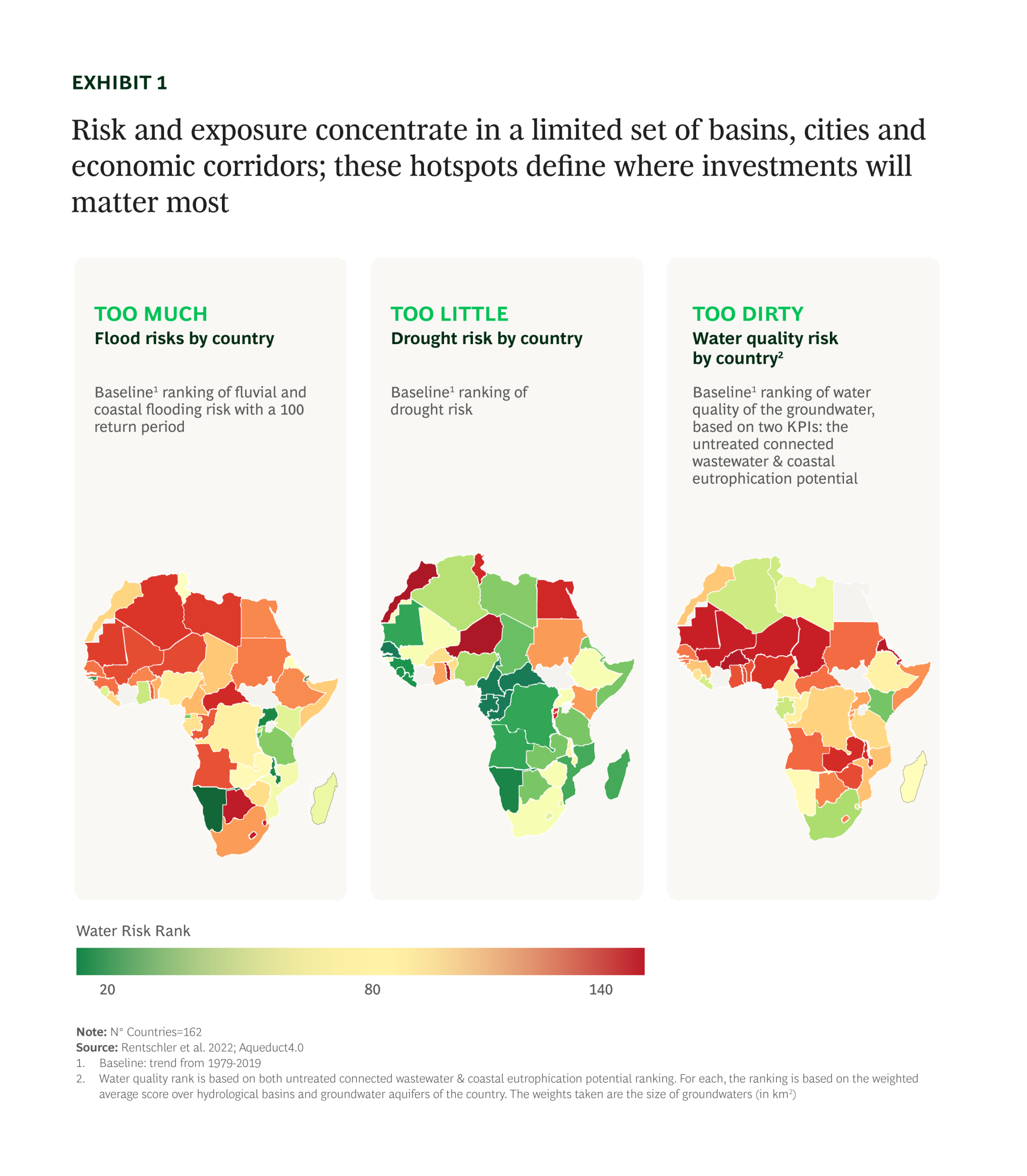
However, water-related risks are unevenly distributed across the continent. Flood, drought and water-quality challenges are concentrated in specific river basins, cities and economic corridors, creating opportunities for investment strategies that prioritise locations where interventions could generate the greatest economic and resilience benefits.
The concentration of risks also presents a challenge for infrastructure planning. Governments and investors may need to move beyond fragmented, project-by-project approaches towards coordinated programmes that address water risks across interconnected economic areas, infrastructure networks and communities.
Muruven said governments, investors and development institutions were increasingly recognising water security as a prerequisite for economic resilience and long-term growth. He emphasised that mobilising capital at scale would require the development of bankable projects capable of translating identified risks into investable programmes.
The financing challenge remains significant because many water infrastructure projects generate substantial social and economic benefits without necessarily producing direct revenue streams sufficient to attract commercial investment. Public financing, concessional capital, guarantees, blended finance and partnerships between governments, development institutions and private investors could therefore play a role in supporting project preparation and implementation.
The report points to developments in continental policy and investment as evidence of increasing momentum. Earlier in 2026, the African Union elevated water and sanitation within its development agenda, reflecting recognition of their importance to Agenda 2063 and the continent’s long-term economic ambitions.
The Africa Water Investment Programme (AIP) has also mobilised more than US$7.5 billion for climate-resilient water and sanitation investments across countries and regional blocs, including Zambia, Tanzania, Zanzibar, the Southern African Development Community and the Lake Chad Basin. The programme illustrates efforts to mobilise capital through regional cooperation and investment frameworks designed to support water infrastructure and resilience.
In Kenya, sanitation enterprises such as Sanergy are demonstrating how circular economy approaches can create economic value from waste management. Through the recovery and processing of sanitation waste into products such as organic fertiliser and animal feed, the model links sanitation service delivery with resource recovery, enterprise development and employment opportunities.
Large-scale infrastructure initiatives such as Grand Inga in the Democratic Republic of Congo also illustrate the wider economic connections between water resources, energy security and industrial development. While projects of this scale involve complex financing, environmental and implementation considerations, they highlight how water-related infrastructure can influence economic activity beyond the provision of basic services.
South Africa’s experience, as discussed in the report, points to a recurring challenge in water investment: the difficulty of translating available solutions into consistent, executable programmes. The issue is not necessarily a shortage of technologies or potential interventions, but the capacity to develop projects, coordinate institutions, manage risks and attract financing.
Across African markets, governments, development finance institutions, businesses and investors are exploring approaches to financing infrastructure, improving water management and strengthening resilience. The scale of the opportunity, however, will depend on the ability to align investment priorities, policy frameworks, project preparation and implementation capacity.
Africa’s water resilience agenda is increasingly tied to broader questions of economic planning, competitiveness and climate adaptation. The estimated US$200 billion annual opportunity outlined by BCG points to the potential economic value of addressing water risks, but capturing that value will require sustained investment, stronger institutional coordination and the delivery of infrastructure and services at scale.
The challenge for African economies is increasingly to move from identifying water-related risks and investment needs towards developing programmes capable of delivering measurable economic and resilience outcomes.