


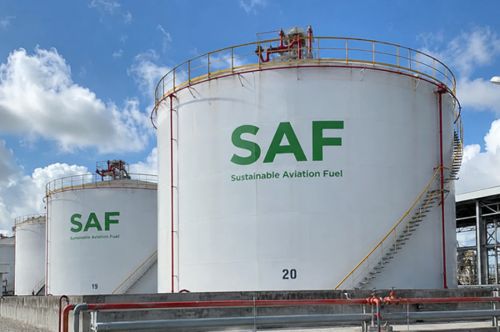
Morocco’s plans to establish a commercial-scale sustainable aviation fuel industry have advanced after French technology provider Axens was selected for a proposed $239 million production facility at the Nador West Med port complex, with Shell already committed to purchasing a substantial share of its output.
Green Sky Capital, the developer behind the project, announced on November 24 that it had chosen Axens’ Vegan hydroprocessed esters and fatty acids (HEFA) technology for the plant, which is designed to process oils and fats into renewable fuels. The facility is expected to have annual production capacity of 200,000 tonnes and begin operations in October 2028.
The project is among the first large-scale sustainable aviation fuel investments planned for Morocco and is being developed to serve demand in Europe, the Mediterranean region and international aviation markets. Its progress brings together three important elements of industrial development: a licensed production technology, a long-term commercial buyer and proposed development-bank financing. However, construction, feedstock procurement and the completion of financing arrangements remain critical to the delivery timetable.

Under a long-term offtake agreement signed in November, Shell Trading Rotterdam, a subsidiary of Shell, secured exclusive purchasing rights for approximately 150,000 tonnes of sustainable aviation fuel annually, or an equivalent volume of hydrogenated vegetable oil, a renewable diesel alternative. The agreement also covers other products expected from the facility, including bionaphtha and biopropane.
The offtake arrangement provides the project with an established commercial counterparty before construction, an important consideration for financing an industrial facility whose revenues will depend on sustained production and access to international markets. The agreement does not, however, mean that all the plant’s planned capacity will be sold as aviation fuel. The option to supply renewable diesel also gives the project flexibility over its product mix.
Axens will provide its proprietary Vegan technology, alongside equipment, catalysts, technical support and training. The process uses hydrogen and heat to convert lipid-based materials, including waste oils and fats, into renewable fuels. The resulting aviation fuel is designed as a drop-in product that can be used within existing aircraft and airport fuel infrastructure, subject to applicable fuel specifications and sustainability certification.
The Moroccan facility will be Green Sky Capital’s second major project using Axens’ technology. The companies are also working on a planned sustainable aviation fuel plant in Egypt, which is under construction and targeted to begin operations by the end of 2027. The two developments form part of Green Sky Capital’s wider strategy to build a regional production platform serving aviation fuel markets in North Africa and beyond.
The financing structure is now another key milestone. The European Bank for Reconstruction and Development is considering a senior secured loan of up to $135 million towards the project’s estimated $239 million cost. The proposed financing comprises an $85 million committed tranche and a further $50 million uncommitted tranche. Up to $20 million of the proposed loan is expected to be funded through the Green Climate Fund, while the project is also expected to benefit from a European Union first-loss guarantee. The EBRD’s board is scheduled to consider the financing on December 2, 2026.
As of November 26, the bank’s project information listed the proposal as having passed final review but remaining pending approval. The financing should therefore not be treated as secured until the relevant approval and subsequent financing steps have been completed. The EBRD has described the project as a potential first-of-its-kind large-scale greenfield sustainable aviation fuel investment in Morocco, with the proposed funding intended to address a financing gap for the emerging sector.
The plant is planned for the Betoya Industrial and Logistic Zone within the Nador West Med development area on Morocco’s Mediterranean coast. According to the EBRD’s project documentation, it will occupy approximately 88,000 square metres and include feedstock pre-treatment, a HEFA processing unit, hydrogen production and storage facilities. In addition to sustainable aviation fuel, the facility is expected to produce renewable diesel, bionaphtha and biopropane.
The planned feedstock supply chain will be central to the plant’s commercial and environmental performance. The EBRD documents indicate that the facility is expected to use waste oils, greases and fats collected through a nationwide network, with imports supplementing domestic supplies when local volumes are insufficient. The bank has also identified training for used-cooking-oil collectors and aggregators, alongside a pilot initiative to integrate women-led cooperatives and collectors into the supply chain.
That sourcing model will need to demonstrate that sufficient eligible feedstock can be collected, traced and delivered consistently at a scale compatible with the plant’s production target. Competition for waste oils and other lipid-based materials is increasing as renewable fuel producers expand capacity in different markets. The sustainability credentials of the final fuel will also depend on the origin of its feedstocks, processing methods and lifecycle emissions, rather than the renewable label alone.
The EBRD’s environmental and social assessment remains in progress. Its project summary states that a Moroccan environmental impact assessment is required and that further assessments, including air-dispersion and noise modelling, traffic analysis and stakeholder engagement, are under way. The project is expected to include wastewater treatment, emissions monitoring, leak detection, waste management and process-safety measures.
The proposed investment is also linked to local industrial development. The EBRD has outlined plans for an operator and technician academy, apprenticeships in maintenance and instrumentation, and graduate engineering training in the Oriental Region. It has set a target for women to account for 10% of the company’s workforce by 2032 and expects the feedstock collection initiative to create opportunities for women-led cooperatives and local aggregators.
The commercial case for the plant is closely connected to regulatory changes in the European aviation market. Under the European Union’s ReFuelEU Aviation regulation, fuel suppliers must ensure that sustainable aviation fuel accounts for at least 2% of aviation fuel supplied at covered EU airports from 2025. The minimum share rises to 6% in 2030 and 20% in 2035, creating a regulatory driver for additional production and supply arrangements.

For Morocco, proximity to European markets and the port infrastructure at Nador West Med could provide a logistical advantage. But access to the market will depend on the plant meeting applicable European sustainability and fuel certification requirements, as well as securing reliable feedstock and delivering fuel at competitive costs. The regulation creates demand for qualifying fuels; it does not guarantee a market for every proposed production project.
The investment also reflects a broader shift in North Africa’s energy and industrial development, as project developers seek to connect renewable fuel production with international buyers and established trading networks. Green Sky Capital’s parallel projects in Morocco and Egypt could help build regional production capacity, although their contribution will ultimately depend on construction progress, financing, operational performance and the availability of sustainable raw materials.
The December 2 EBRD decision is therefore an important near-term test for the Moroccan project. If approved, the proposed financing would help move the facility closer to construction. The longer-term test will be whether the plant can reach its 2028 start-up target and sustain production at a scale that meets Shell’s offtake requirements while complying with the environmental and sustainability standards governing access to European aviation fuel markets.