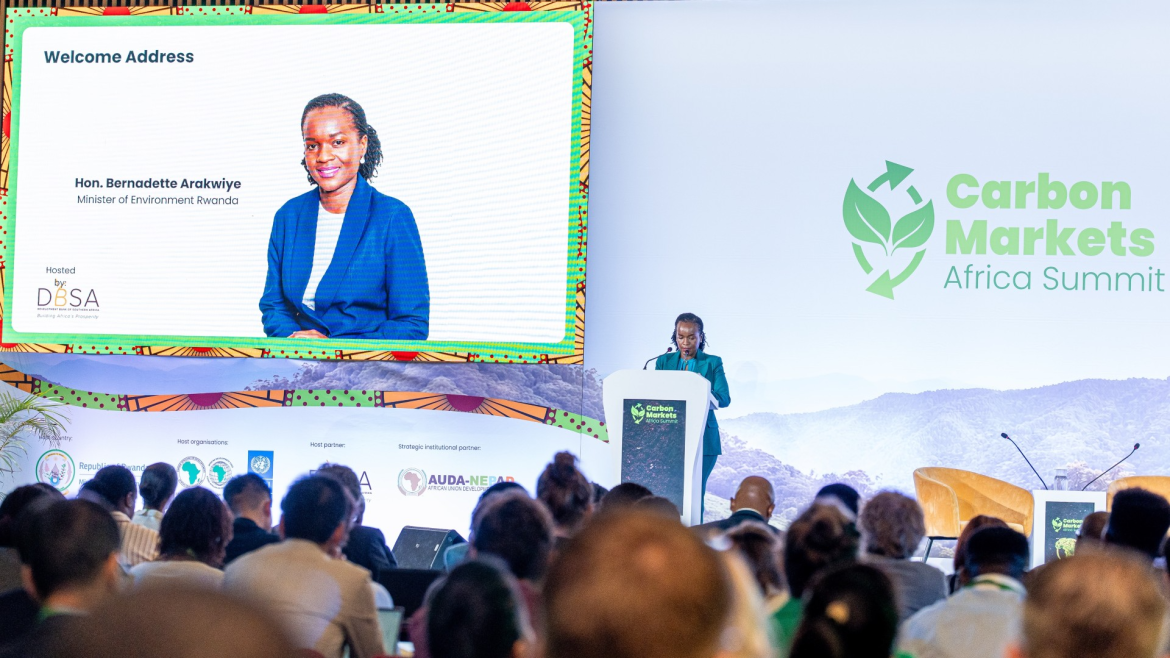
African governments, development finance institutions and international climate organisations are pushing to move the continent’s carbon markets from policy development towards investment and completed transactions, with the distribution of financial benefits to local communities emerging as a central test of market success.
The message dominated the opening sessions of the Carbon Markets Africa Summit (CMAS) 2026 in Kigali, Rwanda, on October 14, where representatives from 45 countries, including 21 African nations, gathered to discuss project financing, carbon-credit integrity and access to international buyers. The summit, running from October 13 to 15, is hosted by Rwanda’s Ministry of Environment, with the United Nations Development Programme (UNDP) and the African Development Bank (AfDB) among its host organisations.
For African countries, the challenge is increasingly how to turn carbon-market frameworks and project pipelines into investments that generate verifiable emissions reductions, attract long-term demand and support national development priorities. While more countries are establishing regulatory systems and authorising carbon projects, speakers warned that policy progress alone would not guarantee financing or ensure that revenue reaches communities hosting those projects.

Rwanda’s Environment Minister, Dr Bernadette Arakwiye, said African carbon markets should be shaped around the continent’s priorities and deliver measurable benefits. She called for greater access to methodologies suited to African conditions, financing for project preparation and sustained demand at prices that reflect the value and integrity of the credits.
She also urged developers and governments to diversify beyond the project categories that have traditionally dominated carbon markets. Renewable energy, electric mobility, sustainable waste management, industrial decarbonisation, agriculture and nature-based solutions could broaden the range of projects seeking carbon finance, provided they meet the required standards and demonstrate credible climate benefits.
Tanzania’s Minister of State in the Vice President’s Office responsible for Union Affairs and Environment, Hamad Yusuf Masauni, similarly argued that Africa needed to prioritise projects capable of reaching issuance and securing buyers rather than relying on the size of announced pipelines. The distinction is important for developers that may have promising concepts but lack the technical studies, funding and commercial agreements required to proceed.
The financing gap was a recurring theme in the opening discussions. Project developers often need capital before they can complete feasibility studies, establish baselines, demonstrate emissions reductions or meet validation and verification requirements. These early costs can be difficult to finance when future carbon-credit revenues remain uncertain.
Leaders from the AfDB, Development Bank of Southern Africa (DBSA) and Kigali International Financial Centre discussed how development finance institutions could help address these barriers through project preparation, patient capital and risk-sharing arrangements. Such support can help move projects towards financial close, although it does not remove the need for credible underlying economics and reliable buyers.
Dr Anthony Nyong, Director of Climate Change and Green Growth at the AfDB, argued that carbon projects should be understood in the context of wider development objectives. The emphasis reflects a broader financing challenge: projects need to demonstrate climate benefits while also contributing to economic activity, livelihoods or infrastructure where appropriate.
The distribution of benefits was another major concern. Maxwell Gomera, UNDP Resident Representative in South Africa and Director of the Africa Sustainable Finance Hub, called for systems that ensure value reaches communities, including farmers and other people whose land, labour or natural resources may underpin carbon projects.
That requires more than promises of local benefits. Clear ownership arrangements, community participation, transparent revenue-sharing rules and accessible grievance mechanisms can influence whether projects retain local support over their operating lives. Where these safeguards are weak, disputes over land, project rights or revenue allocation can undermine both community trust and investment certainty.
Market integrity is also shaping Africa’s ability to compete internationally. Perumal Arumugam, Manager of Markets and Non-Markets and Stakeholder Interaction at the United Nations Framework Convention on Climate Change (UNFCCC), urged African countries to compete on the credibility of their carbon credits rather than price alone.
Credits must demonstrate that emissions reductions are real, measurable and additional to what would have happened without the project. Permanence, reliable monitoring and protection against double counting are also essential, particularly as buyers face greater scrutiny over the climate claims associated with purchased credits.
Representing the European Commission, Lukas Visek, Deputy Head of the Directorate-General for Climate Action Task Force for Carbon Pricing and Carbon Markets, said additionality and permanence would remain critical requirements for international demand. For African developers, that means data quality, transparent project documentation and robust verification are becoming commercial requirements rather than technical details that can be addressed late in development.
Esterine Fotabong, representing AUDA-NEPAD, highlighted the importance of predictable national authorisation processes, functioning carbon registries and credible monitoring, reporting and verification systems. Building African capacity in validation and verification could also help strengthen local expertise and reduce dependence on external service providers.

These systems matter as countries implement Article 6 of the Paris Agreement, which establishes frameworks for international cooperation on emissions reductions. Participating countries must account appropriately for transferred mitigation outcomes and protect their national climate commitments. Strong domestic governance is therefore necessary to ensure that carbon transactions support rather than undermine national climate plans.
For investors, the emerging priority is to identify projects that combine sound climate accounting with workable financing structures, clear authorisations and dependable offtake arrangements. For governments, the challenge is to secure capital while retaining oversight of national mitigation priorities. For communities, the test is whether carbon-market activity produces transparent and tangible benefits.
As CMAS 2026 concludes in Kigali, the next measure of progress will be the extent to which these discussions lead to funded projects, verified credits and completed transactions. Africa’s participation in global carbon markets will depend not only on the volume of credits it can supply, but also on the credibility of those credits, the strength of its market institutions and the share of economic value retained within the continent.