

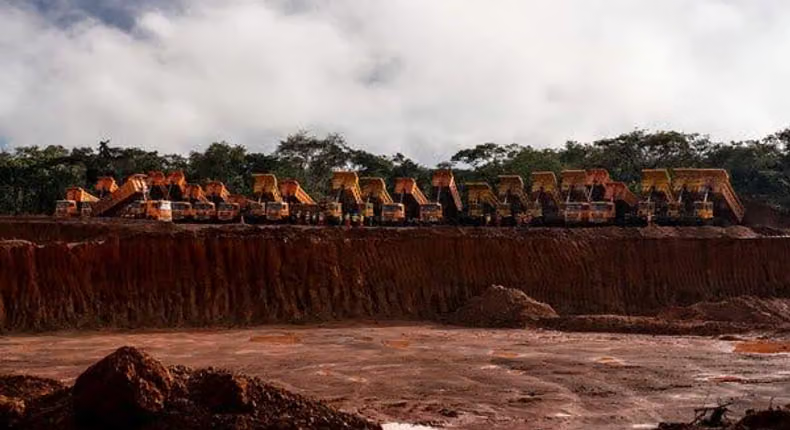
The Democratic Republic of the Congo will suspend all cobalt exports from 30 November 2026 in an effort to curb global oversupply and support falling prices, the country’s strategic minerals regulator said on Monday. The halt covers industrial and artisanal production, including shipments already authorised but still in the country when the measure takes effect. It gives the regulator time to revise an export quota system introduced after a similar suspension last year.
The regulator gave quota holders until 29 November to complete shipments for the month. Its notice also says it can deny future allocations to companies that breach the suspension. Under the previous system, the annual ceiling for 2026 and 2027 was 96,600 tonnes of contained cobalt, including 9,600 tonnes set aside for strategic reserves, according to the U.S. Geological Survey. The regulator has not specified what ceiling will apply when exports resume.
The Authority for the Regulation and Control of Strategic Mineral Substances’ Markets, known as ARECOMS, cited slower consumption and rising inventories. It will review the measure four months after it takes effect, but that review will not automatically reopen trade. A separate decision will set the restart date, permitted volumes and allocation rules. Unused quotas will not automatically carry over.

The decision comes after a fall in prices across several segments of the cobalt market. S&P Global Energy assessed cobalt hydroxide delivered to China at $12.70 per pound of contained cobalt on 23 November, down 49% from the start of the year. Its European cobalt metal benchmark stood at $18.15 per pound on 20 November, down 24% over the same period. RFI, reporting from the Makutano business forum in Kinshasa on Tuesday, said mining-sector participants were cautious about the consequences of the halt.
According to the U.S. Geological Survey, Congo accounted for an estimated 73% of global mined cobalt in 2025, compared with 14% for Indonesia, the second-largest producer. That concentration gives Congo influence over how much fresh supply reaches the market. It does not give the country the same control over demand. Lithium iron phosphate batteries, which contain no cobalt, are already used in electric vehicles. Their adoption means growth in electric-car sales does not translate directly into an equivalent rise in cobalt demand.
For Congo, the immediate trade-off is between the price it might obtain for future shipments and the export income it forgoes while shipments are blocked. The International Monetary Fund said strong mining exports helped improve the country’s external position in 2025. A higher cobalt price would not necessarily offset a prolonged drop in volumes, and the effect on foreign exchange inflows and public revenues would depend partly on when sales resume and on earnings from other minerals. For artisanal miners and cooperatives, the more immediate question is whether local buyers keep purchasing while the export channel is closed. If buying slows, households can lose income even if international prices rise.

The suspension also highlights the difference between controlling mineral exports and attracting investment in processing. Congo and Zambia have designated sites in Musompo and Ndola for a proposed regional battery supply chain. An October assessment published by the International Institute for Sustainable Development identified unreliable electricity and cross-border logistics bottlenecks among the obstacles to investment. Export restrictions alone do not solve either problem. For a prospective processor, the economics depend on reliable power, predictable access to feedstock and the cost of moving materials across the border.
The next material decision for Congolese producers is therefore not the review date but the terms on which trade resumes. Those rules will determine which operators can ship, how much they can sell and whether stock accumulated during the suspension can reach buyers without putting renewed pressure on prices.