


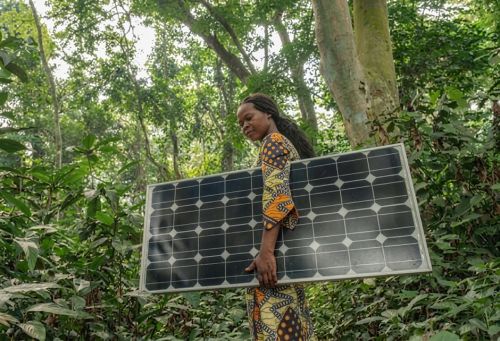
The Democratic Republic of Congo (DRC) has taken an initial step towards developing a 650 MW pipeline of solar power projects after the National Agency for Electrification and Energy Services in Rural and Peri-Urban Areas (ANSER) signed a memorandum of understanding with French energy company ITRA Group, with the proposed developments expected to require about $900 million in investment and potentially create 5,000 direct jobs. Signed on September 1, 2026, the agreement covers project identification, preparation and development in several cities and industrial centres, including Mbujimayi, Lubumbashi, Likasi and Kolwezi.
The agreement comes as the DRC seeks to expand electricity generation while addressing one of the largest energy-access deficits in Africa. The World Bank said in June 2025 that only about 21% of the Congolese population had access to electricity, describing energy access as one of the major constraints on economic transformation and job creation. Under the country’s National Energy Compact, aligned with the Africa-wide Mission 300 initiative, the government is targeting an increase in electricity access to 62% by 2030.
Against that backdrop, the proposed solar portfolio is significant not simply because of its headline capacity, but because of where the projects are being considered. Mbujimayi is a major urban centre in Kasaï-Oriental, while Lubumbashi, Likasi and Kolwezi sit within the economic and mining corridor of southern DRC. These areas combine growing electricity demand with industrial, commercial and residential users that require more reliable power to support production.

According to ANSER, the proposed portfolio could include a project of between 50 MW and 100 MW in Mbujimayi. Lubumbashi and Likasi have each been identified for potential 100 MW developments, while two projects under discussion in Kolwezi could have capacities of 250 MW and 300 MW. If the projects proceed at the upper capacities discussed, the combined pipeline would reach approximately 650 MW.
The proposed investment also highlights the financing challenge facing large-scale renewable energy development in the DRC. The $900 million figure is an estimate of capital that the partners expect to mobilise; it is not yet a committed financing package. The memorandum provides a framework for identifying sites, preparing projects and structuring their development. The projects will therefore need to progress through feasibility studies, site assessments, demand analysis, financial structuring and other stages before construction decisions can be made.
That distinction is important in a market where several renewable energy projects have previously required substantial preparation before reaching financial close. The DRC has considerable renewable energy potential, but translating that potential into operating power plants requires bankable projects, credible offtake arrangements, suitable transmission or distribution infrastructure and financing structures capable of attracting private capital.
The World Bank’s assessment of the country’s electricity sector illustrates the scale of that challenge. Its analysis of solar opportunities found that locations around Lubumbashi have relatively strong solar resources, with an estimated global horizontal irradiation of about 2,149 kWh per square metre annually. The study also identified solar photovoltaic generation as a potentially relevant option for expanding electricity supply in the country.
For the DRC, solar development also offers an opportunity to diversify electricity supply. The country possesses substantial hydropower resources, including the potential of the Inga complex, but dependence on large centralised infrastructure does not by itself solve the problem of connecting dispersed populations and rapidly growing urban and industrial demand.
The country’s geography makes decentralised and distributed renewable energy particularly relevant. The DRC covers roughly 2.35 million square kilometres, with large populations living far from existing electricity infrastructure. The Global Energy Alliance for People and Planet estimates that more than 80% of the population remains without electricity and is supporting efforts to develop urban and peri-urban solar mini-grids.
The proposed ANSER-ITRA projects are different from small mini-grid schemes, given the capacities under discussion, but they fit into the same broader effort to expand electricity availability beyond the country’s existing power infrastructure. The challenge will be connecting new generation capacity to consumers in a way that produces commercially sustainable electricity services.
ANSER has already been pursuing smaller solar projects as part of its rural electrification mandate. In June 2026, the agency provisionally awarded contracts for solar photovoltaic plants in Bumba, Lukolela and Nioki Centre, with a combined value of about $12.1 million. The projects are intended to provide electricity in areas where access to the national grid is limited or absent.
The agency’s wider strategy is also tied to longer-term rural electrification targets. According to a 2026 ANSER report cited by the Congolese Press Agency, the country aims to raise electricity access in rural and peri-urban areas to 50% as part of a broader objective of universal energy access by 2045. The private-sector dimension of the new solar pipeline is equally important. ITRA Group, based in Vergèze in France, operates in areas including solar photovoltaics, electrical installations, electric-vehicle charging infrastructure, air conditioning and heat pumps. However, publicly available references on the company’s website mainly concern small- and medium-sized photovoltaic installations in France and do not establish a track record of projects comparable in scale with the proposed 250 MW and 300 MW developments under consideration in Kolwezi.
That does not invalidate the partnership, but it means the next stages of project development will be important in determining whether the proposed portfolio can progress from an initial memorandum into financeable infrastructure. Large solar projects require substantial technical, financial and institutional capacity, particularly when they are being developed in markets where transmission networks, electricity payment systems and utility finances can present additional risks.
The DRC’s experience with earlier private-sector renewable energy initiatives demonstrates both the opportunity and the difficulty. In 2022, the International Finance Corporation began work with the DRC government on a Scaling Mini-Grid programme designed to attract about $400 million in private investment for 180 MW of solar photovoltaic capacity serving Mbuji-Mayi and Kananga. The programme was designed around public-private partnerships and included work on demand assessment, project sites and regulatory arrangements.
More recently, development finance institutions have continued to look at decentralised renewable energy as a means of overcoming the country’s infrastructure constraints. The World Bank and African Development Bank’s Mission 300 initiative includes the DRC among countries developing national energy compacts aimed at expanding affordable energy, integrating renewable generation and increasing private-sector participation.
For the proposed 650 MW portfolio, the economic implications extend beyond electricity generation. Lubumbashi, Likasi and Kolwezi are closely connected to the DRC’s mining economy, including the production and processing of minerals that are important to global energy-transition supply chains. Reliable electricity is consequently not only an infrastructure issue but also a factor in the competitiveness of industrial businesses, mineral processing and local value addition.
Additional generation could also support businesses outside mining. Reliable electricity can reduce dependence on diesel generators, improve operating hours for manufacturers and service companies, support cold chains and digital services, and create conditions for small and medium-sized enterprises to expand. The development impact, however, will depend on whether electricity is available at prices that businesses and households can afford.
The employment figure attached to the proposal is another area that will require further scrutiny. ANSER estimates that the projects could generate about 5,000 direct jobs. At this stage, however, that figure should be treated as a potential associated with the proposed development rather than employment already secured. The number and duration of jobs will ultimately depend on how many projects proceed, their construction schedules, local-content requirements and the scale of operations and maintenance activity.
There is also an institutional dimension. ANSER’s role is not limited to building generation assets; its mandate covers electrification and energy services in rural and peri-urban areas. Its ability to coordinate with government institutions, local authorities, developers, financiers and electricity-sector regulators will influence whether the proposed projects move efficiently through preparation and implementation.
The DRC’s regulator, the Autorité de Régulation du secteur de l’Électricité, will also remain relevant as projects advance, particularly around technical and financial oversight of the electricity sector. Sandrine Mubenga, who has led the regulatory institution, has been involved in broader discussions around electricity-sector development and renewable energy regulation. Other institutions, including the World Bank, IFC and GEAPP, have also been active in developing financing and market structures for renewable energy in the country.
The environmental case for the projects is relatively straightforward, but their sustainability will ultimately depend on execution. Solar generation can diversify the DRC’s power mix and reduce reliance on fossil-fuel-based backup generation where diesel is currently used. Yet renewable capacity only delivers its full economic value when it is connected to demand, supported by adequate networks and operated under commercially viable arrangements.
For investors, the $900 million opportunity therefore comes with a series of questions. The first is whether the identified sites can support projects at the proposed scale. The second is whether sufficient electricity demand exists under bankable contracts or other offtake arrangements. The third concerns transmission and distribution infrastructure. The fourth is whether financing can be structured at a cost that allows solar generation to compete with existing electricity sources.
These issues will determine whether the 650 MW figure becomes a construction pipeline or remains a development target. For Africa more broadly, the proposed DRC projects illustrate the continuing shift towards renewable energy investment in markets where electricity shortages remain a major constraint on economic development. The World Bank said in 2026 that progress towards universal electricity access in sub-Saharan Africa has slowed and that the pace of electrification needs to accelerate significantly to meet the 2030 Sustainable Development Goal. Distributed renewable energy, including solar and mini-grids, is increasingly being viewed as part of the solution because such systems can reach communities that conventional grid expansion may struggle to serve economically.
The DRC now has an opportunity to combine both approaches: larger renewable projects around major demand centres and decentralised systems for communities outside established grids. The ANSER-ITRA memorandum is an early step in that direction. For now, the proposed 650 MW portfolio remains a pipeline rather than an operating asset, and the $900 million investment remains to be mobilised. The immediate test will be whether the partners can convert the memorandum into bankable projects through site validation, technical studies, financial structuring, regulatory approvals and credible routes to market.
If those steps are completed, the proposed solar projects could add meaningful generation capacity in some of the DRC’s most important economic centres while creating opportunities for local employment and private investment. Until then, the significance of the agreement lies less in megawatts already being generated than in whether it can build the institutional and financial foundation needed to turn the country’s substantial renewable-energy potential into reliable electricity for households, businesses and industry.


