


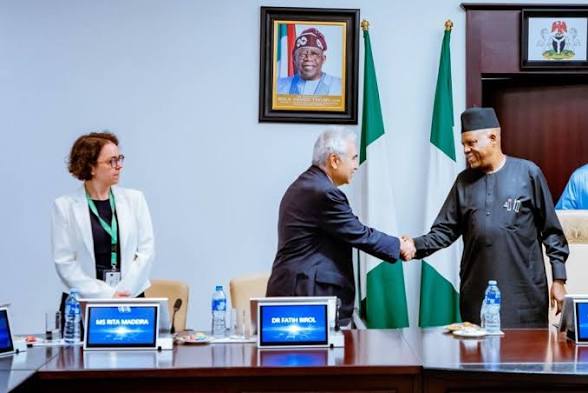
Nigeria and the International Energy Agency have launched a joint work programme aimed at strengthening energy data, investment planning and policy coordination, shifting the focus of their newly deepened relationship beyond Nigeria’s role as an oil and gas producer towards the broader challenge of building a more reliable and investable energy system. The programme, signed in Abuja in September, covers energy security, investment, data and statistics, energy efficiency and clean cooking, while also providing for technical cooperation and capacity building between Nigerian institutions and the Paris-based agency.
The agreement comes as Nigeria faces a structural contradiction at the centre of its energy economy. The country is one of Africa’s largest producers of oil and natural gas, yet millions of households and businesses continue to experience unreliable electricity supply and limited access to modern energy services. The International Energy Agency has identified electricity access and clean cooking as among the continent’s most important development priorities, estimating that Africa needs around US$22 billion a year between 2023 and 2030 to connect homes and businesses to electricity, alongside another US$4 billion annually for clean cooking.
 For Nigeria, the implications of better energy data extend beyond statistics. Reliable information on generation, transmission, distribution, demand, fuel supply and investment requirements is fundamental to determining where capital should be deployed and how risks should be priced. Investors assessing power projects need visibility over electricity demand, grid performance, tariffs, market rules and the financial condition of sector institutions. Weak or fragmented data can increase uncertainty and raise the cost of capital, particularly in infrastructure projects with long payback periods.
According to the IEA, the new programme will deepen exchanges between Nigerian institutions and its experts through analysis, data cooperation, policy advice and training. Nigerian ministries, regulators and other energy institutions were consulted in developing the programme, which is intended to create a more structured basis for cooperation over the coming years.
That emphasis is significant because Nigeria’s energy challenge is no longer simply a question of adding generation capacity. The country must also improve the systems that connect electricity producers to consumers and ensure that investment translates into dependable supply. Additional generation that cannot be transmitted or distributed efficiently does little to resolve the constraints faced by manufacturers, commercial businesses and households.
Electricity reliability also has direct implications for Nigeria’s fiscal position and business competitiveness. Companies that cannot depend on the grid frequently invest in diesel generators and other backup systems, shifting part of the country’s electricity costs onto individual businesses. For manufacturers, hospitals, telecommunications companies, retailers and small enterprises, these expenses affect operating margins and can influence decisions on whether to expand production or invest in new facilities.
The data challenge becomes more complicated as Nigeria attempts to develop several parts of its energy system simultaneously. Gas remains central to the country’s electricity supply and export economy, while the government is also seeking to expand renewable generation, improve electricity access and increase energy efficiency. These priorities require investment decisions based on comparable and credible information across different technologies and regions.
The clean-cooking component of the programme also brings the partnership closer to the social and household dimensions of Nigeria’s energy transition. The IEA has repeatedly identified clean cooking as a major energy-access challenge in Africa, where traditional fuels remain widely used. Nigeria’s large population means that improvements in cooking technology, fuel availability and affordability can have implications for household energy expenditure, public health and demand for electricity and other modern fuels.
Energy efficiency is another area where better data can affect investment decisions. Improving efficiency in buildings, industry, transport and household appliances can reduce the amount of new generation required to meet demand, but policymakers need reliable information about consumption patterns and the economic cost of different efficiency measures. For businesses, efficiency investments can also reduce exposure to volatile fuel and electricity prices.
The partnership therefore places energy information within a wider investment framework. Nigeria needs substantial capital to modernise generation, transmission and distribution infrastructure, develop gas resources, expand renewable energy and improve access. Yet attracting that capital depends not only on the size of the country’s energy market but also on the quality of institutions, regulation and information available to investors.
Nigeria’s admission as an IEA Association country provides a formal platform for that cooperation. The IEA’s Governing Board approved Nigeria’s entry in June, bringing Africa’s most populous country into the agency’s wider network of Association countries. Nigeria joins South Africa, Kenya and Senegal among IEA Association countries in Sub-Saharan Africa.
The broader African significance lies in the possibility of strengthening the evidence base for energy policy in a market whose problems are shared, in different forms, across the continent. Many African countries face the same combination of rising electricity demand, limited fiscal space, ageing infrastructure, unreliable supply and difficulty attracting affordable long-term capital. The IEA’s cooperation with Nigeria could therefore provide lessons for how governments use data, regulation and technical capacity to make energy markets more transparent and investable.
There are limits to what technical cooperation can achieve on its own. Better data cannot resolve inadequate transmission infrastructure, weak distribution networks or the financial constraints of utilities. Nor can analysis substitute for regulatory reforms that give investors greater certainty or public investment where commercial returns remain insufficient. The value of the programme will depend on whether its technical work is incorporated into actual planning, budgeting, regulation and project development.
This distinction is particularly important for Nigeria’s public finances. Large-scale energy infrastructure requires long-term capital, while government budgets must compete with demands for healthcare, education, transport and other public services. Better information can help governments prioritise projects and assess where public resources can be used to unlock private investment, rather than attempting to finance the entire energy system through public expenditure.
The partnership also comes as global energy markets become more sensitive to supply security and geopolitical disruption. Nigeria’s oil and gas resources give it strategic importance, but the country’s ability to convert those resources into broader economic value depends on infrastructure, investment and domestic energy availability. Recent disruptions in international energy markets have reinforced the value of reliable suppliers, but they have also highlighted the risks for countries whose public finances remain closely tied to hydrocarbons.
That creates a more complex sustainability question for Nigeria. The energy transition is not simply about reducing fossil-fuel use; it is also about ensuring that economic growth, industrialisation and electricity access can continue while the global energy system changes. For Nigeria, the challenge is to use its oil and gas resources while strengthening electricity infrastructure, expanding lower-carbon energy options and reducing the economic losses associated with unreliable power.
The IEA partnership provides an institutional mechanism for addressing part of that challenge. Its focus on data, investment, efficiency and access suggests a broader approach to energy policy in which sustainability is increasingly connected to the quality of infrastructure and economic decision-making.
 For Nigeria, the immediate test will be whether improved energy statistics and technical cooperation can translate into better investment decisions, more credible planning and projects that reach consumers. For Africa more broadly, the experience could demonstrate whether stronger energy institutions and better market information can help close the gap between the continent’s substantial energy resources and the reliable, affordable energy required to support businesses, households and industrial growth.


