


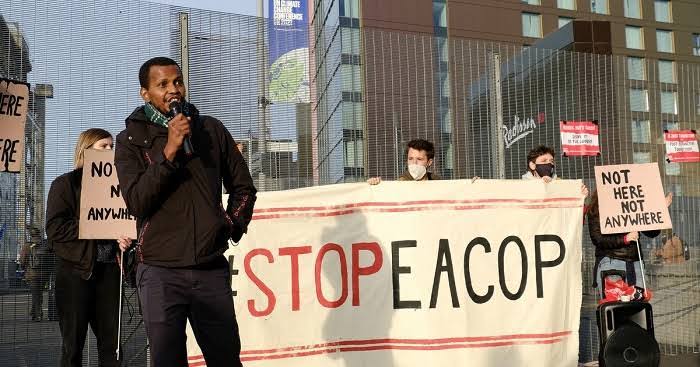
A coalition of 149 civil society organisations has called on eight African and Middle Eastern financial institutions to disclose their exposure to the East African Crude Oil Pipeline (EACOP), following an analysis by Reclaim Finance that identified about $3.7 billion in project lending linked to the pipeline between 2025 and 2026. The demand, set out in an open letter issued on October 28, intensifies scrutiny of how regional lenders assess the environmental, social and financial risks of one of East Africa’s largest fossil fuel infrastructure projects.
The institutions named in the coalition’s letter include Afreximbank, KCB Group and KCB Bank Uganda, the Islamic Development Bank Group and the Islamic Corporation for the Development of the Private Sector, NMB Bank Tanzania, Qatar National Bank, Standard Bank Group and Stanbic Bank Uganda, and Uganda Development Bank. The coalition says the amounts, structures and terms of several institutions’ involvement have not been publicly disclosed. The $3.7 billion figure refers to lending identified by the analysis and should not be interpreted as a confirmed amount independently attributed to each of the eight institutions.

The financing dispute comes as EACOP approaches a revised target for commercial oil production. Uganda National Oil Company officials said at African Energy Week in October that production was now targeted for June 2027, following earlier target dates in 2025 and 2026. Tanzania’s state petroleum company has separately indicated that crude could reach the Coastal Port of Tanga by February 2027, with the first tanker loading expected in March.
The approximately 1,443-kilometre pipeline is designed to transport crude oil from Uganda’s Lake Albert oil fields to Tanga for export. Its development is central to Uganda’s plan to commercialise its petroleum resources and could generate export earnings, government revenue and related economic activity in both countries. However, construction delays, financing requirements and environmental and social concerns have kept the project under scrutiny.
According to the StopEACOP coalition, more than 40 banks and 30 insurance companies have declined to support the project or adopted policies restricting their involvement. The coalition argues that African and Gulf lenders have consequently become more important to its financing. EACOP Ltd confirmed in March 2025 that its first tranche of external financing included Afreximbank, Standard Bank, Stanbic Bank Uganda, KCB Bank Uganda and the Islamic Corporation for the Development of the Private Sector, but did not disclose the individual amounts.
The coalition is asking the eight institutions to publish the full scope, structure and terms of their support, including exposure through loans, bonds, guarantees and advisory services. It has also called on them to rule out further financing for EACOP expansion and related oil and gas development, and to contribute to an independent, community-led mechanism for addressing harm associated with the project. The institutions have been asked to clarify their positions by November 16, after which the coalition says it intends to publish their responses and non-responses.
The disclosure dispute highlights a wider governance question for African financial markets: how lenders should assess infrastructure investments that promise economic returns but carry significant environmental, social and reputational risks. Publicly identifying a project’s financiers and the terms of their exposure allows investors, regulators and affected communities to better understand who bears the financial risks and what safeguards accompany the investment.
For regional banks, the issue extends beyond the pipeline itself. Lending decisions can affect access to international capital, relationships with institutional investors and the credibility of environmental, social and governance commitments. Where institutions have adopted sustainability policies, transparent explanations of how those policies apply to specific transactions can help establish whether commitments are reflected in lending practices. Disclosure alone, however, does not establish that a lender has breached its policies or that the project has violated applicable standards.
The economic case for EACOP rests on the prospect of moving Uganda’s crude to international markets and generating revenue from petroleum production. For Uganda, that could broaden export earnings and provide fiscal resources, although the eventual public benefit will depend on production volumes, global oil prices, project costs and the management of petroleum revenues. Tanzania could benefit from pipeline-related investment, services and export infrastructure around Tanga, while also carrying responsibilities linked to the project’s route and coastal terminal.
Those potential returns must be assessed alongside the project’s long-term exposure to oil market volatility and the global transition towards lower carbon energy systems. Oil infrastructure typically requires substantial upfront capital and depends on sustained demand to recover its costs. Changes in oil prices, financing conditions or market demand could affect the economic returns expected by project sponsors and lenders over time. These risks are relevant to public finances and financial stability where government institutions, state-owned companies or domestic banks have direct or indirect exposure.
The social and environmental questions are equally significant. The coalition has raised concerns about land acquisition, compensation, disrupted livelihoods, biodiversity and environmental damage along the pipeline route and at the Chongoleani terminal in Tanzania. It argues that some affected households have not been adequately compensated or restored to their previous economic position. These are claims made by campaign groups and require assessment against project records, applicable legal obligations and independent evidence.
For communities whose land has been acquired for infrastructure, compensation is not only a legal matter but also an economic one. The loss of farmland, access routes or other productive assets can affect household income and food security, particularly where replacement land or alternative livelihoods are difficult to secure. The ability of project developers and authorities to address grievances, restore livelihoods and provide credible remedies will influence the project’s social and institutional risks.

The next phase of the dispute will test whether lenders are prepared to provide detailed disclosures and explain how environmental and social risks were assessed. For African financial institutions, the outcome could help clarify the standards expected when financing large infrastructure projects with contested impacts. For Uganda and Tanzania, the broader challenge is to ensure that prospective oil revenues and infrastructure benefits are assessed alongside financing costs, community impacts and the long-term risks associated with dependence on fossil fuel exports.


