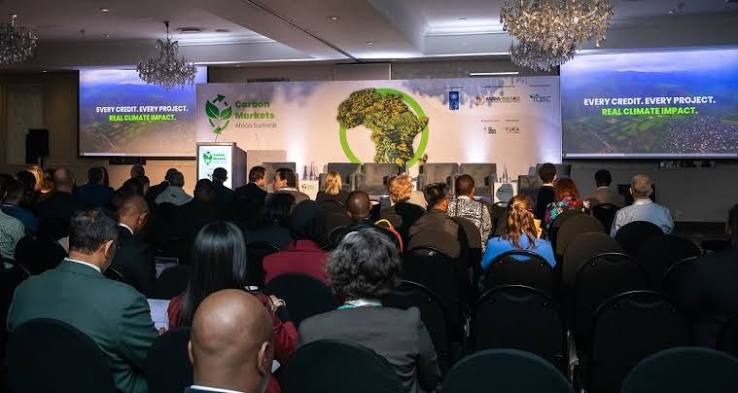
The Carbon Markets Africa Summit 2026 concluded in Kigali on 15 October with new financing initiatives and calls for stronger project preparation, credible carbon accounting and fair community benefit-sharing, as African governments and investors seek to turn the continent’s natural resources into investable climate and conservation opportunities.
Held from 13 to 15 October at the Kigali Convention Centre, the summit brought together policymakers, project developers, carbon-credit buyers, financial institutions and technical specialists to address barriers preventing African carbon projects from progressing from development to commercial transactions. Discussions covered blue carbon, reforestation, agriculture, rangeland restoration and waste management, with a focus on connecting project pipelines to buyers and capital.
A key announcement was the launch of the Africa Nature Impact Fund by Finance Earth, FSD Africa and FSD Africa Investments. The financing platform is targeting US$100 million to support early-stage nature and nature-based carbon projects across Africa, with a first close of US$20 million targeted for 2027. FSD Africa Investments has made a £5 million cornerstone commitment, equivalent to approximately US$6.6 million. The wider fundraising target and planned first close remain objectives rather than funds already fully raised or deployed. FSD Africa

The fund is intended to address a financing gap that frequently affects projects before they begin generating carbon-credit revenue. Project developers can face substantial costs associated with feasibility studies, technical design, land and community engagement, environmental assessments, validation, verification and regulatory authorisations. These expenses arise before credits can be issued and sold, leaving projects exposed to development risks that conventional lenders or commercial investors may be reluctant to absorb.
The Africa Nature Impact Fund aims to provide capital for projects at earlier stages, helping them progress towards implementation and more predictable revenue streams. The initiative also reflects a broader effort to structure nature finance around measurable environmental outcomes and the economic interests of communities hosting projects.
According to FSD Africa, more than 62% of Africa’s gross domestic product depends on natural capital. Yet investment in nature-based carbon and biodiversity projects remains below the level required to support the scale of conservation and restoration needed. The challenge is particularly significant for projects that generate public environmental benefits but face uncertain timelines for commercial returns.
For African countries, the issue extends beyond attracting international buyers. The ability to retain greater value from carbon markets will depend on the quality of project development, domestic technical expertise, access to finance and the terms under which carbon assets are sold. Projects must also demonstrate that claimed emissions reductions or removals are real, measurable and sufficiently durable, while avoiding double counting and managing social and environmental risks.
Rwanda’s participation in the summit highlighted the relationship between carbon-market development and wider financial-sector reform. On 15 October, the Kigali International Financial Centre (KIFC) launched the country’s Sustainable Finance Roadmap 2.0, setting out priorities through 2030 to strengthen investment readiness, expand carbon finance and improve sustainability data.
The roadmap establishes 54 initiatives building on Rwanda’s first sustainable finance framework, launched in 2022. Its emphasis includes preparing businesses and projects to attract capital, strengthening financial-market infrastructure and developing financing options for sustainable investments. The framework seeks to move beyond policy commitments towards greater capital deployment and investment in businesses. Rwanda Dispatch
KIFC Chief Executive Officer Hortense Mudenge highlighted the potential for sustainable finance to support business expansion, employment and economic resilience. She also outlined Rwanda’s ambition to position Kigali as a centre for carbon aggregation and investment structuring, potentially helping connect African project developers with international capital.
The ambition faces practical tests. Carbon projects often require financing structures that can accommodate long development periods, fluctuating credit prices and changing regulatory requirements. Investors must assess the reliability of future credit revenues, while developers need clarity on authorisations, ownership rights, applicable standards and the rules governing the transfer of credits across borders.
During the summit, Rwanda’s Minister of Environment, Dr Bernadette Arakwiye, outlined an approach the country is exploring to use a share of carbon transaction proceeds through the Rwanda Green Fund to help prepare and pre-finance future projects. Such a mechanism could help address early-stage funding needs, although its eventual impact will depend on how the arrangement is designed, financed and implemented.
Technical workshops and solution labs also examined authorisations, risk-sharing, registry interoperability, changing international requirements and local verification capacity. Demonstrations of digital monitoring and reporting tools reflected growing interest in using technology to improve the tracking of project performance and strengthen the evidence supporting carbon-credit claims.
However, digital systems alone cannot guarantee environmental integrity. Reliable project outcomes depend on sound methodologies, credible baseline assessments, consistent monitoring and independent verification. The ability of local institutions and technical specialists to perform these functions will be important to reducing project costs and strengthening African participation in the market.
Market credibility and the distribution of economic benefits were central themes in the summit’s discussions. Carbon projects can generate revenue for land restoration, forest conservation, agricultural improvements and other climate-related activities, but the allocation of that revenue can be contested when communities have limited influence over project design or contractual arrangements.
Shikha Sharma, Global Technical Lead for Offsets and Removals within SGS’s Climate Solutions business, emphasised the role of independent validation and verification in establishing confidence in carbon credits. She said environmental integrity, credible projects and meaningful benefits for local communities were essential to the market’s development.
The issue is particularly important where projects depend on land, forests, mangroves or agricultural systems used by local communities. Clear land and resource rights, transparent contracts, accessible grievance mechanisms and fair benefit-sharing arrangements can help reduce conflict and improve the durability of project outcomes. Conversely, weak consultation or unclear ownership can expose projects to legal, reputational and operational risks.
Maxwell Gomera, UNDP Resident Representative in South Africa and Director of the UNDP Africa Sustainable Finance Hub, delivered closing remarks that stressed the need to turn relationships established at the summit into prepared projects and completed transactions. He underscored that community rights and fair benefit-sharing should be built into projects from the beginning, rather than treated as considerations to address after financing has been secured.
The summit’s emphasis on implementation reflects a wider challenge for African carbon markets. Bringing together buyers and developers can establish commercial interest, but interest does not necessarily translate into signed offtake agreements, financial close or issued credits. Project developers still need to demonstrate that their proposals can meet buyers’ technical requirements, secure regulatory approvals and generate dependable environmental and financial results.
African countries are also navigating international carbon-market rules, including arrangements under Article 6 of the Paris Agreement, which provide frameworks for cooperation between countries in meeting climate targets. Where emissions reductions are authorised for international transfer, corresponding adjustments and transparent accounting can be important to prevent the same mitigation outcome from being counted towards more than one country’s climate target. The practical requirements vary according to the transaction and applicable rules, placing a premium on institutional capacity and clear national procedures.
The summit was hosted by Rwanda’s Ministry of Environment, with the United Nations Development Programme and the African Development Bank as host organisations. The Development Bank of Southern Africa was a host partner, while AUDA-NEPAD served as a strategic institutional partner. Their participation reflected the need for coordination between national governments, development finance institutions and continental bodies as carbon markets expand.

For development finance institutions, one challenge will be to mobilise private investment without transferring disproportionate risks to communities or weakening environmental safeguards. For governments, the task will include establishing transparent regulatory systems that protect national interests while providing investors with sufficient clarity to commit capital. For project developers, the test will be to deliver verified outcomes at a cost and scale that buyers are willing to support.
Emmanuelle Nicholls, Portfolio Director at VUKA Group, said the ambition was for African countries to shape carbon markets that finance the continent’s priorities and create lasting value for its people. She said the organisers hoped to build on the connections made in Kigali and see more African projects secure the investment and partnerships needed to grow.
The next phase will depend on whether the summit’s financing initiatives and commercial discussions lead to tangible results. The Africa Nature Impact Fund’s progress towards its first close in 2027, the implementation of Rwanda’s sustainable finance roadmap and the conversion of project showcases into investment agreements will offer practical measures of that progress.
For Africa, the opportunity lies not simply in increasing carbon-credit sales, but in building markets that can finance credible climate action, strengthen local technical capacity and direct a fair share of the resulting value to communities. Achieving those outcomes will require capital to reach projects at the right stage, regulatory systems to support transparent transactions and environmental integrity to remain central to the market’s long-term credibility.