


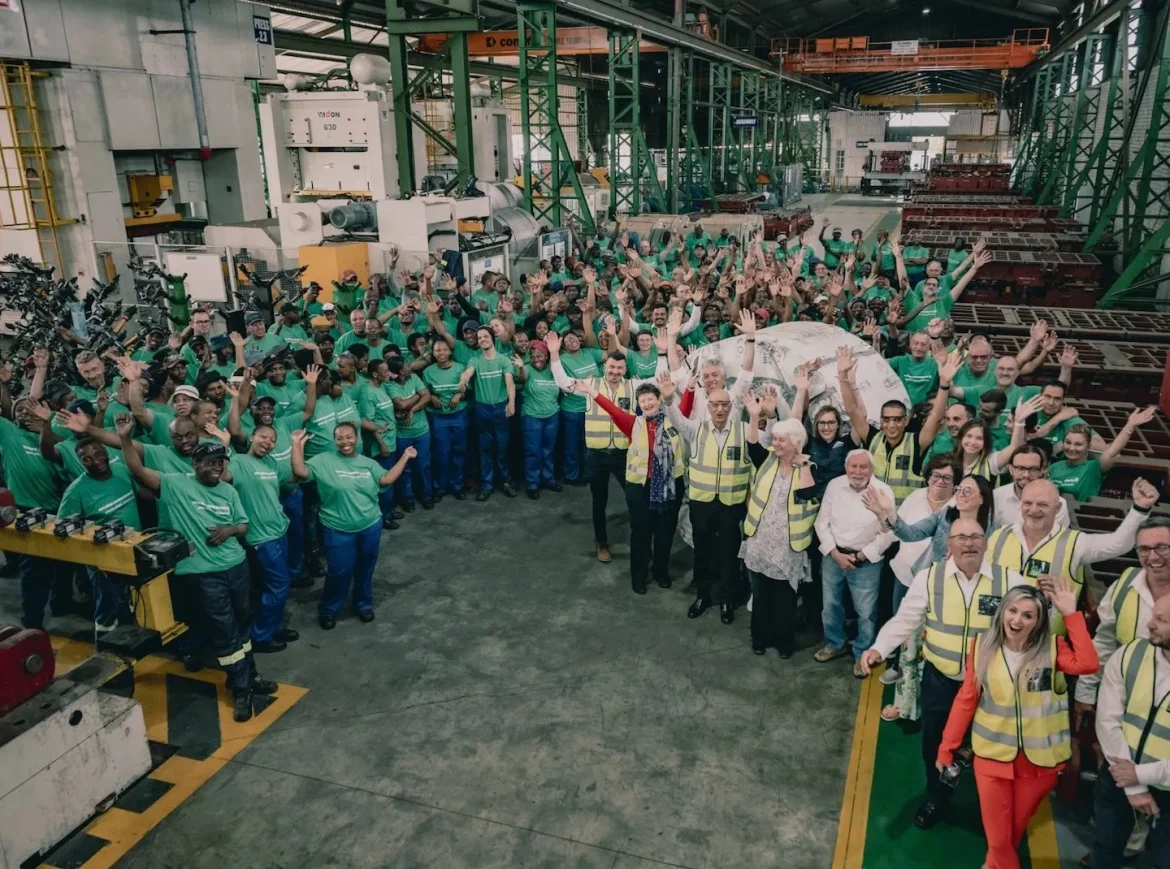
A new commercial agreement between Google and Swedish steel producer Stegra is highlighting an emerging mechanism for financing lower-emissions industrial products, with environmental attribute certificates tied to up to 91,000 tonnes of near-zero-emission steel in the first year of the arrangement. Announced on September 17, the deal will allow Google to address steel-related emissions from its operations, including data-centre construction, while providing Stegra with an additional source of revenue as it brings its hydrogen-based steel plant in Northern Sweden towards production. For Africa, the transaction offers a window into a market that could become increasingly relevant to countries seeking to combine renewable energy, green hydrogen, iron ore, and industrial processing rather than exporting raw materials alone.
The agreement uses an environmental attribute certificate, or EAC, model based on what is known as “book and claim”. Under the arrangement, the environmental characteristics of the steel are separated from the physical product, allowing a buyer to purchase the associated environmental attributes even where it cannot take delivery of the specific steel produced. Stegra says the certificates will initially cover up to 91,000 tonnes of first-year production, with the possibility of additional volumes during the agreement. The company is using green hydrogen produced with renewable electricity in its ironmaking process, replacing coal traditionally used in conventional steelmaking.
The commercial significance lies in the role of demand. New low-emissions industrial technologies frequently face high capital costs before they reach scale, while potential customers may be geographically distant from production facilities. A mechanism that allows companies to purchase verified environmental attributes can create an additional revenue stream during the early stages of industrial development. Stegra has said the arrangement will contribute to cash flow during the initial years of operations and the ramp-up of production.
That model is relevant to Africa because the continent has many of the underlying resources required for lower-carbon iron and steel production, but much of its mineral wealth remains exported with limited processing and manufacturing taking place locally. Africa is a net exporter of iron ore, while more than 80% of its ironmaking capacity is based on direct reduced iron, according to the International Energy Agency. The IEA argues that combining iron ore, renewable energy, natural gas and emerging hydrogen production could allow African countries to increase domestic value addition and reduce some dependence on imported industrial products.
The opportunity, however, is not simply a question of possessing resources. Producing competitive low-carbon steel requires reliable and affordable electricity, access to large volumes of low-emissions hydrogen, transport infrastructure, water, industrial facilities and access to customers willing to pay for lower-emissions products. It also requires financing structures capable of supporting projects whose capital requirements are substantial and whose commercial markets are still developing.
Africa’s green hydrogen pipeline illustrates the scale of that challenge. According to the IEA’s 2026 Global Hydrogen Review, Africa currently produces only about 6 kilotonnes of low-emissions hydrogen, all from renewable sources, despite a project pipeline that could raise production substantially by 2030. Of 31 projects identified in the pipeline, only one had reached a final investment decision at the time of the assessment. The IEA identifies blended finance, offtake guarantees, credit guarantees and insurance as among the mechanisms that could help reduce financing risks.
South Africa is one of the countries attempting to connect these elements. At the Africa Green Hydrogen Summit in September, the government unveiled a first wave of six green hydrogen and Power-to-X projects, including the Saldanha Hydrogen Direct Reduced Iron project, which is intended to link green hydrogen with lower-emissions iron production. The project remains at pre-feasibility stage, according to the South African government, but its inclusion in the national priority portfolio reflects an effort to connect hydrogen development with industrial activity rather than treating hydrogen only as an export commodity.
The African Development Bank has also identified the connection between hydrogen and industrial decarbonisation as an emerging investment area. In September, the Bank announced prospective reimbursable grants totalling $20 million for four green hydrogen or derivative projects in Egypt, Morocco, Namibia and South Africa, subject to Board approval. Among them is the Saldanha Hydrogen DRI project, while Morocco’s Guelmim Green Hydrogen Valley is intended to develop a wider industrial ecosystem around hydrogen. The Bank said its funding is intended to prepare projects for investment.
Morocco is also examining how green hydrogen can be integrated into its existing steel industry. UNIDO reported in July that a Green Climate Fund readiness project had produced studies aimed at strengthening the enabling environment for hydrogen applications in Morocco’s steel sector. The work identifies technical, regulatory, institutional and financial coordination as necessary conditions for deploying hydrogen in steelmaking.
For Africa, the industrial question is larger than the production of a lower-carbon commodity. Steel sits at the centre of construction, transport, energy infrastructure and manufacturing. Greater domestic production could reduce exposure to imported steel while creating demand for engineering, equipment, logistics, electricity and other industrial services. The economic value therefore depends on how much of the wider supply chain remains within African economies.
That is where the distinction between exporting green molecules and developing green industrial value chains becomes important. Green hydrogen can be exported as hydrogen, ammonia or other derivatives, but it can also be used domestically to process minerals and manufacture industrial products. South Africa’s government has explicitly positioned hydrogen within a wider industrialisation strategy that includes green iron and steel, sustainable fuels, chemicals, equipment and related services.
The development of a market for environmental attributes could add another layer to that industrial strategy. Corporate buyers with large construction footprints, including technology companies, are increasingly examining ways to account for the emissions associated with materials used in their infrastructure. Google said its agreement with Stegra is intended to help address emissions from its own operations, including data-centre construction, and estimated that incorporating low-carbon steel and concrete could reduce the embodied carbon of its data-centre infrastructure.
For African producers, access to such markets would depend on credible standards and measurement systems. Environmental certificates need clear accounting rules to establish where the environmental benefit originates, prevent double counting and distinguish physical procurement from claims associated with environmental attributes. Stegra’s arrangement includes provisions intended to prevent double counting when the physical steel is sold separately from its environmental attributes.
This governance requirement could become increasingly important as African countries seek to develop their own green industrial markets. Certification systems, carbon accounting, product standards and emissions data will influence whether African steel can qualify for international procurement programmes and whether buyers can make credible claims about the emissions associated with their supply chains.
There is also a financing implication. Large industrial projects typically require substantial upfront capital, while green hydrogen and low-carbon steel projects add further costs associated with renewable generation, electrolysers, hydrogen storage and new production technologies. Development-finance institutions can help reduce those barriers through project preparation, guarantees and concessional finance, but commercial demand remains necessary if projects are ultimately to operate without continued dependence on public support.
The IEA’s assessment points to this financing challenge directly. It says African hydrogen projects need measures that reduce the cost of capital and strengthen demand, including blended finance and offtake guarantees. It also notes that balancing domestic use with exports could create stronger deployment opportunities than relying exclusively on export markets.
For governments, this raises questions about infrastructure planning and public expenditure. Green steel projects require reliable electricity and transport systems, while hydrogen production can require new pipelines, storage facilities, ports and water infrastructure. Where several projects share these assets, coordinated planning could affect the economics of individual investments and determine whether industrial clusters become viable.
The potential benefits also come with trade-offs. Large hydrogen and industrial projects can place pressure on land, water and electricity resources, particularly in regions where communities and existing industries already face infrastructure constraints. The economic case for green industrialisation therefore depends not only on the emissions intensity of the final product but also on how projects manage water, land, employment, local procurement and community participation.
The Google–Stegra agreement does not establish a green steel market in Africa, nor does it demonstrate that environmental attribute certificates will provide a sufficient financing model for African industrial projects. It does, however, illustrate how corporate procurement can become part of the financial architecture supporting new low-emissions production capacity. For African economies seeking to move up mineral value chains, that emerging demand is potentially relevant because it links industrial investment with the changing carbon requirements of global supply chains.
The strategic question for Africa is therefore shifting from whether the continent can produce low-carbon materials to whether it can build the infrastructure, financing systems, standards and industrial capacity required to sell them competitively. As green steel markets develop, countries with renewable power, iron ore resources and industrial infrastructure will face a choice about where they capture value in the emerging transition.
 For Africa, the significance of green steel is ultimately tied to that value-chain question. If the transition produces demand only for African raw materials and imported technology, much of the industrial opportunity will remain outside the continent. If financing, infrastructure and market mechanisms can support domestic processing and manufacturing, lower-carbon steel could become part of a broader industrial strategy linking renewable energy and mineral resources to higher-value production.


