


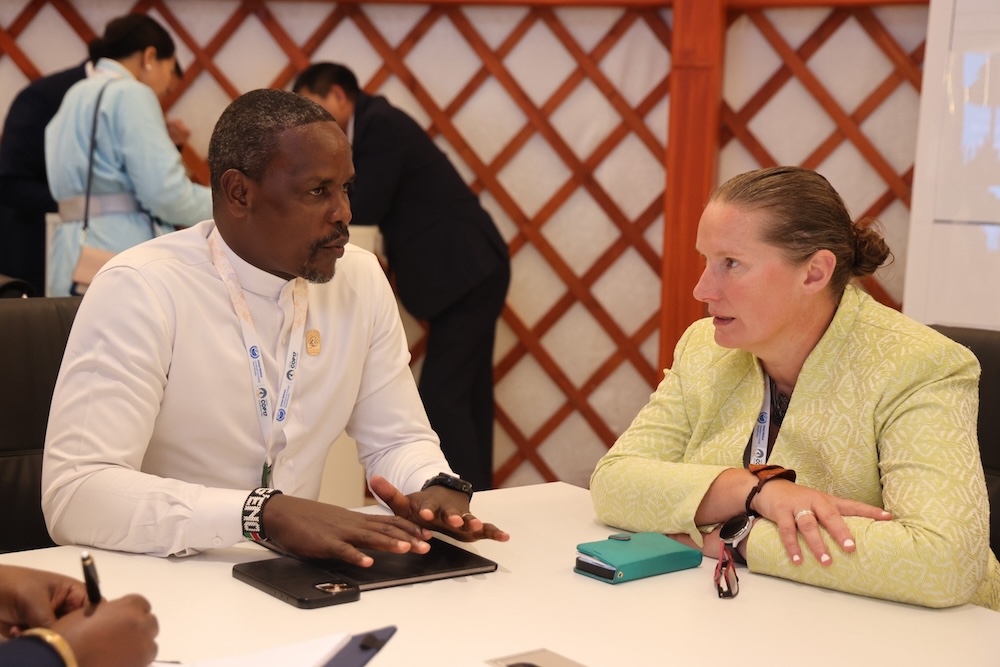
Kenya is seeking to deepen cooperation with the World Bank on circular economy development and carbon markets as the government looks to improve waste management, mobilise private investment and turn resource efficiency into a potential source of climate finance. The discussions were held between Environment and Climate Change Principal Secretary Eng. F. Ngeno and Valerie Hickey, World Bank Director for Environment for Kenya, on the sidelines of the UN Convention to Combat Desertification COP17 in Ulaanbaatar, Mongolia.
The talks focused on how Kenya can strengthen the economic systems needed to reduce waste, recover materials and lower greenhouse gas emissions while creating investment opportunities for businesses and counties. At the centre of the discussions was the development of a circular economy approach to waste management, supported by Kenya’s Sustainable Waste Management Policy and Act and Extended Producer Responsibility regulations.
The government considers EPR an important economic instrument because it places greater responsibility on producers for the products and packaging they introduce into the market. Effective implementation could encourage businesses to redesign products, improve collection systems and invest in recycling and resource recovery.

However, significant infrastructure and coordination gaps remain. Discussions between Kenya and the World Bank highlighted challenges including waste segregation at source, management of legacy waste and the establishment of Material Recovery Facilities. These constraints affect the ability of counties and private operators to recover valuable materials before waste reaches disposal sites.
Ngeno called for a whole-value-chain approach involving national and county governments, businesses and development partners. The approach is significant because Kenya’s waste management responsibilities are distributed across different levels of government, while collection, recycling and resource recovery also depend heavily on private-sector participation.
The discussions also connected circular economy development with Kenya’s expanding carbon market. Ngeno welcomed continued World Bank support for the country’s carbon markets, saying recent legislation had strengthened community safeguards while improving transparency and accountability.
The connection between the two areas could become increasingly important. Recycling, composting, methane capture, material recovery and resource efficiency can reduce emissions, but accessing carbon finance requires those reductions to be measured, verified and transparently accounted for.
Kenya and the World Bank therefore explored the possibility of integrating circular economy projects into the country’s carbon market pipeline. Such an approach could allow projects with demonstrable emissions reductions to become eligible for carbon finance while creating additional revenue streams for developers and communities.
Potential areas of cooperation include a National Circular Economy Strategy and investment framework, blended-finance facilities for recycling and resource-efficiency projects, and systems for measuring circularity and greenhouse gas reductions.
Blended finance could be particularly relevant for Kenya because recycling and waste-management infrastructure often faces challenges in securing affordable long-term capital. Combining public or development finance with private investment could help reduce project risks and support infrastructure that might otherwise struggle to attract commercial funding.
For counties, improved financing could support waste collection, sorting and recovery infrastructure while creating markets for recyclable materials. For businesses, stronger recovery systems could reduce dependence on imported raw materials and create opportunities in recycling, remanufacturing and resource-efficient production.
The carbon-market component also introduces an important governance requirement. Projects must be able to demonstrate genuine, measurable and additional emissions reductions if they are to attract credible carbon finance. Weak measurement systems or questionable claims could undermine investor confidence and the integrity of Kenya’s carbon market.
The proposed systems for measuring circularity and greenhouse gas reductions could therefore become important infrastructure for the emerging market. Reliable data would help investors assess projects, governments track climate benefits and communities understand how revenues and environmental benefits are being generated.
For Kenya, the economic significance extends beyond waste management. Circular economy models can create employment, support small businesses and reduce pressure on land, water and raw materials. They can also contribute to climate resilience by reducing dependence on linear supply chains vulnerable to global price and supply disruptions.
The discussions with the World Bank come as Kenya seeks to position itself as a regional leader in climate finance and sustainable development. Linking circular economy investments with carbon markets could provide an additional mechanism for mobilising capital, provided environmental integrity and community protections remain central to implementation.
The immediate challenge will be translating the proposed areas of cooperation into bankable projects, measurable emissions reductions and functioning waste-management systems. For Kenya, the opportunity lies in moving circular economy policy beyond waste disposal towards a broader economic model in which materials retain value for longer, businesses become more resource efficient and verified climate benefits can attract investment.
If successfully developed, the emerging cooperation between Kenya and the World Bank could help connect three priorities that are often addressed separately: better waste management, lower emissions and access to climate finance. The ability to convert that policy alignment into investable projects will determine how much economic value Kenya ultimately captures from its circular economy and carbon-market transition.


