


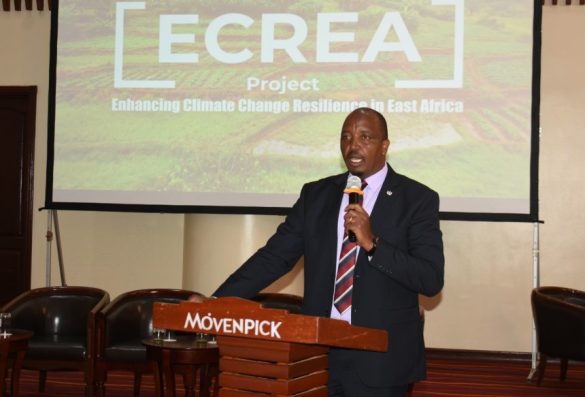
Kenya is recording increased public and institutional demand for weather and climate information services as investments in forecasting systems, county-level meteorological infrastructure and regional climate resilience programmes strengthen the country’s capacity to manage climate-related risks. The trend was highlighted during the closure of the Enhancing Climate Change Resilience in East Africa (ECCREA) Project Reflection and Closure Workshop held in April 2026, where officials from Kenya, Uganda, Tanzania and Rwanda reviewed progress in expanding access to climate intelligence across the region.
According to Kenya Meteorological Service Authority Acting Director Edward Muriuki, improvements in forecast accuracy and accessibility have significantly increased public confidence in weather information, particularly among farmers, disaster management agencies, infrastructure planners and local governments.
The establishment of meteorological offices across all 47 counties has expanded access to localized forecasting services, enabling communities to make more informed decisions in sectors increasingly exposed to climate variability. The growing reliance on climate information reflects a broader shift in how African economies are responding to climate risk. Weather forecasting, once viewed primarily as a scientific or aviation-related function, is increasingly being integrated into economic planning, food security management, water resource allocation and disaster preparedness strategies. In countries heavily dependent on rain-fed agriculture, the economic consequences of delayed or inaccurate climate information can extend from household food insecurity to inflationary pressures, infrastructure damage and fiscal strain on governments responding to emergencies.
Kenya has experienced a succession of climate shocks in recent years, including prolonged droughts, destructive flooding and irregular rainfall patterns linked to rising global temperatures. These disruptions have affected agricultural production, hydropower generation, transport infrastructure, and public health systems, increasing pressure on governments to strengthen early warning mechanisms and climate adaptation systems.
The ECCREA programme sought to address some of these vulnerabilities by strengthening the production and use of Weather and Climate Information Services (WCIS) across selected regions. In Kenya, the initiative was implemented in Homa Bay, Elgeyo Marakwet, Nakuru and Machakos counties, areas where agriculture and rural livelihoods remain highly exposed to climate variability. The programme focused on improving both the technical quality of forecasts and the ability of communities and institutions to apply climate information in planning and risk management.
The project was financed by the United Kingdom’s Foreign, Commonwealth and Development Office through the UK Met Office and implemented in partnership with the Intergovernmental Authority on Development Climate Prediction and Applications Centre (ICPAC), National Meteorological and Hydrological Services (NMHSs), agricultural research institutions and regional media organizations. The collaboration reflects increasing international recognition that climate information systems are becoming critical infrastructure for economic resilience across Africa.
According to regional climate specialists, investments in meteorological services are gaining importance as governments attempt to reduce the economic cost of climate-related disasters. Floods, droughts and extreme weather events continue to impose substantial financial burdens on African economies through crop losses, damaged infrastructure, humanitarian response costs and reduced productivity.
The World Meteorological Organization (WMO) has previously estimated that early warning systems can significantly reduce disaster losses by enabling faster preparedness and response measures. For African economies facing constrained public finances and rising climate adaptation costs, improved forecasting systems may help reduce long-term fiscal exposure while strengthening resilience in climate-sensitive sectors.
In Kenya, climate information is increasingly being incorporated into agricultural extension services, insurance products and infrastructure planning processes. Farmers are using seasonal forecasts to guide planting decisions and crop selection, while disaster response agencies are relying on localized weather data to anticipate flood risks and coordinate emergency interventions.
The expansion of digital forecasting platforms and county-specific advisories is also contributing to wider public access to climate intelligence. Mobile technology and community-based dissemination systems are helping bridge information gaps in remote areas where exposure to droughts and floods remains high, and institutional support is often limited.
Regional cooperation is emerging as another critical component of climate resilience planning in East Africa. Climate systems and weather patterns frequently cross-national borders, particularly in shared ecosystems and transboundary river basins. As a result, countries are increasingly coordinating forecasting efforts, data sharing and early warning systems through regional institutions such as ICPAC and the Intergovernmental Authority on Development (IGAD).
For Africa more broadly, the expansion of climate information services carries implications beyond weather preparedness. Reliable climate data is becoming increasingly important for attracting climate finance, supporting agricultural modernization, strengthening insurance markets, and guiding investments in resilient infrastructure. Development of finance institutions and climate-focused investors is placing greater emphasis on data-driven adaptation planning as part of broader resilience financing strategies.

The strengthening of meteorological services also aligns with the African Union’s Agenda 2063 objectives on environmental sustainability and climate resilience. Across the continent, governments are under growing pressure to improve climate adaptation capacity while balancing economic growth, food security, and infrastructure development demands.
Kenya’s investment in localized weather and climate information systems reflects a wider recognition that climate intelligence is evolving into an economic governance tool rather than solely a scientific resource. As climate volatility increases across Africa, the ability of governments, businesses and communities to access accurate and actionable weather data may increasingly shape agricultural output, disaster preparedness, infrastructure resilience and long-term economic stability.


