


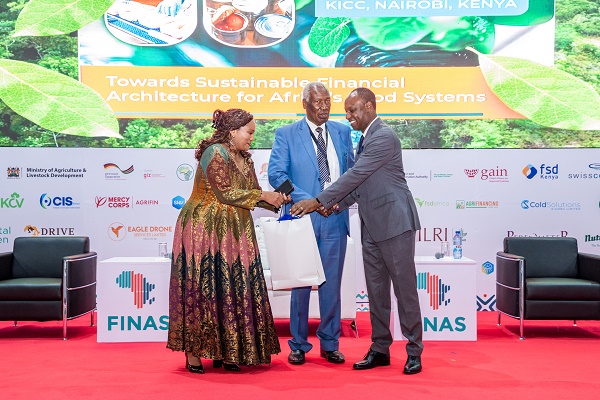
The Government of Kenya has unveiled a KES 1.1 trillion National Agri-food Systems Investment Plan (NASIP) 2026–2030, setting out an ambitious financing framework designed to modernise agriculture, strengthen food security, attract private investment and create more than two million jobs over the next five years.
The investment blueprint, launched during the Financing Agri Food Systems Sustainably (FINAS) Summit 2026 at the Kenyatta International Convention Centre, represents the second implementation phase of Kenya’s Agricultural Sector Transformation and Growth Strategy (ASTGS). It provides a fully costed roadmap aimed at transforming the country’s agricultural sector while positioning Kenya as a regional hub for sustainable agri-food investment.

The strategy seeks to strengthen agricultural productivity through investments in climate-smart farming, irrigation expansion, value addition, agribusiness development, food systems resilience and improved market access. Beyond increasing agricultural output, the plan is intended to improve farmer incomes, stimulate rural industrialisation and strengthen national food security in the face of mounting climate and economic pressures. Launching the investment framework on behalf of Mutahi Kagwe, Jonathan Mueke said NASIP establishes a practical financing architecture capable of mobilising both domestic and international capital to accelerate agricultural transformation. According to the financing framework, 35% of the investment will be funded jointly by the national government and county governments, while the private sector is expected to contribute 45%. Development finance institutions and bilateral development partners will provide the remaining 20%, reflecting an increasing emphasis on blended finance models to bridge Africa’s agricultural financing gap.
“This investment will be mobilised through a strategic partnership in which the Government of Kenya, together with County Governments, will contribute 35%. I am calling on the commitment of the County Governments, through the Council of Governors, to achieve this goal. The private sector is expected to contribute 45%, and the Development and bilateral partners’ share is 20% of the total investment envelope,” Mueke said.
The announcement comes as African governments seek to translate policy commitments into tangible investments following the adoption of the Comprehensive Africa Agriculture Development Programme Kampala Declaration, which sets out the continent’s agricultural development priorities through 2035. Held under the theme “Towards Sustainable Financial Architecture for Africa’s Food Systems,” the FINAS Summit has brought together policymakers, development finance institutions, commercial banks, investors, agribusiness leaders and development partners to examine how innovative financing mechanisms can unlock greater investment in African agriculture. Discussions throughout the summit have focused on blended finance, climate-smart agriculture, agricultural insurance, digital financial services, value chain financing and private capital mobilisation, drawing lessons from Kenya, Nigeria, Ethiopia and other African countries implementing agricultural financing reforms.
The emphasis on financing reflects one of Africa’s most persistent development challenges. Although agriculture employs more than half of the continent’s workforce and contributes substantially to GDP across many economies, the sector continues to receive a disproportionately small share of private investment relative to its economic significance. According to the Food and Agriculture Organization (FAO), Africa must significantly increase investment in agriculture to meet growing food demand driven by rapid population growth, urbanisation and changing consumption patterns. Climate change, land degradation and rising production costs are simultaneously increasing the need for resilient agricultural systems capable of sustaining long-term productivity.
Kenya’s NASIP therefore places considerable emphasis on climate-smart agriculture, recognising that improving food security increasingly depends on strengthening resilience to droughts, floods and shifting weather patterns. Investments in irrigation infrastructure, climate-resilient crops, digital agricultural technologies and sustainable land management are expected to play a central role in achieving these objectives. The strategy also aligns with Kenya’s broader economic transformation agenda by promoting value addition and agro-industrial development. Rather than focusing solely on primary agricultural production, the investment plan seeks to strengthen processing, storage, logistics and export competitiveness, creating higher-value employment opportunities throughout agricultural supply chains.
This integrated approach reflects growing recognition that agriculture represents more than food production. It is increasingly viewed as a driver of industrialisation, trade, manufacturing and rural economic development. The private sector’s anticipated contribution of nearly half the total investment highlights an important shift in agricultural financing. Governments increasingly recognise that public resources alone are insufficient to finance agricultural transformation. Creating investment-friendly environments that reduce commercial risks and improve returns has therefore become a central policy objective.
Speaking during the summit, Charity Mutegi said the conference is moving beyond policy dialogue towards practical implementation by connecting institutions capable of financing agricultural transformation.
“In its third edition, FINAS continues to advance sustainable finance as a catalyst for meaningful change in Africa while laying the foundation for a private sector-led agriculture finance working group,” she said.
Participants are also evaluating agricultural financing assessment tools jointly developed by the FAO, the World Bank and the International Fund for Agricultural Development (IFAD). These frameworks seek to identify investment gaps while improving the mobilisation of both public and private capital into agricultural value chains. International development partners attending the summit emphasised that stronger partnerships will be essential to delivering Africa’s food systems transformation. Caitríona Ingoldsby highlighted the importance of collaboration among governments, development agencies, financial institutions, agribusinesses and smallholder farmers in building inclusive agricultural systems capable of supporting sustainable development.
Similarly, Hamadi Boga called on governments to move beyond policy commitments by accelerating implementation of investment programmes that generate measurable improvements in agricultural productivity and farmer livelihoods. Maren Kneller noted that creating investment-friendly regulatory environments will be critical for attracting greater private-sector participation while supporting innovation throughout agricultural value chains. Meanwhile, Rashmi Pillai stressed the importance of financial products designed specifically for micro, small and medium-sized enterprises (MSMEs) and smallholder farmers, arguing that inclusive financial systems remain fundamental to resilient food systems.
For Africa, Kenya’s investment framework represents more than a national agricultural strategy. It illustrates a broader continental transition from publicly financed agricultural programmes towards blended finance models capable of mobilising institutional investors, commercial lenders, development finance institutions and private enterprises around shared development objectives. This shift reflects growing recognition that achieving food security requires substantial long-term investment across entire food systems rather than isolated interventions in agricultural production.

https://www.aecweek-registration.com/2026/
The World Bank estimates that Africa’s population will approach 2.5 billion people by 2050, significantly increasing demand for food, employment and agricultural productivity. Meeting these needs will require not only increased production but also stronger value chains, improved infrastructure, digital innovation and greater resilience to climate change.
Against this backdrop, Kenya’s KES 1.1 trillion NASIP provides one of the continent’s most comprehensive investment frameworks for agricultural transformation. Its success will depend on effective coordination between government institutions, county administrations, private investors and development partners, alongside transparent implementation and sustained political commitment.
If successfully executed, the investment plan could strengthen Kenya’s position as a regional agricultural leader while demonstrating how blended finance, climate-smart investment and public-private collaboration can support more resilient, productive and sustainable food systems across Africa.


