


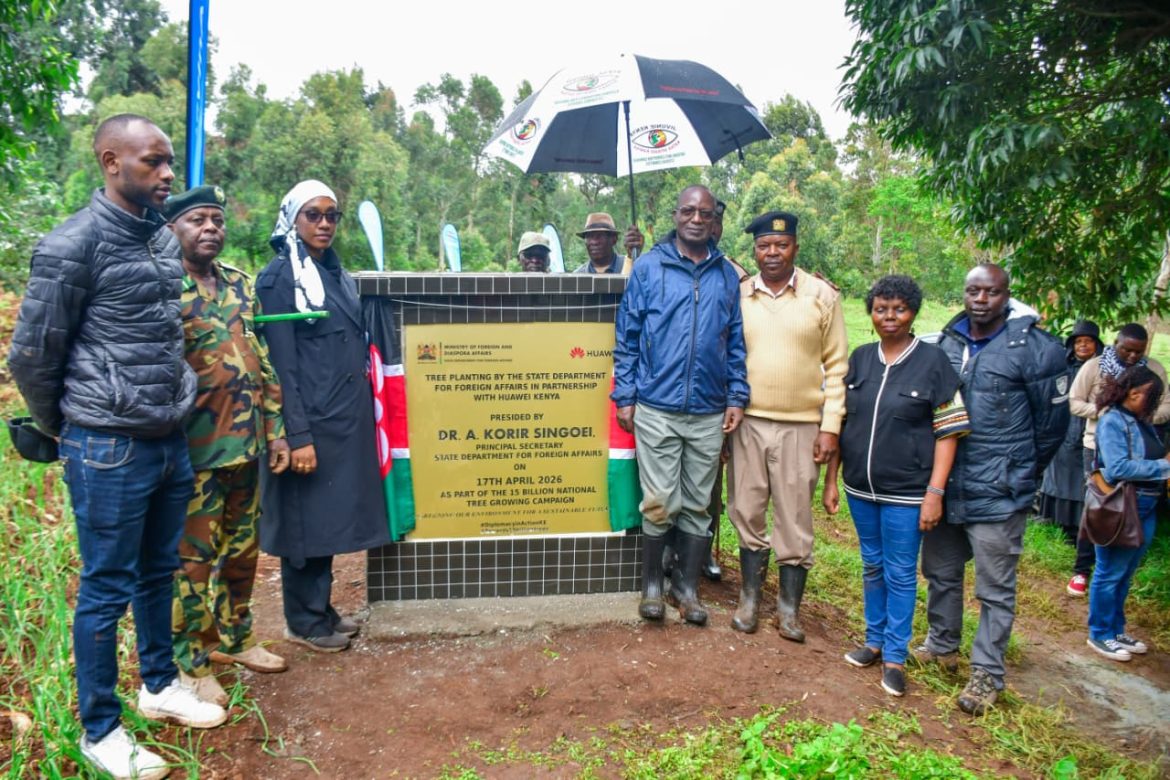
On April 19, 2026, Kenyan authorities unveiled a collaborative restoration plan targeting the endangered natural forests in Limuru, Kiambu County, as part of ongoing efforts to combat deforestation and climate change.
The initiative brings together the Ministry of Foreign and Diaspora Affairs, the Ministry of Environment, Climate Change and Forestry, and Huawei Technologies Kenya to restore critical forest ecosystems in the Uplands area of Limuru (Lari Sub-County), which hosts six of Kiambu County’s eight forests vital for biodiversity and water catchments. Over the weekend, the partnership resulted in the planting of 5,000 indigenous trees at the Uplands Forest Station, marking an immediate step forward in the drive.
The plan aligns directly with Kenya’s ambitious national target to grow 15 billion trees by 2032, aimed at boosting forest cover to 30% and addressing annual losses of over 84,000 hectares of forest. The Ministry of Foreign and Diaspora Affairs has already grown approximately 107,000 tree seedlings and now targets five million seedlings this year through such partnerships, with the Limuru project serving as a flagship example of environmental diplomacy in action.
Huawei’s involvement draws on its #Tech4All sustainability agenda, including prior collaborations like the 2025 Tech4Nature project with Kenya Wildlife Service. Key goals of the Limuru restoration include enhancing overall forest cover, improving air and water quality by conserving vital water resources, conserving biodiversity through indigenous species that provide wildlife habitats, and building climate resilience against degradation.
The initiative also emphasizes sustainable livelihoods, enabling communities to integrate agro-forestry practices that generate income while protecting ecosystems. Local leaders highlighted how indigenous trees support both conservation and household economies via programs like the Tree Establishment and Livelihood Improvement Scheme.
Community involvement stands at the heart of the plan’s long-term success, with over 2,600 members of Community Forest Associations (CFAs) and Community-Based Organizations (CBOs) actively nurturing and safeguarding the forests. Participants include local administrators, forest managers, and residents who balance conservation with temporary farming allowances in designated zones until trees mature, reducing illegal logging by giving communities a direct stake. Uplands CFA Chairman Charles Kimani noted the positive shift from past charcoal burning to collective restoration, while Deputy County Commissioner Samuel Kariuki stressed the need for ongoing monitoring beyond initial planting.
Huawei Technologies Kenya’s Public Affairs Director Khadija Mohammed praised the grassroots partnerships for strengthening climate adaptation, stating they contribute meaningfully to the 15 billion tree national goal. Ambassador Michael Kiboino, representing Foreign Affairs Principal Secretary Korir Sing’Oei, described the effort as “environmental diplomacy through local action,” underscoring that the trees will enhance forest cover, air quality, water conservation, and wildlife habitats for future generations. This public-private model exemplifies how targeted local initiatives in areas like Limuru can support Kenya’s broader climate agenda.
As Kenya continues its push toward the 2032 target, the Limuru plan demonstrates a scalable blueprint for restoring degraded forests while empowering communities and fostering international partnerships. Success will hinge on sustained stewardship, with survival rates and biodiversity gains serving as key metrics. The initiative not only addresses immediate environmental threats but also positions Limuru as a model for nationwide restoration efforts.


