


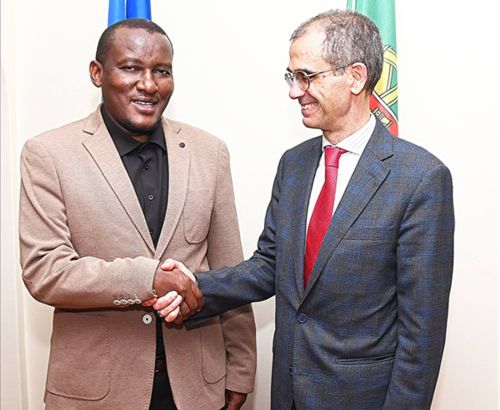
Kenya is exploring a potential partnership with Portugal to support the development of irrigation infrastructure and attract investment into the country’s ambitious agricultural modernization programme, as Nairobi seeks to reduce its dependence on rainfall and strengthen food production amid growing climate pressures.
The discussions took place in Nairobi on May 29, where Principal Secretary for Irrigation Ephantus Kimotho Kimani met Portuguese Ambassador Paulo Neves Pocinho to examine areas of cooperation under Kenya’s National Irrigation Sector Investment Plan (NISIP), a long-term strategy designed to expand irrigation coverage and improve water management across the country.
According to the State Department of Irrigation, the talks focused on leveraging Portugal’s experience in sustainable irrigation systems, water resource management and climate-resilient agricultural infrastructure.
The proposed cooperation could encompass technical assistance, financing arrangements and private-sector participation in large-scale irrigation projects.
The discussions come as Kenya accelerates efforts to transform its agricultural sector through a KSh598 billion ($4.6 billion) investment programme aimed at bringing an additional 400,000 hectares of land under irrigation by 2035. Under the NISIP framework, the government plans to finance approximately 39 percent of the programme, while the remaining funding is expected to come from private investors and development partners.
The proposed partnership would support strategic investments in dam construction, water abstraction systems, irrigation canals and water conveyance infrastructure. Canal lining and other efficiency measures are also being considered to reduce water losses, a critical concern in a country where water availability remains uneven across regions.
Kenya is also seeking to attract Portuguese investors through Public-Private Partnerships (PPPs) targeting commercial irrigation schemes and large-scale food production projects. Such investments are expected to support corporate farming, strengthen agricultural value chains and increase domestic food production capacity.
The discussions reflect a broader shift in Kenya’s agricultural policy as the country attempts to reduce the economic risks associated with rain-fed farming. Agriculture remains a cornerstone of Kenya’s economy, contributing significantly to employment, export earnings and rural livelihoods. However, increasingly erratic rainfall patterns linked to climate variability have exposed vulnerabilities in agricultural production systems, affecting harvests, incomes and food security.

Expanding irrigation is viewed by policymakers as a key strategy for improving productivity and stabilising output. According to the Food and Agriculture Organization of the United Nations (FAO), irrigated farmland globally is approximately 3.2 times more productive by value than rain-fed land and generates average yields that are 76 percent higher. These productivity gains have become increasingly important as African governments seek to enhance food security while responding to climate-related disruptions.
For Kenya, the opportunity is particularly significant given the large gap between its irrigation potential and existing infrastructure. The State Department of Irrigation estimates that the country has the potential to irrigate nearly 1.34 million hectares through a combination of surface water resources, groundwater development, water harvesting and storage systems. Yet FAO data shows that only about 288,000 hectares were equipped for irrigation in 2023, leaving substantial room for expansion.
Portugal’s experience in managing water resources under Mediterranean climatic conditions could offer relevant lessons for Kenya. Portuguese irrigation systems have evolved in response to recurrent droughts, water scarcity and climate variability, challenges that increasingly mirror those faced across parts of East Africa.
Read also:http://Rwanda Looks To Japan For Sustainable Irrigation Schemes
The potential cooperation also highlights the growing role of international partnerships in financing Africa’s agricultural transformation. Across the continent, governments are under pressure to improve food production while managing fiscal constraints, making private investment and external technical expertise increasingly important components of agricultural development strategies.

https://www.aecweek-registration.com/2026/?repid=
Should the discussions translate into concrete agreements, the partnership could contribute to Kenya’s broader efforts to modernise agricultural infrastructure, enhance resilience to climate shocks and unlock the economic potential of irrigated farming. The outcome will be closely watched as policymakers seek practical solutions to increase productivity, strengthen rural economies and support long-term food security in one of Africa’s largest agricultural markets.


