


Namibia has approved a National Upstream Petroleum Local Content Policy as major offshore oil discoveries move towards development, seeking to ensure that billions of dollars in expected investment translate into contracts, jobs, skills and technology for Namibian businesses rather than primarily benefiting international suppliers.
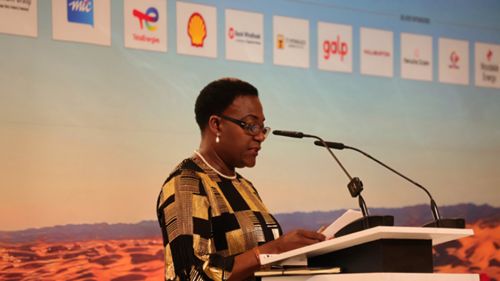
The policy, announced on August 19 by Kornelia Shilunga, Special Advisor and Head of Namibia’s Upstream Petroleum Unit, comes as the country prepares for potentially transformative investments in the Orange Basin. Among the most advanced projects is TotalEnergies’ Venus development, which could produce about 150,000 barrels of oil per day at peak and is targeting first oil in late 2029 or early 2030. The policy will focus on local procurement, employment, skills development, technology transfer and greater participation by Namibian companies across the petroleum value chain. The government’s stated approach is not simply to reserve contracts for domestic firms, but to help them build the technical and financial capacity required to compete for work as the industry develops.
That distinction is important because the largest economic opportunity from Namibia’s offshore discoveries may extend well beyond crude production. Major oil developments require engineering, fabrication, logistics, marine services, construction, maintenance, catering, transportation, equipment supply and other specialised services. The extent to which Namibian companies can participate in those activities will influence the wider economic impact of the petroleum sector.

The timing of the policy is closely linked to TotalEnergies’ Venus project. The French energy company has said the project is technically ready for a final investment decision, although fiscal discussions with the Namibian government remain part of the process. Once development moves forward, procurement decisions will begin determining which companies capture contracts associated with the project.
Venus is expected to initially target about 750 million barrels of oil equivalent of recoverable resources. At peak production of around 150,000 barrels per day, its development would make Namibia a significant new player in African offshore oil markets. For the government, however, the challenge is to convert resource development into broader industrial capacity. Namibia has historically had a relatively small domestic industrial base, meaning that many specialised goods and services required by the petroleum industry could initially come from foreign companies. Without deliberate investment in skills, financing and supplier capacity, a substantial share of project expenditure could therefore leave the country.
According to officials at the Namibia Oil and Gas Conference, opportunities are emerging in sectors including refining, petrochemicals, gas-to-power, logistics, fabrication, marine services, storage and engineering. The conference, held from August 12 to 14, also focused on technical upskilling, financing and supplier development, including opportunities for Namibian businesses to engage with potential industry partners.
Infrastructure will be another constraint. Walvis Bay and Lüderitz have been identified as potential logistics and service hubs for offshore petroleum activity. Their ability to support a rapidly expanding industry will depend on investment in ports, supply bases, roads, airports and other supporting infrastructure. This could give the local-content policy significance beyond the petroleum sector. If offshore investment encourages improvements in ports and industrial facilities, the resulting infrastructure could also support mining, manufacturing, logistics and regional trade. But that outcome will depend on whether infrastructure planning is coordinated with broader national development priorities rather than designed exclusively around individual petroleum projects.
The policy also comes as Namibia reviews its petroleum legal and fiscal framework. The government faces the difficult task of balancing investor requirements with demands for public revenue and domestic economic participation. Excessively restrictive local-content requirements could increase project costs or delay procurement, while weak requirements could limit the industry’s contribution to domestic enterprise development. The issue has wider relevance across Africa, where oil and gas discoveries have frequently generated substantial expectations around employment and industrialisation. In many cases, however, specialised technical requirements, limited local financing and insufficient supplier capacity have meant that international contractors capture a large share of high-value procurement.
Namibia’s approach therefore places capability development at the centre of its strategy. The emphasis on technology transfer and skills could help domestic firms move from low-value support services into more technically demanding segments of the petroleum supply chain. That transition would require sustained training, access to finance and partnerships between international operators and local businesses.

The potential petroleum pipeline is also expanding. TotalEnergies has received government approval to become operator of the Mopane discovery after agreeing to acquire a 40% interest from Galp. If developed, Mopane could add another major offshore project to Namibia’s emerging oil industry and increase the scale of procurement opportunities available to domestic suppliers.
For Namibia, this raises the stakes of implementation. A local-content policy can establish the framework for participation, but the economic outcome will depend on how targets are translated into enforceable procurement requirements, supplier-development programmes, financing mechanisms and measurable skills-transfer commitments.
The Venus project may consequently become an early test of whether Namibia can use its offshore resources to build capabilities onshore. The country is moving closer to a new phase of petroleum development, but the more consequential question for its economy will be how much of the value created offshore can be retained, invested and multiplied within Namibia.


