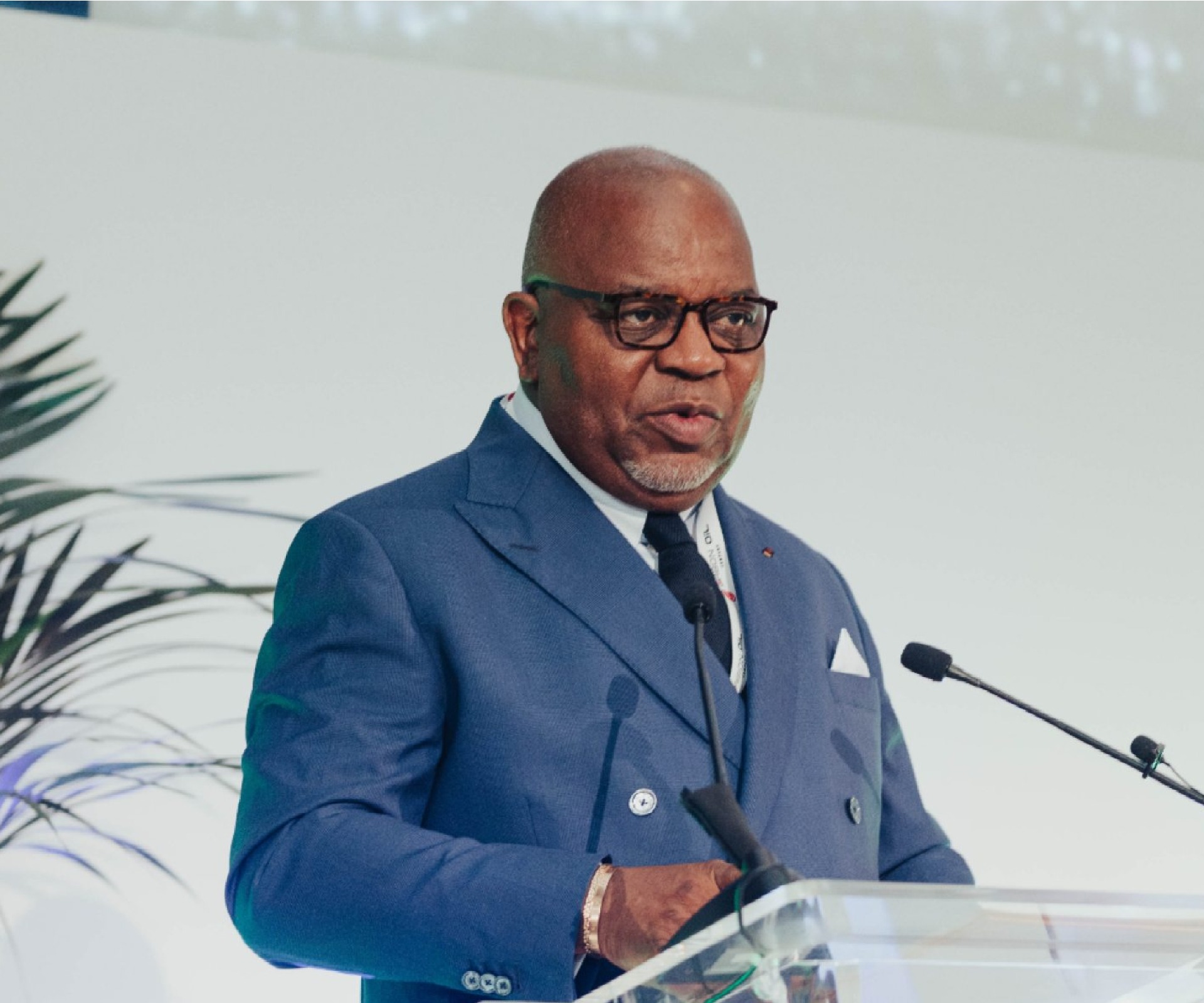

The Republic of Congo began exporting liquefied natural gas from the second phase of its Congo LNG project in early February 2026, lifting national liquefaction capacity to 3 million tonnes per annum, as Hydrocarbons Minister Bruno Jean-Richard Itoua prepares to engage investors at the Invest in African Energy Forum in Paris in April.
The expansion, operated by Italy’s Eni, was commissioned ahead of schedule through the new Nguya floating liquefied natural gas (FLNG) facility, marking a significant step in Congo’s strategy to monetise offshore gas resources and strengthen its export revenues.
Phase 2 adds to output from the earlier Tango FLNG unit and draws gas from the Nené and Litchendjili fields under the Marine XII licence. The project reached first exports roughly 35 months after construction began, underscoring an accelerated execution timeline at a time when global LNG markets remain structurally tight. According to industry data, European buyers continue to diversify supply sources following disruptions to Russian pipeline gas, creating space for new African exporters to enter or scale up in international markets.
Read also: Sustainability and energy investments in the Republic of Congo in 2025
For Congo, a long-established oil producer but historically a marginal gas exporter, the increase in liquefaction capacity alters the structure of its hydrocarbon sector. Gas monetisation offers a route to stabilise fiscal receipts in an environment of oil price volatility.
Hydrocarbons account for the majority of government revenues and export earnings, making the timing and pricing of new LNG volumes consequential for public finances. While LNG revenues are subject to international price swings, long-term offtake agreements can improve revenue predictability compared with spot crude sales.
The expansion also carries implications for domestic infrastructure and institutional capacity. Floating LNG technology enables offshore gas processing without extensive onshore terminals, reducing lead times and upfront capital intensity. However, it requires regulatory clarity, maritime logistics, and skilled labour.
According to officials in Brazzaville, a revised gas code is nearing adoption, aimed at streamlining fiscal terms and clarifying investment rules for upstream and midstream operators. Such reforms are central to sustaining investor interest beyond initial flagship projects.
International companies continue to position themselves in Congo’s upstream sector. TotalEnergies recently secured the Nzombo exploration permit with a one-well drilling programme, while Perenco is redeveloping the Kombi-Likalala-Libondo II offshore field to extend production and increase gas recovery. These developments suggest that LNG infrastructure is reshaping the commercial logic of mature oil assets by creating additional pathways for associated gas that might otherwise remain underutilised.
Read also: Madagascar cancels 21 oil permits and 21 production-sharing contracts in Hydrocarbon overhaul
Congo’s LNG expansion reflects a broader pattern across sub-Saharan Africa, where countries including Mozambique, Nigeria and Senegal are pursuing export-oriented gas strategies. For African governments, gas projects are increasingly framed not only as energy transition assets but as instruments of macroeconomic management, capable of supporting foreign exchange reserves, debt servicing and infrastructure financing.
According to the International Monetary Fund, several hydrocarbon-dependent African economies face elevated debt vulnerabilities, intensifying the importance of stable export earnings.
The longer-term context is complex. European climate policy and the global push toward decarbonisation introduce uncertainty around long-lived fossil fuel investments. While LNG is often positioned as a transition fuel, demand trajectories beyond the 2030s remain debated.
For Congo, this creates a window in which rapid execution and early revenue capture may be financially prudent, but it also underscores the need to translate gas income into diversified economic assets.
Minister Itoua’s forthcoming participation in the Paris energy forum is expected to focus on investment opportunities in gas, marginal fields and exploration. The discussions take place against the backdrop of Congo’s effort to reposition itself within global energy supply chains while strengthening regulatory frameworks at home.
For a country of just over five million people, the move from modest oil producer to scaled LNG exporter represents more than an industrial milestone. Its significance will ultimately be measured not by cargo volumes alone, but by how effectively gas revenues are integrated into fiscal planning, infrastructure development and broader economic resilience in an increasingly uncertain global energy landscape.
Engage with us on LinkedIn: Africa Sustainability Matters