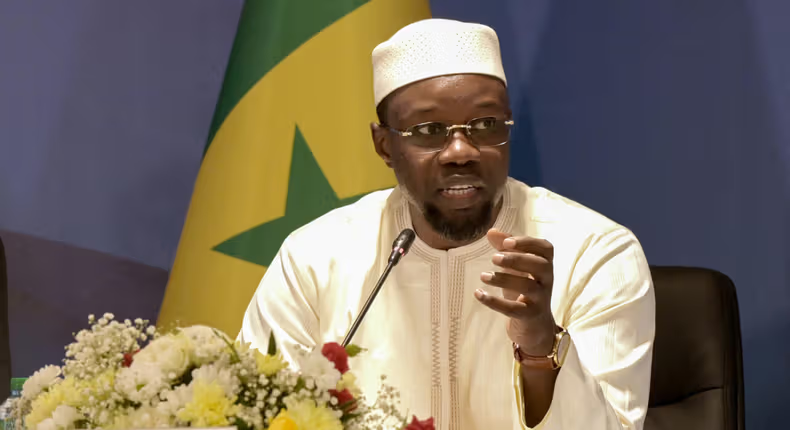

Senegal has revoked 71 mining and quarry licences, frozen the bank accounts of a major industrial operator and launched a broader audit of extractive and energy contracts, in what the country’s Prime Minister Ousmane Sonko described as a push to correct “unfair” agreements and recover hundreds of millions of dollars owed to the state, marking one of the most far-reaching resource sector overhauls in West Africa to date.
The measures, announced in Dakar in mid-March, include the cancellation of dozens of permits across the mining sector and the freezing of accounts linked to Industries Chimiques du Sénégal (ICS), a phosphate producer controlled by Singapore-based Indorama, until it settles an estimated €380 million ($438 million) in outstanding payments.
According to the government, the actions follow findings of non-compliance with fiscal and regulatory obligations, including unpaid taxes and royalties.
The crackdown extends beyond mining. Authorities have also initiated a review of hydrocarbons agreements, including the Greater Tortue Ahmeyim gas project operated by BP, which Senegal shares with Mauritania. Sonko said the contract underpinning the offshore development was “unfair” and would be subject to renegotiation.
According to Reuters, a government assessment concluded that the terms were economically imbalanced, prompting calls to secure better returns for the state and reduce gas costs for domestic industries and households.
The reforms come as Senegal faces mounting fiscal strain. According to the International Monetary Fund, the country’s public debt reached 132% of gross domestic product at the end of 2024, following the discovery of previously misreported liabilities during a government audit. The Fund subsequently suspended its lending programme, increasing pressure on the authorities to mobilise domestic revenues and restore fiscal credibility.
Within this context, the extractive sector has become a central focus of policy. According to the Extractive Industries Transparency Initiative, mining, hydrocarbons and quarrying accounted for 31.89% of Senegal’s exports and 4.7% of GDP in 2023, highlighting both the sector’s economic importance and the stakes involved in renegotiating its governance framework.
Officials have linked the current measures to a broader effort to address revenue leakages and cost inefficiencies. The government has cited evidence of overpricing in infrastructure contracts by an average of 15%, alongside gaps in royalty and tax payments within the extractive industries.
In parallel, authorities have announced plans to close 19 public agencies as part of a wider attempt to contain expenditure amid rising fiscal pressures, which have already contributed to labour unrest in the education sector and delays in student support payments.
Senegal’s actions reflect a wider shift across Africa, where governments are increasingly reassessing long-term resource agreements signed under earlier investment cycles. Niger has revoked mining licences over compliance concerns, while countries such as Ghana and Zambia have tightened regulatory frameworks to capture a larger share of resource rents.
In West Africa in particular, recent interventions in Guinea and Mali have included permit withdrawals, contract reviews and efforts to expand state participation in strategic assets.

This trend, often characterised as a resurgence of resource nationalism, is being driven by a combination of fiscal constraints, rising domestic expectations and intensifying global competition for critical minerals and energy resources.
For African economies, where extractive industries underpin export earnings and public revenues, the recalibration of contract terms is increasingly seen as a mechanism to stabilise public finances and strengthen economic sovereignty.
However, the approach carries legal and financial risks. Disputes over contract changes can lead to international arbitration and compensation claims, potentially offsetting short-term fiscal gains.
Investor sentiment may also be affected if regulatory changes are perceived as abrupt or lacking transparency, particularly in sectors that require long-term capital commitments such as mining and offshore gas.
Read also: Malawi to host Africa’s 5th regional conference on climate loss and damage
In Senegal, several foreign operators remain active across gold, phosphates and mineral sands, and the extent to which the current measures reshape the investment landscape will depend on their implementation and the clarity of the revised legal framework. Sonko has indicated that the audit and renegotiation process will continue throughout his term, covering mining, energy and infrastructure contracts.
The outcome of these reforms will influence not only fiscal balances and energy costs, but also the credibility of regulatory institutions and the pace at which resource wealth is translated into broader economic development.
Engage with us on LinkedIn: Africa Sustainability Matters