


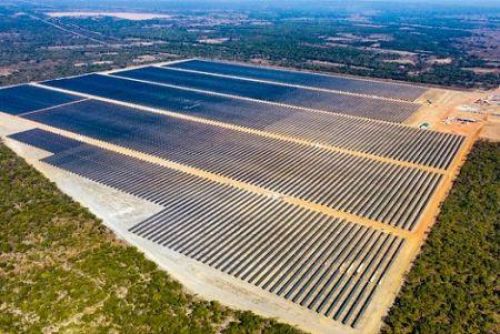
Solarcentury Africa has increased the operational capacity of its Mailo solar power plant in Zambia to 59.5 megawatts-peak (MWp), adding 34.5 MWp of generation capacity as the company expands its presence in a market seeking to diversify electricity supplies and attract private investment in renewable energy.
The second phase, known as Mailo 2, entered full commercial operation on 20 October 2026 after construction and grid-compliance testing were completed. Located in Chitambo District, the project was delivered in less than 12 months by Namibian engineering and construction company Alensy Energy Solutions. Standard Bank South Africa arranged debt financing, while Solarcentury Africa’s parent company, BB Energy, provided equity investment.
The expansion builds on Mailo’s first 25 MWp phase, which began operating in July 2025. The overall development is planned to reach 118 MWp when all phases are completed, forming part of Solarcentury Africa’s wider ambition to establish a 350 MW solar portfolio in Zambia. Mailo’s commercial structure distinguishes it from many conventional utility-scale renewable energy projects. Rather than depending exclusively on a long-term power purchase agreement with the national utility, the plant operates on a merchant basis, selling electricity to industrial customers and through the Southern African Power Pool (SAPP), the regional electricity market serving participating countries in Southern Africa.

This model gives the developer flexibility to sell electricity to eligible buyers and traders through market arrangements, but it also exposes revenues to changing electricity prices, demand and trading conditions. Unlike a long-term contract that establishes an agreed framework for selling power, merchant generation requires developers to manage greater uncertainty over future revenue.
Solarcentury Africa has described Mailo as the first dedicated merchant solar plant to trade electricity through SAPP. The arrangement creates an alternative route to market for private renewable energy developers, allowing them to participate in regional electricity trading rather than relying solely on bilateral contracts with a national utility.
For industrial customers, additional solar generation can broaden the range of electricity sources available to businesses whose operations depend on reliable power. The commercial value of that supply will depend on the prices offered, the timing of generation, transmission availability and the terms under which electricity is purchased and delivered.
The Southern African Power Pool provides a framework for electricity trading between participating utilities and eligible market participants. Regional trade can help connect areas with surplus generation to markets experiencing shortages, although its effectiveness depends on transmission capacity, interconnector availability, trading rules and the supply available at any given time.
Mailo’s expansion comes as Zambia continues to diversify its electricity mix following severe power shortages associated with drought and reduced hydropower generation in 2024. The country’s dependence on hydroelectricity has exposed its power system to changes in rainfall and reservoir levels, while demand from households, mines and other industries has increased the importance of developing additional generation capacity.
The Zambian government has been pursuing new solar projects and other generation investments to improve supply resilience. Solar power offers a way to diversify the electricity mix and reduce dependence on hydrological conditions. However, solar output varies with sunlight and cannot alone provide the continuous supply required by many industrial operations. Its contribution to energy security will depend on how it is integrated with other generation sources, storage, transmission infrastructure and regional electricity trading.
Mailo’s merchant structure is one approach to attracting investment in that environment. Financing from Standard Bank South Africa, combined with equity from BB Energy, supported the second phase without making a long-term utility purchase agreement the sole route to market. The arrangement demonstrates how commercial lenders and parent-company investment can support renewable generation where developers are prepared to take on market exposure.
The project also highlights the importance of construction speed. Delivering the 34.5 MWp expansion in under 12 months demonstrates the potential for relatively rapid deployment of utility-scale solar infrastructure when financing, engineering, procurement and grid integration progress in coordination. The speed of construction, however, is only one measure of project performance; the plant’s long-term output, operating costs and revenue stability will determine its contribution to the electricity market.
Solarcentury Africa is pursuing a second model through its involvement in the 56 MWp Kafue Solar Project, developed by independent power producer Globeleq in Lusaka Province. Solarcentury Africa and Alensy Energy Solutions have been appointed as the project’s engineering, procurement and construction contractors, while Solarcentury also acted as a technical development partner.
Unlike Mailo, Kafue will sell electricity to Zambia’s state-owned utility ZESCO under a 25-year power purchase agreement. The project has reached financial close and is being developed through the GET FiT Zambia programme, which supports private investment in renewable energy generation. Its long-term financing was provided by Dutch development bank FMO and British International Investment, which committed a combined US$52.1 million. The Norwegian Agency for Development Cooperation is supporting key grid infrastructure upgrades associated with the project.
Kafue is designed to provide 40 MW of alternating-current capacity, equivalent to 56 MWp of installed solar photovoltaic capacity. It is expected to begin supplying electricity in 2027, with the project developers targeting the third quarter of the year. The long-term contract with ZESCO provides a defined buyer and a revenue framework that can help lenders assess the project’s ability to repay debt.
The contrast between the two projects illustrates the range of financing and commercial structures available to renewable energy developers. Mailo’s merchant model depends on market access and the ability to sell electricity competitively, while Kafue’s utility-backed arrangement provides a contractual route to market over a defined period. Neither structure removes all risk: merchant projects face price and demand uncertainty, while contracted projects depend on the terms of the power purchase agreement, buyer creditworthiness and the reliability of grid infrastructure.

For Zambia, attracting both types of investment could broaden the pool of capital available for new generation. Long-term power purchase agreements can help make projects bankable, while merchant models may offer additional flexibility for developers and industrial customers. The effectiveness of either approach will depend on transparent market rules, adequate transmission capacity and the ability of electricity buyers to meet their contractual obligations.
The expansion of Mailo also raises questions about how Zambia will accommodate growing volumes of solar generation. As more projects enter service, grid operators must manage variations in output and balance supply with demand. Investments in transmission, interconnections, storage and flexible generation will become increasingly important if new capacity is to translate into reliable electricity for homes, businesses and mines.
For Solarcentury Africa, Mailo 2 advances its presence in Zambia while providing a demonstration of the merchant model at utility scale. The company’s broader 350 MW portfolio ambition will depend on completing further projects, securing financing and maintaining viable routes to market. For Zambia, the more significant test will be whether new solar capacity contributes to a more resilient electricity system and helps meet demand without creating additional constraints on the grid.
The two projects show that Zambia’s renewable energy expansion is not only a question of installing solar panels. It also depends on how electricity is financed, sold, transmitted and integrated into the regional power system. The long-term value of the new capacity will be measured by the electricity it reliably delivers and the extent to which the market can absorb it at competitive prices.


