


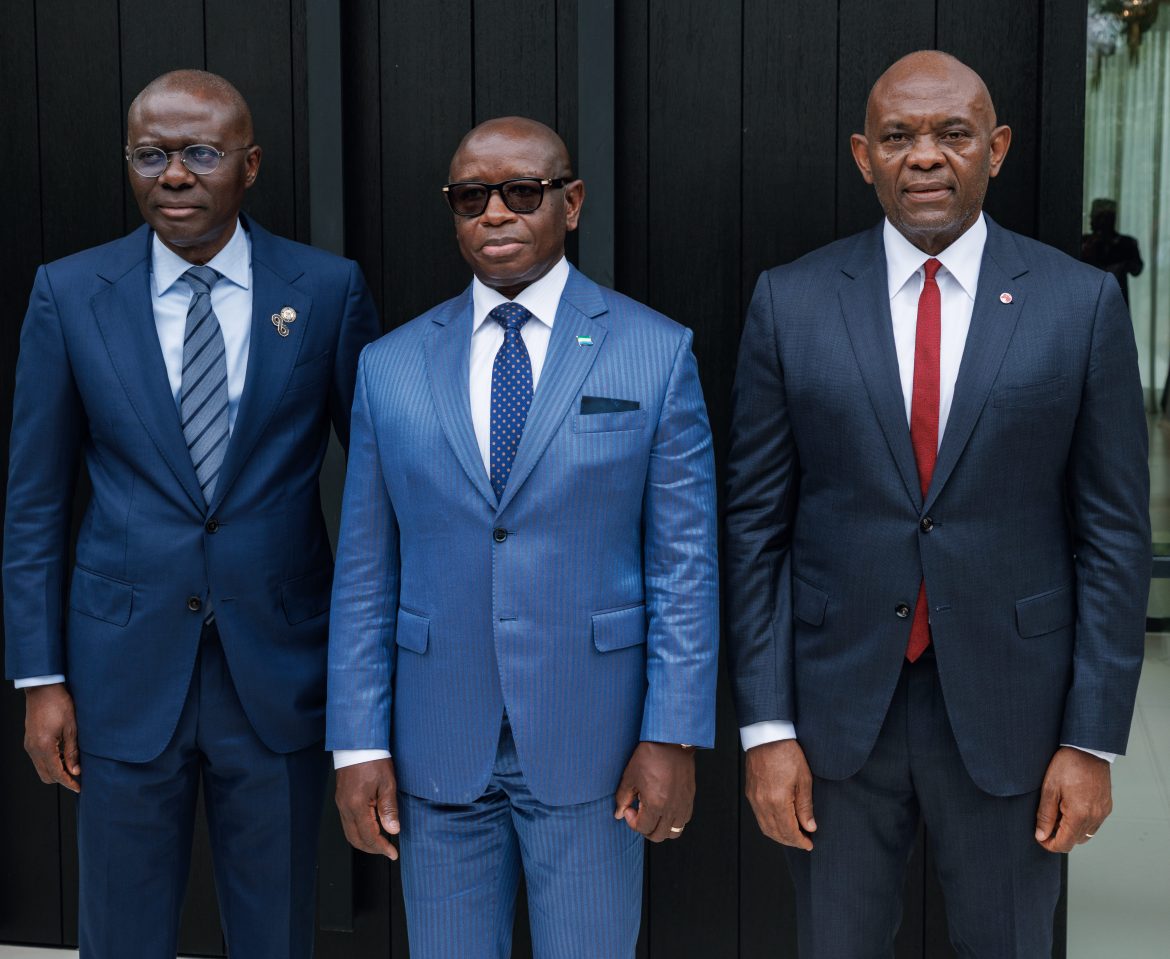
West Africa is seeking to move regional integration from political commitments to investable projects as governments and private-sector leaders intensify efforts to mobilise capital across energy, strategic minerals, agribusiness and digital transformation. Sierra Leone President Julius Maada Bio and Heirs Holdings Chairman Tony O. Elumelu have called on businesses and financial institutions to take a more active role in converting the region’s economic potential into industries, jobs and cross-border value chains.
The call came as President Bio hosted Elumelu in Lagos ahead of the inaugural West Africa Integration and Investment Summit (WAIIS), where leading business executives and financial institutions convened for the first physical meeting of the WAIIS Private Sector Advisory Board. The engagement placed private capital at the centre of preparations for a summit designed to connect governments, investors, development finance institutions and businesses around regional investment opportunities.
WAIIS is scheduled for November 17–18, 2026, at the Julius Maada Bio International Conference Centre in Lungi, Sierra Leone. The organisers describe the summit as an investment and deal-making platform focused on four strategic areas: energy trade and industrialisation, strategic minerals, agribusiness, and digital transformation. The summit is expected to bring together more than 1,000 high-level participants, including heads of state and government, development finance institutions, sovereign wealth and pension funds, investors, multilateral development banks and business leaders.
For West Africa, the emphasis on investment reflects a longstanding challenge in translating regional market integration into productive economic activity. The region has a combined market of more than 450 million people and a combined GDP exceeding $600 billion, according to WAIIS organisers. Yet the ability to capture the benefits of that scale depends on infrastructure, policy coordination, access to finance, cross-border trade and the development of industries capable of serving markets beyond individual national economies.
President Bio has positioned WAIIS around that implementation challenge. Addressing the Private Sector Advisory Board, he argued that the region’s natural resources, markets and entrepreneurial capacity would only generate broader prosperity if they were converted into productive enterprises, competitive industries, regional value chains, jobs and wealth. He called on board members to act as partners in execution by connecting ideas with partnerships, investment and commercially viable projects.
The emphasis on execution follows several months of technical and policy preparation. According to Sierra Leone’s State House, more than 100 experts, ministers, senior government officials, development institutions and private-sector actors participated in preparations that produced the Freetown Communiqué. The process identified practical recommendations, priority investment pipelines and policy reforms intended to inform the main WAIIS summit.
Energy trade and industrialisation are particularly important to the agenda because electricity costs, supply constraints and fragmented infrastructure continue to affect the competitiveness of African businesses. A more integrated regional energy market could allow countries to trade electricity more efficiently while supporting industrial facilities that require more reliable and affordable power. The focus also aligns with Sierra Leone’s own push to expand energy access and attract private investment into the power sector.
Strategic minerals provide another avenue for regional investment, particularly as global demand for minerals used in energy technologies and advanced manufacturing increases. For West Africa, the investment question extends beyond extraction. Building processing capacity, transport infrastructure and industrial linkages within the region could determine how much economic value remains in producing countries rather than being captured further down international supply chains.
Agribusiness presents a similar opportunity. The region has substantial agricultural production and a large domestic consumer market, but weak storage, logistics, processing and market connectivity can limit the value captured by farmers and businesses. Regional investment in processing and distribution could strengthen food systems while creating opportunities for manufacturing, logistics, financial services and digital platforms connected to agriculture.
Digital transformation is the fourth pillar, reflecting the growing importance of digital infrastructure and services to regional commerce. Cross-border digital payments, e-commerce, business platforms and data-driven services could reduce transaction costs and make it easier for smaller companies to reach customers and suppliers beyond their home markets. However, the scale of those opportunities will depend on regulatory coordination, infrastructure and the ability of businesses to operate across multiple jurisdictions.
Elumelu has argued that African businesses need to look beyond national borders and combine capital, expertise and capabilities to build enterprises that can compete at scale. His position reflects his long-standing Africapitalism philosophy, which places private-sector investment and entrepreneurship at the centre of Africa’s economic transformation. At the WAIIS engagement, he reaffirmed support for mobilising African and international investment alongside institutions including the Africa Finance Corporation, Afreximbank, United Bank for Africa and Ecobank.
The participation of major financial institutions will be important because many of the projects required for deeper regional integration are capital-intensive and involve long development periods. Energy infrastructure, industrial plants, mineral processing facilities, agricultural value chains and digital infrastructure can require significant upfront financing before generating returns. Blending commercial capital with development finance, guarantees and other risk-mitigation instruments could therefore become an important part of converting identified opportunities into bankable transactions.
The private sector, however, cannot resolve the investment gap alone. Elumelu has stressed the need for governments to provide policy certainty, regulatory efficiency and security so that investors can commit capital over longer periods. Lagos State Governor Babajide Sanwo-Olu similarly highlighted industrialisation and the free movement of goods and services as essential elements of a functioning regional market, arguing that political leaders must create the conditions for businesses to invest, produce and trade across borders.
The implementation challenge is particularly relevant as the summit approaches. President Bio has called on the Private Sector Advisory Board to move beyond advocacy by engaging prospective investors, matching them with viable projects and identifying financing gaps and policy decisions that could prevent transactions from moving forward. This shifts the role of the summit from a conventional policy gathering towards a platform for investment preparation and transaction development.
The approach is consistent with earlier WAIIS planning work. Sierra Leone’s State House has said the summit is being designed to generate a pipeline of bankable regional projects and facilitate public-private collaboration rather than operate solely as a forum for dialogue. ECOWAS has also formally approved the convening of WAIIS, with the initiative expected to work with the ECOWAS Business Council to advance private-sector-led investment and regional economic integration.
The composition of the Private Sector Advisory Board reflects the breadth of capital and expertise being brought into the process. Its members include leaders from banking, infrastructure finance, energy, mining, manufacturing, telecommunications and investment, creating a platform that spans both project development and capital mobilisation.
The immediate test for WAIIS will therefore be whether the November summit can translate its four strategic pillars into identifiable transactions with sponsors, financing structures, policy requirements and implementation timelines. For West Africa, the economic significance lies not simply in the size of its market, but in whether regional integration can reduce the cost of moving capital, goods, energy, data and skills across borders.
If the process succeeds in connecting investors with bankable projects, it could strengthen the foundations for regional value chains and provide businesses with larger markets in which to operate. But achieving that outcome will depend on sustained policy coordination, infrastructure investment and private-sector participation beyond the summit itself. The central question for WAIIS is therefore increasingly practical: how quickly can West Africa convert regional economic ambition into projects that can attract capital, create productive capacity and deliver jobs across borders?


