


The Democratic Republic of Congo is confronting a rapidly escalating Ebola outbreak that has triggered international concern after health authorities confirmed dozens of infections linked to the rare Bundibugyo strain of the virus in the eastern provinces of Ituri and North Kivu. The World Health Organization has declared the outbreak a public health emergency of international concern, warning that the scale and speed of transmission, combined with insecurity and weak healthcare infrastructure, could complicate containment efforts across the Great Lakes region.
At Rwampara General Hospital in Eastern Congo, healthcare workers dressed in protective equipment moved bodies into sealed and disinfected coffins as families mourned relatives who succumbed to the disease after experiencing severe symptoms including vomiting, diarrhoea, internal bleeding, and acute fever. Medical officials say the outbreak initially circulated undetected after early laboratory tests focused on more common Ebola strains and returned negative results, delaying identification of the Bundibugyo variant.
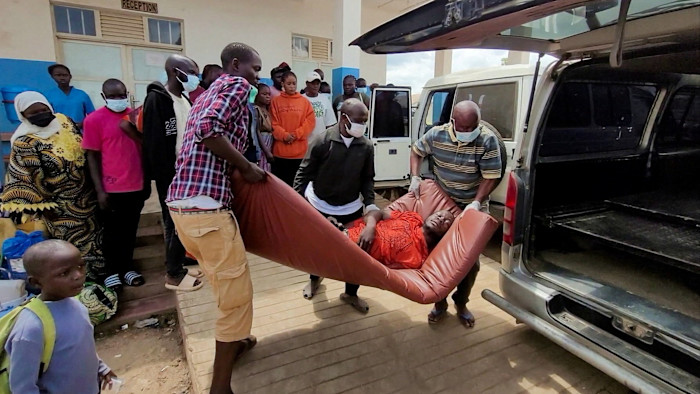
According to the World Health Organization, 51 confirmed cases have been recorded in Congo alongside two confirmed infections in neighbouring Uganda. Congolese health authorities have also reported 139 suspected deaths and nearly 600 suspected infections, although humanitarian agencies warn the true number may be significantly higher due to limited surveillance capacity and ongoing insecurity in affected areas.
The outbreak marks Congo’s 17th Ebola epidemic, but health experts say the current strain presents distinct operational challenges. Unlike the Zaire strain, which has been the focus of previous vaccination campaigns, there is currently no approved vaccine or targeted treatment for the Bundibugyo variant. Containment efforts are therefore relying heavily on rapid detection, isolation, contact tracing, and infection prevention measures within communities and health facilities.
Medical teams working in Ituri province say hospitals remain under pressure as new suspected cases continue to emerge. At Rwampara General Hospital, emergency treatment tents are being prepared to isolate patients and reduce transmission risks within overcrowded healthcare facilities. However, health workers warn that the virus is spreading across multiple localities faster than response systems can fully contain it.
The outbreak is unfolding within one of Africa’s most fragile security environments. Eastern Congo continues to experience violence linked to multiple armed groups, including CODECO militias and the Allied Democratic Forces (ADF), complicating humanitarian access and limiting the movement of healthcare teams. Population displacement, porous borders, and regional trade flows have further heightened the risk of cross-border transmission into neighbouring East African states.
According to public health specialists, the outbreak underscores the growing intersection between health security, conflict, and economic resilience in African development planning. Epidemics of this scale place immediate strain on already constrained public finances while disrupting agriculture, trade, education, and labour productivity across affected communities.
The economic implications are particularly significant for Eastern Congo, where livelihoods depend heavily on informal trade, small-scale agriculture, and mining activities. Restrictions on movement, border screenings, and fears surrounding transmission risks could affect regional supply chains and local market activity, particularly along trade corridors linking Congo with Uganda, Rwanda, and South Sudan.
Health emergencies also carry long-term institutional consequences. Analysts note that repeated outbreaks in conflict-affected regions expose structural weaknesses in healthcare financing, disease surveillance systems, and emergency preparedness capacity across parts of the continent. While African governments and regional health agencies have improved epidemic response systems since the West African Ebola crisis of 2014–2016, uneven investment in healthcare infrastructure continues to affect response speed and coordination.
The current outbreak has also renewed scrutiny over international health financing and vaccine research priorities. Public health experts say diseases concentrated in lower-income countries frequently receive less sustained investment in vaccine development and treatment research until outbreaks escalate into wider global threats. The absence of a vaccine for the Bundibugyo strain has highlighted ongoing disparities in global preparedness for emerging infectious diseases affecting African populations.

For communities in Eastern Congo, however, the crisis remains deeply immediate. Families continue to navigate fear, grief, and uncertainty as health workers search for infected individuals and attempt to break chains of transmission in densely populated and insecure areas. According to local medical officials, the outbreak is not yet under control, with active detection efforts continuing across hospitals and surrounding communities.
The resurgence of Ebola in Eastern Congo reinforces how public health emergencies remain closely tied to broader questions of governance, infrastructure, and resilience across African economies. As governments increasingly position healthcare systems as central components of sustainable development strategies, the ability to contain outbreaks quickly and maintain public trust may prove as important to long-term stability as investment in physical infrastructure or economic growth itself.


