



Climate and agricultural stakeholders in Kenya are urging the government to accelerate the development of regulations governing carbon credit trading and methane financing, warning that policy delays are slowing investments in waste recycling, renewable energy and agricultural climate mitigation projects at a time when global demand for verified carbon reductions is expanding rapidly.
The calls emerged during a Parliament-Media Breakfast Dialogue on Methane Emissions held at Parliament Buildings in Nairobi ahead of next week’s Inter-Parliamentary Union Regional Seminar on Methane and Climate Action, which is expected to bring together lawmakers and climate experts from across Africa to discuss methane mitigation policies and climate financing frameworks.
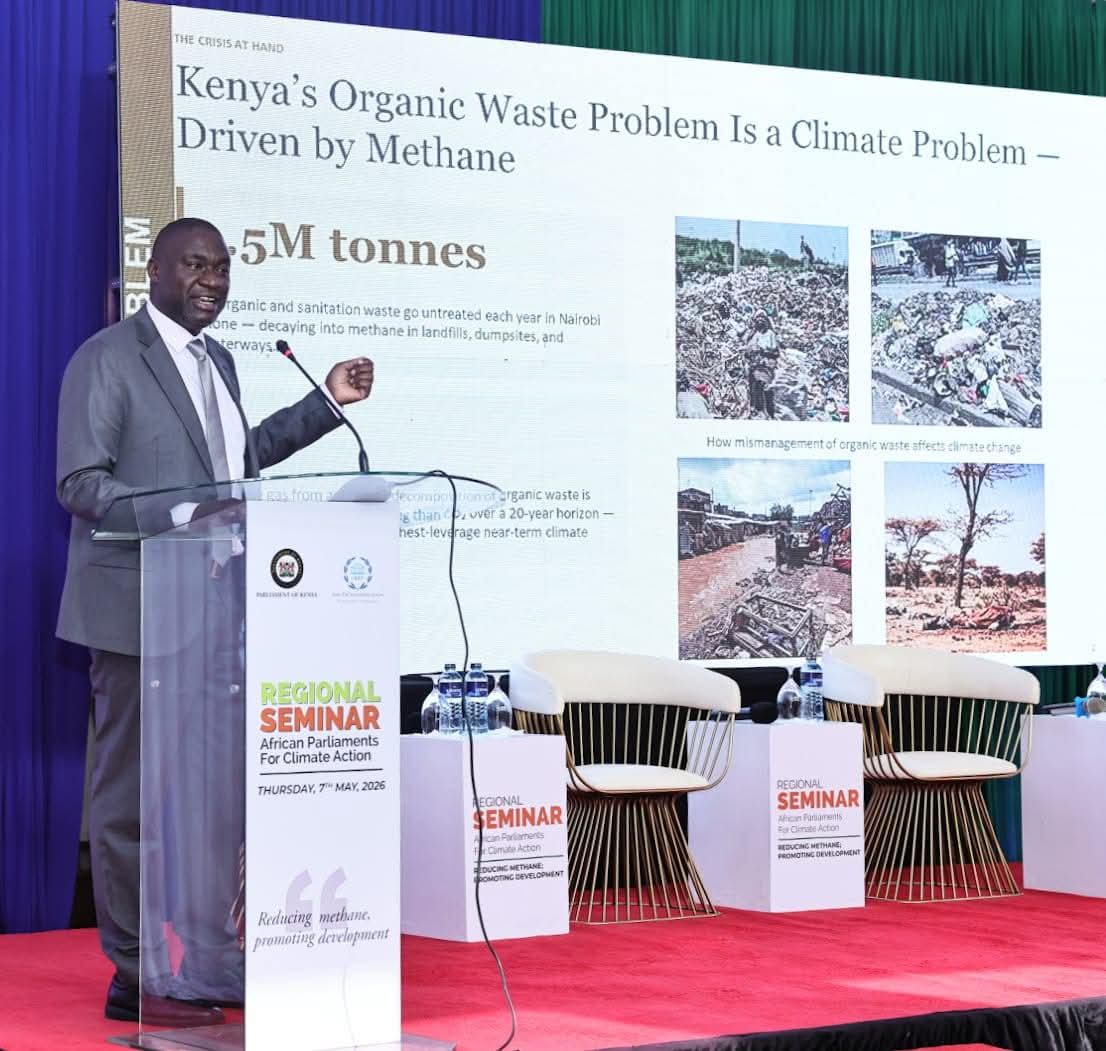
Michael Lwoyelo, Managing Director of Regen Organics, said Kenya risks missing a major opportunity to position itself as a regional leader in carbon markets and circular economy investments unless the government establishes clear systems for approving and recognising carbon credit projects.
“Our ask is that government quickly starts recognizing and approving carbon credits from companies like ourselves,”
Lwoyelo said, arguing that businesses already implementing methane reduction initiatives continue to face uncertainty due to the absence of structured regulatory support.
He noted that Kenya generates approximately 22,000 tonnes of waste daily, nearly 60% of it organic material that decomposes in open dumpsites and produces methane, a greenhouse gas considered significantly more potent than carbon dioxide over shorter time horizons. According to Lwoyelo, poor waste management should increasingly be viewed not only as a sanitation issue, but also as a climate and economic challenge.
“When you walk around Nairobi and see waste dumped on streets and in dumpsites, it is not just a cleanliness problem. It is actually a climate problem,” he said.
Regen Organics currently processes close to 50,000 tonnes of organic waste annually, converting it into animal feed proteins, organic fertilizer and biochar while reducing methane emissions from decomposing waste streams. Lwoyelo argued that carbon credits remain one of the few scalable financing tools available for climate mitigation projects in developing economies, particularly in sectors such as waste management, renewable energy and sustainable agriculture.
He added that stronger government-backed approval systems could help local firms participate more effectively in intergovernmental carbon trading mechanisms while unlocking additional private investment into climate-related industries.
The debate reflects broader efforts across Africa to expand participation in carbon markets as governments seek alternative financing mechanisms to meet climate commitments while supporting economic growth. Analysts note that carbon finance has increasingly become a strategic issue for African economies seeking to leverage natural resources, renewable energy potential and ecosystem restoration projects to attract international investment flows.
International Livestock Research Institute Senior Scientist Claudia Arndt said practical methane mitigation solutions already exist across sectors including livestock production, waste management and agriculture, but scaling these interventions requires stronger institutional systems and measurable reporting frameworks.
“We do have solutions. We do know what works and we do have an idea what works in which systems, but we need to really scale,” Arndt said.
She stressed that accurate measurement systems remain critical both for Kenya’s reporting obligations under its nationally determined contributions and for enabling businesses and farmers to access carbon financing opportunities linked to emissions reductions.“We need to do measurements to actually report on it in our nationally determined contributions and also to leverage carbon credits,” she said.
Arndt cautioned, however, that carbon markets should complement rather than replace economically viable agricultural reforms. “Mitigation strategies need to be profitable by themselves because we do not have carbon markets under control, but they can provide additional income for farmers to improve their production systems,” she said.
According to Arndt, livestock remains Kenya’s largest source of methane emissions, followed by waste and rice farming. She noted that improving livestock feed quality alone could increase milk production by approximately 30% while reducing methane emissions by 15%, while reforms in Kenya’s beef sector could potentially cut methane emissions by up to 50% by 2050 through better breeding, feeding and animal health systems.
United Nations Environment Programme Director of the Industry and Economy Division Sheila Aggarwal-Khan said methane mitigation should be viewed not only as an environmental priority, but also as a source of emerging economic opportunity.“We are seeing methane emissions growing globally and yet affecting agricultural productivity,” she said, highlighting investment potential in organic waste recycling, renewable energy generation, fertilizer production and livestock feed innovation.
Aggarwal-Khan added that reducing methane emissions could help Kenya address rising climate shocks, declining agricultural productivity and public health risks linked to pollution and unmanaged waste.

The discussions also reflected growing pressure within Parliament to establish methane-specific legislation as Kenya seeks to align itself with international climate commitments, including the Global Methane Pledge, which targets a 30% reduction in methane emissions by 2030.
John Mutunga, Chairperson of the Departmental Committee on Livestock and Agriculture, said Kenya has limited time remaining to meet its methane reduction targets and urgently requires policies focused on livestock breeds, feed quality and waste management systems.
“There is need for appropriate regulations, legislation and policies,” Mutunga said. “These legislations should focus on the breed of animals we have, quality of feeds and waste management systems so that we reduce methane emissions.”
Abdullahi Bashir, Chairperson of the Parliamentary Pastoralist Group, said Kenya still lacks legislation specifically targeting methane emissions despite the disproportionate climate vulnerabilities facing pastoralist communities. He also called for climate policies and public participation frameworks tailored to nomadic populations often excluded from mainstream climate policy discussions.
Read also:ICC and Carbon Measures form global carbon accounting panel, raising stakes for African industries
Meanwhile, Mohamed Faki, Chairperson of the Senate Standing Committee on Lands, Environment and Natural Resources, said methane mitigation should be treated as both an environmental and economic priority given its implications for agriculture, food systems and public health.
For Kenya and other African economies, the debate increasingly centres on how climate regulation can evolve from compliance-driven policy into a catalyst for industrial investment, agricultural transformation and green financing. As global carbon markets expand and investors place greater emphasis on measurable emissions reductions, countries able to establish credible regulatory systems may gain a competitive advantage in attracting climate-linked capital.


