


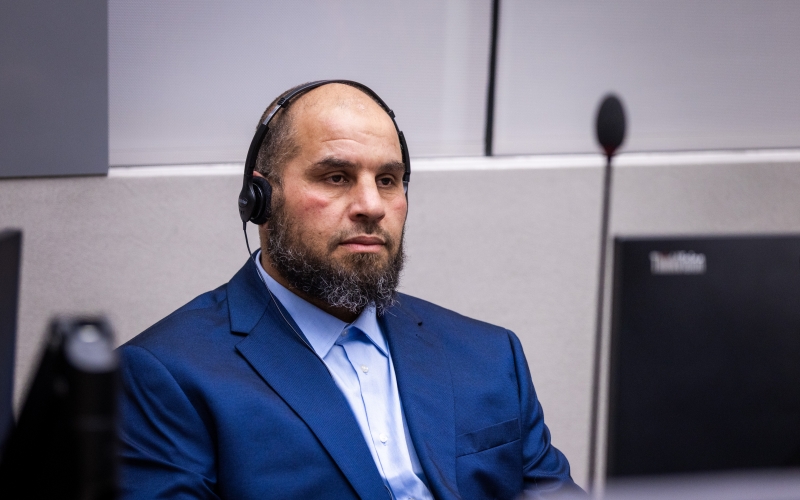
The International Criminal Court (ICC) has opened hearings against former Libyan prison commander Mohammed Ali El Hishri over allegations of crimes against humanity committed at the Mitiga Detention Centre near Tripoli, a case that places renewed international focus on Libya’s migrant detention system and the broader governance vacuum that has shaped human rights abuses since the country’s post-2011 conflict.
Prosecutors allege that El Hishri oversaw systematic violence against migrants and civilians detained at Mitiga prison between 2014 and 2020, including torture, sexual violence, persecution and slavery. According to court filings presented before ICC judges, the former commander exercised extensive authority within the facility, particularly over sections housing women and children, during a period when Libya became a central transit route for migrants attempting to cross the Mediterranean into Europe.
The prosecution argues that Mitiga prison operated through what it described as an “institutionalised system of violence” in which abuse became routine and widespread. Court documents state that thousands of detainees were subjected to physical and psychological violence over several years, with some victims alleging severe beatings, sexual assault and forced labour.
The hearings represent one of the most significant international legal examinations of abuses linked to Libya’s detention infrastructure, which has faced years of criticism from human rights organisations, migration agencies and humanitarian groups. The case also underscores the increasingly complex intersection between migration management, armed conflict and governance failures across North Africa.
Fifty four victims have been authorised to participate in the proceedings, including former detainees now living as refugees in Europe. Among them is South Sudanese refugee Lam Magok, who described enduring years of imprisonment and violence while stranded in Libya during attempts to flee conflict in his home country.
The proceedings are expected to determine whether El Hishri will face a full trial before the court. Legal analysts note that the case could become an important test of international accountability mechanisms related to migrant abuses in conflict-affected transit states.
Libya’s detention system emerged from years of institutional fragmentation following the fall of Muammar Gaddafi in 2011. Rival armed groups, political factions and security actors have since competed for territorial and economic control, creating conditions in which detention centres frequently operated with limited oversight or legal accountability. According to migration experts, detention facilities became deeply intertwined with trafficking networks, extortion systems and irregular migration economies that expanded across the Mediterranean Corridor.
For African countries, the implications extend beyond Libya itself. The country remains one of the main transit points for migrants and refugees from sub-Saharan Africa seeking routes into Europe, particularly people fleeing conflict, economic instability or climate-related pressures in countries including Sudan, Eritrea, South Sudan and parts of West Africa.

International agencies have repeatedly warned that the absence of stable governance structures in Libya has increased vulnerabilities for migrants, exposing them to detention, exploitation and trafficking. The International Organization for Migration and other humanitarian groups have documented overcrowded detention conditions, abuse by armed actors and the proliferation of informal detention networks operating outside formal judicial systems.
The case also reflects broader geopolitical tensions surrounding migration governance between Africa and Europe. European governments have increasingly supported efforts to limit irregular migration flows across the Mediterranean, including cooperation with Libyan authorities and coastal security structures. Critics, however, argue that external migration containment policies have at times failed to address the conditions faced by migrants within detention systems inside Libya.
According to regional analysts, unresolved instability in Libya continues to affect trade corridors, labour migration patterns and security dynamics across North Africa and the Sahel. The persistence of armed groups and fragmented authority structures has complicated efforts to restore institutional governance while undermining investment confidence and economic recovery.
The ICC hearings arrive as several African governments and regional institutions seek stronger international cooperation on migration management and human trafficking. At the same time, legal accountability for abuses against migrants remains uneven, particularly in conflict-affected states where judicial systems are weakened or politically contested.
For many victims participating in the proceedings, the hearings carry significance beyond individual accountability. They represent an attempt to document abuses that occurred within a system shaped by years of political instability, regional migration pressures and weak institutional oversight.
The outcome of the case may ultimately influence how international courts, African governments and multilateral institutions address future accountability efforts linked to migration detention systems and conflict-related abuses. It also reinforces growing scrutiny over how fragile governance environments can allow parallel systems of detention and exploitation to emerge in strategically important transit regions.


