


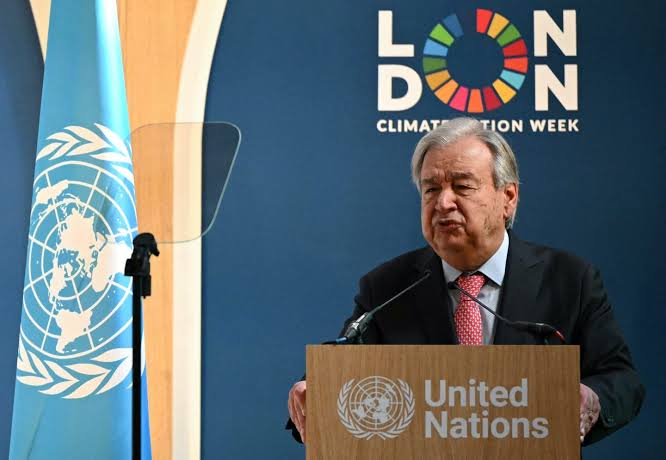
Accompanying the rapid expansion of artificial intelligence infrastructure, the United Nations has launched a global transparency initiative urging AI companies to publicly disclose the environmental footprint of their data centres, warning that unchecked growth in electricity and water consumption could deepen resource pressures in vulnerable regions, including Sub-Saharan Africa. The initiative, announced by UN Secretary-General António Guterres during London Climate Action Week, calls for greater accountability on water use, carbon emissions and land consumption, while encouraging technology companies to transition all AI data centres to renewable energy by 2030.
The move comes as governments, investors and regulators increasingly scrutinise the environmental consequences of artificial intelligence, whose accelerating computational demands are driving an unprecedented expansion of energy-intensive data centres worldwide. According to Guterres, if current trends continue, global data centres could consume more electricity by 2030 than every country except the world’s five largest energy users. He added that projected annual water consumption could equal the amount required to meet the basic needs of the entire population of Sub-Saharan Africa, estimated at approximately 1.3 billion people.
 Speaking at the launch of the UN Artificial Intelligence Environmental Transparency Initiative, Guterres argued that technological innovation must be matched by greater disclosure of environmental impacts. He urged AI developers and operators to measure and publicly report their carbon emissions, freshwater consumption and land-use requirements while committing to renewable electricity across their operations.
According to the United Nations, transparency is intended to strengthen investor confidence, improve regulatory oversight and encourage more sustainable infrastructure planning as artificial intelligence becomes increasingly embedded in global economies.
The initiative arrives at a pivotal moment for Africa, where digital transformation is accelerating alongside expanding investments in cloud computing, data infrastructure and artificial intelligence applications. Several African countries are positioning themselves as emerging digital economy hubs, with new investments in data centres announced across markets including South Africa, Kenya, Nigeria, Morocco and Egypt. While these facilities are expected to strengthen digital connectivity and support economic diversification, they also introduce new demands on electricity networks and water resources that remain under significant pressure.
For African policymakers, the environmental cost of digital infrastructure is becoming an increasingly important governance issue rather than solely a technology discussion. Data centres require continuous electricity supply and extensive cooling systems, making access to reliable power and sustainable water management critical determinants of long-term investment viability. In countries already balancing rapid urbanisation, industrial expansion and climate-related water stress, poorly managed growth in digital infrastructure could intensify competition for scarce natural resources.
According to international energy analysts, electricity demand from data centres is expected to rise sharply over the coming decade as artificial intelligence models become larger and more computationally intensive. This places additional emphasis on renewable energy deployment, grid modernisation and energy efficiency if countries are to accommodate digital economic growth without increasing dependence on fossil fuels or undermining national decarbonisation objectives.
The United Nations argues that renewable energy offers one of the most effective pathways for managing these competing priorities. Guterres reiterated that expanding renewable electricity generation while electrifying transport, industry and buildings remains among the fastest strategies for reducing greenhouse gas emissions and strengthening energy security. He also criticised continued investment in fossil fuels, warning that global climate objectives remain significantly off track.
Alongside the AI transparency initiative, Guterres launched a separate call for stronger action on methane emissions, urging oil and gas producers to eliminate routine flaring, repair methane leaks and adopt internationally recognised scientific standards for emissions management. Methane is estimated to account for roughly one-third of current global warming despite having a much shorter atmospheric lifespan than carbon dioxide, making rapid reductions one of the most cost-effective climate mitigation measures available.
The Secretary-General further announced plans to convene world leaders in September ahead of the 2026 United Nations Climate Change Conference (COP31) in Türkiye to accelerate implementation of commitments supporting a just transition away from fossil fuels.
 For Africa, the convergence of artificial intelligence, renewable energy and environmental governance presents both opportunities and policy challenges. Expanding digital infrastructure can stimulate investment, innovation and employment while supporting sectors ranging from financial services and healthcare to agriculture and manufacturing. However, these benefits will increasingly depend on the availability of resilient energy systems, sustainable water management and transparent environmental reporting that enables governments, investors and communities to understand the true resource implications of digital growth.
The UN initiative therefore signals a broader shift in global sustainability governance, where environmental accountability is becoming an integral component of digital transformation. As African economies continue expanding their participation in the global digital economy, integrating environmental disclosure into technology investment decisions may become increasingly important for attracting responsible capital, protecting natural resources and ensuring that digital development contributes to long-term economic resilience rather than creating new environmental vulnerabilities.


