


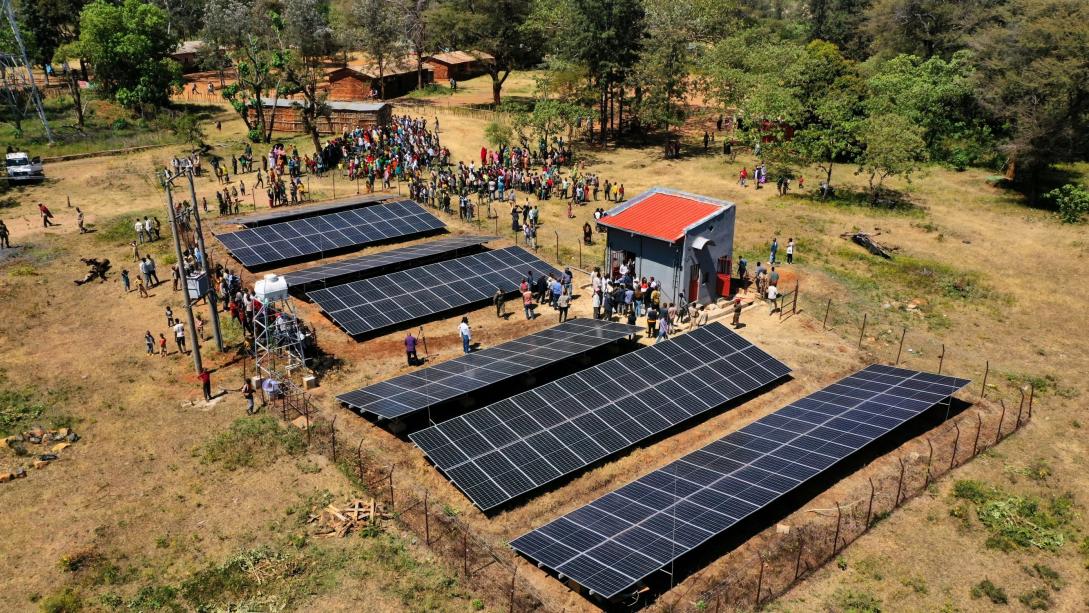
The African Development Bank (AfDB), through its Sustainable Energy Fund for Africa (SEFA), has approved a US$2 million grant to support the development of two renewable energy mini-grid projects in rural Ethiopia, reinforcing efforts to expand electricity access while demonstrating a business model that integrates clean energy with agricultural productivity.
According to a statement issued by the African Development Bank on 29 July, the financing will support RVE.SOL ETH Energy Generation Solutions in developing the Lelicho and Murche renewable mini-grids. The projects are expected to provide electricity to underserved rural communities while simultaneously powering irrigation systems, creating productive demand that improves the commercial viability of decentralized energy infrastructure.
The investment comes as Ethiopia intensifies efforts to close one of Africa’s largest electricity access gaps despite possessing one of the continent’s most abundant renewable energy resources. By combining energy access with agricultural production, the initiative seeks to address two of the country’s most pressing development priorities rural electrification and food security through a single integrated investment model.
Unlike conventional rural electrification projects that rely primarily on household consumption, the Ethiopian initiative is designed around productive energy use. The mini-grids form part of the Distributed Renewable Energy and Agriculture Modalities (DREAM) programme, which promotes a model where agricultural activities, including irrigation and agro-processing, generate consistent electricity demand throughout the year.
According to the African Development Bank, creating reliable commercial demand allows mini-grid operators to generate more stable revenues, improving the financial sustainability of projects that have historically struggled with low electricity consumption in sparsely populated rural communities.
Energy experts increasingly view productive-use models as critical to improving the long-term economics of decentralized renewable energy systems. In many African countries, household electricity demand alone is often insufficient to generate revenues capable of covering operating and maintenance costs. Integrating agriculture, small businesses, water pumping and rural enterprises into mini-grid systems enables operators to diversify income streams while stimulating local economic development.
For Ethiopia, the investment addresses a persistent challenge in the country’s electricity sector.
According to Ethiopia’s National Energy Compact, the national grid has expanded considerably over the past decade, reaching most administrative centres. However, extending electricity connections to remote rural communities remains both technically difficult and financially expensive due to dispersed populations, mountainous terrain and limited infrastructure.
Despite substantial investments in hydropower generation, including the Grand Ethiopian Renaissance Dam (GERD), approximately 60 million Ethiopians still lacked access to electricity in 2025, according to the World Bank. The figures illustrate that expanding electricity generation alone does not automatically translate into universal access unless investments also reach distribution networks and last-mile connections.
The challenge is not unique to Ethiopia.
Across sub-Saharan Africa, more than 570 million people continue to live without access to electricity, making the region home to nearly four-fifths of the global population lacking modern energy services. According to the International Energy Agency (IEA), achieving universal electricity access will require a combination of national grid expansion and decentralized renewable energy systems capable of serving communities located far from existing transmission infrastructure.
The IEA estimates that under its pathway towards universal electricity access by 2035, approximately 55% of all new electricity connections across Africa will come from decentralized solutions, including renewable mini-grids and standalone solar systems, with the remaining connections delivered through grid expansion. These projections highlight the growing importance of decentralized energy technologies within Africa’s broader energy transition.
Mini-grids have increasingly emerged as an attractive solution because they can be deployed more rapidly and at lower cost than extending national transmission networks into isolated communities. Powered by solar photovoltaics, battery storage and, in some cases, hybrid renewable technologies, these systems provide reliable electricity for households, schools, health centres, businesses and agricultural activities while reducing dependence on diesel generators and traditional biomass fuels.
The Ethiopian projects also reflect the African Development Bank’s wider strategy to accelerate distributed renewable energy across the continent.
SEFA has become one of Africa’s leading catalytic financing mechanisms for decentralized energy projects by providing grants, concessional finance and technical assistance aimed at reducing investment risks for private developers. According to the AfDB, the facility supports innovative business models capable of mobilising significantly larger volumes of private capital into renewable energy markets.
Integrating agriculture into rural electrification also supports broader climate resilience objectives.
Agriculture accounts for a significant share of Ethiopia’s economy, employing approximately two-thirds of the labour force and contributing substantially to export earnings. However, the sector remains highly vulnerable to climate variability, prolonged droughts and changing rainfall patterns. Expanding access to renewable-powered irrigation systems can help farmers reduce dependence on increasingly unpredictable rainfall while improving crop productivity and strengthening food security.
According to the Food and Agriculture Organization (FAO), irrigation remains one of the most effective climate adaptation measures available to smallholder farmers across Africa, particularly when combined with renewable energy technologies that reduce operating costs associated with diesel-powered water pumps.
The projects also align with Ethiopia’s broader ambitions to build a low-carbon economy. The country remains one of Africa’s leading renewable energy producers, with hydropower accounting for the overwhelming majority of electricity generation. Authorities are increasingly seeking to diversify the energy mix by expanding solar, wind and decentralized renewable systems capable of complementing large hydropower infrastructure while improving resilience during periods of reduced rainfall.
From an investment perspective, the DREAM programme offers a practical demonstration of how rural electrification projects can become commercially sustainable without relying indefinitely on public subsidies. If successful, the model could be replicated across Ethiopia and other African countries facing similar challenges of low rural electricity demand, dispersed populations and limited fiscal resources.
For Africa, the significance of the investment extends beyond the two mini-grid projects themselves. It illustrates a broader evolution in rural energy planning, where electricity access is increasingly viewed not simply as a social service but as productive infrastructure capable of supporting agriculture, enterprise development, climate adaptation and rural industrialisation simultaneously. As governments and development finance institutions seek cost-effective pathways towards universal energy access, integrated models linking renewable energy with economic activity are likely to become an increasingly important component of Africa’s sustainable development agenda.


