


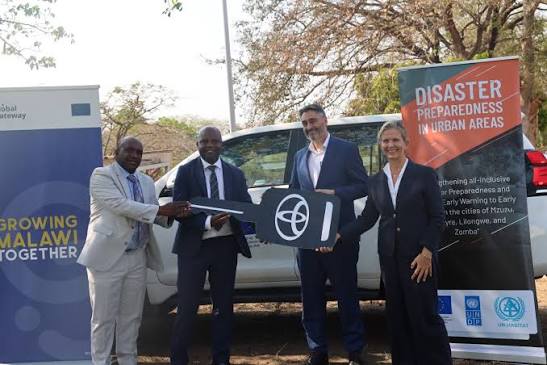
Malawi is strengthening its capacity to turn climate warnings into faster action as it prepares for the 2026/27 rainfall season, with the European Union and United Nations Development Programme (UNDP) providing a field vehicle to the Department of Disaster Management Affairs (DoDMA) to improve assessments, monitoring and emergency coordination. The handover in Lilongwe on 29 September 2026 comes as the country anticipates a strong El Niño season and seeks to strengthen the operational systems needed to protect communities exposed to floods, droughts and other climate-related hazards.
The vehicle was provided by the European Union through its Directorate-General for European Civil Protection and Humanitarian Aid Operations (DG ECHO) and UNDP under the Strengthening All-Inclusive Disaster Preparedness and Linking Early Warning to Early Action project. It will support DoDMA teams conducting field assessments, monitoring conditions, undertaking preparedness activities and coordinating emergency responses when warnings indicate that intervention may be required.
The handover brought together EU Ambassador to Malawi Daniel Aristi Gaztelumendi, DoDMA Commissioner Wilson Moleni and UNDP Malawi Resident Representative Fenella Frost. Gaztelumendi described the vehicle as part of a broader preparedness effort, arguing that the value of such an intervention lies in the ability to act before a disaster escalates rather than simply responding after losses have occurred.

That distinction is increasingly important for Malawi, where climate-related shocks have repeatedly placed pressure on communities, infrastructure, agriculture and public institutions. UNDP identifies Malawi as particularly vulnerable to floods, droughts and strong winds associated with tropical cyclones, with the country having experienced more than 19 major flooding events and seven droughts over the past five decades.
The 2026/27 season has added urgency to the preparedness agenda. Malawi’s Ministry of Natural Resources said in September that the country was anticipating a strong El Niño and called for early, coordinated action rather than waiting for impacts to materialise. The Department of Climate Change and Meteorological Services has also published the 2026/27 seasonal outlook and an El Niño preparedness brief, reinforcing the need to connect forecasts with decisions by government, local authorities and communities.
For DoDMA, the new vehicle is therefore intended to address a practical part of the disaster-management chain: physical access. A warning may identify an approaching hazard, but authorities still need to reach exposed communities, verify conditions, assess infrastructure and livelihoods, identify urgent needs and coordinate resources. Moleni described the vehicle as an operational tool for preparedness, early warning, anticipatory action, assessments, coordination and emergency response.
The intervention builds on a wider programme that has already sought to strengthen Malawi’s disaster preparedness at community and city level. According to UNDP, contingency planning, capacity building and resources for priority preparedness activities under the project have supported 376,811 people across 16 wards. City and ward disaster risk management committees have received skills and tools intended to improve their ability to prepare for and respond to hazards.
The programme has also focused on one of the physical vulnerabilities that can turn heavy rainfall into a major urban emergency: inadequate drainage. Drainage rehabilitation and community-led clearing activities have improved drainage systems serving 198,444 people. The investment illustrates why effective climate resilience cannot rely on forecasting alone; it also requires infrastructure capable of absorbing or managing hazards and local institutions able to maintain that infrastructure.
Another component is an impact-based flood forecasting system that combines weather forecasts, hydrological modelling, rainfall information and water-level monitoring. The objective is to move beyond simply forecasting whether severe weather may occur and provide information about the likely consequences, allowing authorities to identify vulnerable locations and determine what preparedness measures should be taken.
This approach is part of a broader strengthening of Malawi’s climate-information infrastructure. In February 2026, the government, UNDP and the Systematic Observations Financing Facility launched a $3.84 million programme to improve weather and climate observations and bring national systems closer to World Meteorological Organization standards. The five-year investment is intended to improve the generation, processing and sharing of weather and climate data, providing a stronger foundation for forecasting and early warning.
The Department of Climate Change and Meteorological Services plays a central role in that system. Led by Director Dr Lucy Mtilatila, the department is responsible for providing weather and climate services for socioeconomic development, while its forecasting, observation, climate and communications functions provide the information required by disaster managers and other sectors.
For Malawi, the combination of better observations, impact-based forecasting, local preparedness committees, drainage improvements and stronger field response capacity points to a more integrated model of climate-risk management. The objective is not simply to issue warnings but to shorten the distance between information and decisions.
That shift has economic significance. Floods and storms can damage roads, bridges, homes, schools, health facilities and agricultural assets, while droughts can reduce crop production and increase pressure on food systems and household incomes. When response comes late, governments and humanitarian agencies can face higher costs for emergency relief, reconstruction and recovery. Strengthening preparedness can therefore be viewed not only as a humanitarian investment but also as part of protecting public infrastructure, livelihoods and development gains.
The need for such investment extends beyond Malawi. Across Africa, governments are increasingly confronting the fiscal consequences of extreme weather while attempting to expand infrastructure and maintain essential public services. The challenge is particularly acute where local authorities have limited resources to maintain drainage, emergency equipment, communications systems and community preparedness structures.

The Malawi experience also demonstrates why climate resilience requires coordination across institutions. The project brings together UNDP, UN-Habitat, Habitat for Humanity and the Malawi University of Science and Technology, working with DoDMA and participating city councils, with funding from the European Union through DG ECHO. Such partnerships combine technical expertise, financing and local implementation capacity around a common disaster-risk objective.
For DoDMA, the immediate test will be whether the additional operational capacity can consistently translate forecasts into field-level decisions. That will depend on maintenance of the vehicle and other assets, reliable communication between national and local institutions, quality of climate data, functioning preparedness committees and clear procedures for acting when risk thresholds are reached.
Malawi’s preparations for the 2026/27 El Niño season therefore provide a broader test of the country’s shift towards anticipatory action. The vehicle handed over in Lilongwe is a visible component of that effort, but the more important development is the system around it: better data, stronger forecasting, local preparedness, resilient infrastructure and institutions capable of moving quickly when warnings arrive.
As climate risks place greater pressure on African economies and public institutions, the effectiveness of early warning systems will increasingly be measured not by how accurately they identify hazards, but by whether governments and communities have the capacity to act before those hazards become disasters. Malawi’s latest investment is part of that transition from warning to action.


