


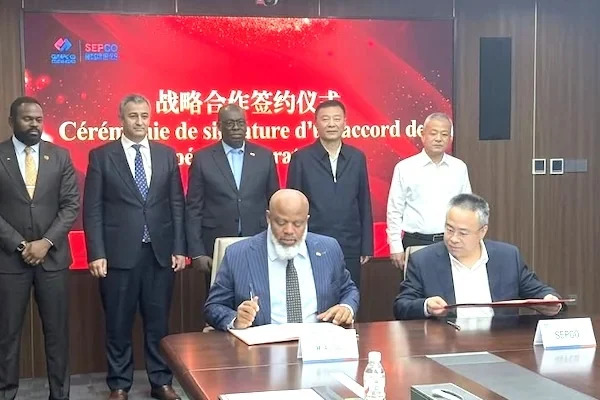
The Democratic Republic of Congo (DR Congo) has entered a cooperation agreement with Chinese engineering company SEPCO to develop energy and industrial projects, including a proposed 100-megawatt (MW) solar power facility expected to be delivered by June 2027. The partnership between SEPCO, a subsidiary of state-owned PowerChina, and the National Agency for Electrification and Energy Services in Rural and Peri-Urban Areas (ANSER) is intended to expand electricity generation while supporting industrial development in a country where access to reliable power remains a major infrastructure challenge.
The agreement followed a delegation visit to Jinan, China, from October 26 to 28, 2026, led by ANSER Deputy Director General Damien Twambilangana. The delegation met SEPCO representatives in the presence of DR Congo’s ambassador to China and Carousel Finance Africa, which has been designated as the project’s financial structuring partner.
The cooperation covers both energy infrastructure and industrial activities, with an indicative investment allocation of 70% for energy infrastructure and 30% for industrial development. The arrangement is intended to link additional electricity generation with productive economic activity, reflecting the role of energy availability in supporting manufacturing, enterprise growth and broader industrial expansion.

The first phase centres on a 100 MW photovoltaic solar facility that will supply electricity to the national grid operated by Société Nationale d’Électricité (SNEL). The proposed plant is expected to connect through the Bukangalonzo substation in Kwango province, with the objective of improving supply to Kenge and areas surrounding Kinshasa. The partners have set June 2027 as the target for delivery.
The proposed financing structure includes supplier credit, while discussions have also begun with Sinosure, China’s state-owned export credit insurer, to assess mechanisms for managing risks associated with international commercial operations and investments. Such arrangements could help structure the financing of infrastructure projects where upfront capital requirements and investment risks can limit participation by conventional lenders.
However, important financial and commercial details remain undisclosed. The partners have not announced the total project cost, their respective financial contributions or the repayment terms of the proposed supplier credit. The electricity sales arrangements are also yet to be clarified, including whether SNEL will enter into a power purchase agreement, the applicable tariff per kilowatt-hour and the duration of any purchase commitment.
The infrastructure required to connect the proposed facility to the national grid will also influence the project’s delivery and operating arrangements. Details on the cost of grid connection and any necessary upgrades to transmission infrastructure have not been provided. These elements will be important in determining how effectively the additional generation capacity can reach consumers.
The SEPCO agreement adds to ANSER’s expanding portfolio of partnerships with international companies seeking to develop electricity infrastructure across DR Congo. The agency has pursued agreements involving solar power, hydropower and mini-grid development, with projects at different stages of financing, procurement and implementation.
In March 2025, ANSER signed a €150 million commercial contract with Germany’s GAUFF Engineering to support electrification across 36 territories. The four-year programme includes the construction of 230 photovoltaic solar installations and small hydropower plants. The partnership reached a further contractual milestone in April 2026, when the parties signed the procurement contract following project approval and completion of financing arrangements.
The GAUFF agreement represents a broader effort to extend electricity infrastructure beyond major urban centres. Expanding access across rural and peri-urban territories requires a combination of generation technologies and distribution systems capable of serving communities with different levels of demand and infrastructure readiness.
ANSER also signed a $182 million memorandum of understanding with India’s Angelique International Limited in July 2025 to develop hydropower plants with a planned combined capacity of 26.8 MW. One of the main projects under the agreement is the 20 MW Mbombo hydropower plant in Kasaï-Central province, estimated to cost $120 million.
The Mbombo project advanced in August 2026 when the parties signed a construction agreement, followed by an official relaunch of works in late October. The Industrial Promotion Fund (FPI) has announced an initial $30 million contribution towards financing the project, which is being developed under a public-private partnership arrangement. The progress from an initial memorandum of understanding to a construction agreement and financing contribution places the project at a more advanced stage than initiatives that remain at preliminary cooperation discussions.
In April 2026, ANSER signed a €25 million commercial contract with Germany’s Off-Grid Europe to deploy photovoltaic solar mini-grids. The first phase targets 8.5 megawatts-peak (MWp) of installed capacity and is expected to provide electricity to approximately 27,700 households across six communities.
Mini-grid projects offer an alternative to extending conventional electricity networks into areas where grid expansion may be difficult or costly. Their contribution will depend on the reliability of generation, affordability of electricity and the ability of operators to maintain infrastructure over time. For communities beyond established transmission networks, these systems can support household access and provide electricity for local businesses and services.
More recently, on September 1, 2026, ANSER signed a memorandum of understanding with French group ITRA to identify, prepare and develop energy projects. The agreement targets approximately $900 million in financing for 650 MW of generation capacity and the creation of around 5,000 direct jobs. The scale of the proposed investment places the partnership among the larger initiatives in ANSER’s current international cooperation portfolio, although its development will depend on project preparation, financing and subsequent contractual arrangements.
Taken together, the agreements with SEPCO, GAUFF Engineering, Angelique International, Off-Grid Europe and ITRA point to a diversified approach to expanding DR Congo’s electricity infrastructure. The projects cover utility-scale solar generation, hydropower, distributed solar systems and wider energy development, reflecting the different technologies required to address the country’s electricity needs.

Their implementation stages, however, differ considerably. Some agreements remain at the memorandum of understanding or cooperation stage, while others have progressed to commercial contracts, procurement arrangements, financing commitments or construction activity. The distinction is important because announced investment targets and planned generation capacity do not automatically translate into operational electricity supply.
For the SEPCO partnership, the immediate test will be whether the proposed financing arrangements can be converted into firm commitments and whether the project can meet its June 2027 delivery target. Clear electricity purchase arrangements, adequate grid infrastructure and transparent allocation of project costs will also shape its commercial viability.
For DR Congo, the wider objective is not simply to add generation capacity but to ensure that new electricity infrastructure improves access, supports productive sectors and contributes to industrial development. The country’s growing pipeline of international partnerships provides potential avenues for investment, but their economic impact will ultimately depend on financing certainty, timely construction and the ability of the national power system to distribute electricity to the communities and businesses that need it.


