
Two community-led environmental initiatives in Kenya have received international recognition at the 2026 Water Air Food Awards (WAFA), highlighting approaches to plastic waste recovery, urban river restoration, youth empowerment and local economic development.
The Flipflopi Project, operating in the Lamu Archipelago, won the Air Award, while Komb Green Solutions, founded in Korogocho, Nairobi, received the Youth Climate Action Award. The awards were announced on November 20 during the Generation Green Workshop at the Green Business Forum 2026, held at Copenhagen Business School in Denmark.
The two Kenyan initiatives were selected from 12 finalists representing 10 countries across five continents. WAFA said the awards were based on demonstrated community impact and the potential for the projects’ nature-based solutions to be scaled and replicated. Kenya secured two of the four awards presented in the 2026 competition, with the winning projects addressing environmental challenges in coastal and urban settings through community participation and resource recovery.
In Lamu, The Flipflopi Project has developed a plastic recovery and recycling system aimed at addressing waste management gaps across the archipelago. In Korogocho, Komb Green Solutions has integrated riverbank clean-ups, tree planting, waste conversion, urban food production and community training into a model for neighbourhood regeneration.
The Flipflopi Project’s work began in 2016 amid growing plastic pollution in the Lamu Archipelago, where limited waste management infrastructure has contributed to plastic accumulating in waterways, beaches and settlements. The pollution threatens marine ecosystems and livelihoods linked to fishing and tourism, while the practice of burning waste in open spaces has contributed to local air pollution and greenhouse gas emissions.
The project established Lamu County’s first plastic recovery and recycling facility, which the award announcement says serves approximately 70 per cent of the archipelago and 28 per cent of the county’s population. Its collection system brings plastic waste into a processing facility where materials are sorted and converted into recycled products, including durable plastic planks used in local production.
The initiative has also used recycled plastic in boat construction, including the development of a traditional sailing dhow made entirely from recycled plastic. The vessel has been used to raise awareness about plastic pollution and promote regional discussions on reducing single-use plastics.
According to figures provided in the WAFA announcement, the project has recovered 350,000 kilograms of plastic to date, collecting between 10 and 12 tonnes each month. Of the recovered materials, 73,000 kilograms have been converted into locally manufactured recycled plastic planks, while 122,000 kilograms of PET bottles have been recovered for recycling.
The project also reported avoiding 318 tonnes of carbon dioxide-equivalent emissions between June 2022 and December 2024 by preventing plastic waste from being burned in open fires. The initiative said it has contributed to a 20 per cent reduction in recyclable plastics at local dumpsites.
Beyond waste recovery, the programme has supported income generation among residents of low-income communities. More than 1,000 people have received direct income support totalling over US$40,000, according to the award announcement. The project reports that 95 per cent of those supported previously lacked stable income, with women accounting for 60 per cent of beneficiaries.
Skills development has also formed part of the initiative. The project has worked with Lamu Polytechnic to deliver an accredited 12-week vocational training programme, through which 106 students have graduated. The training is intended to strengthen local skills in recycling and related production activities, supporting a workforce capable of participating in the circular economy.
The project’s recognition comes amid continued efforts to strengthen waste recovery and circular economy systems in coastal communities where limited infrastructure, waste leakage and livelihood pressures intersect. Its approach combines collection infrastructure, community participation, local manufacturing and vocational training, although replicating the system elsewhere will require suitable waste collection networks, processing capacity, market demand and sustained community engagement.
Komb Green Solutions, meanwhile, has focused on the environmental and socioeconomic challenges facing Korogocho, one of Nairobi’s informal settlements. The initiative was founded in 2018 by Christopher Waithaka, who sought to mobilise young people around waste management, environmental restoration and community development.
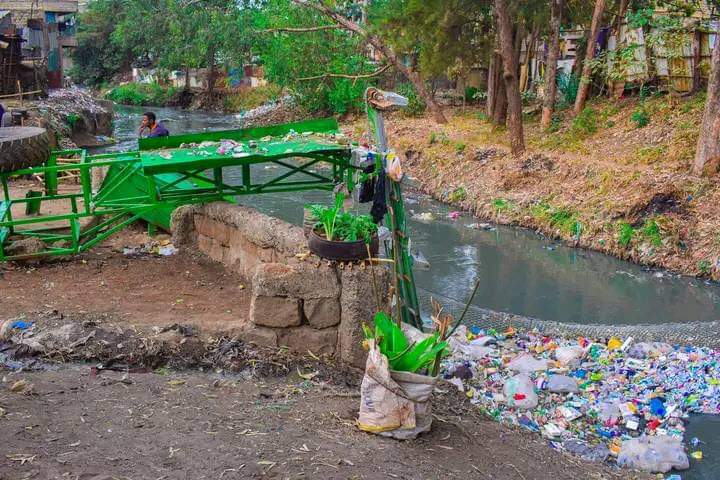
Waste accumulation along the Nairobi River has contributed to pollution, degraded public spaces and health risks for communities living nearby. Komb Green Solutions has responded by mobilising local youth to clear waste from riverbanks and reclaim dumping sites for green spaces and community parks.
The initiative extends beyond clean-up activities by incorporating organic waste processing into local food and livelihood systems. Organic materials are converted through vermicomposting and black soldier fly larvae into fertile soil and high-protein animal feed. The compost supports kitchen gardens, while the feed is used in local fish, poultry and pig farming.
The programme has also established a tree nursery intended to support riverbank restoration and improve the resilience of the surrounding urban environment. The WAFA announcement reports that the initiative has removed more than 120 tonnes of waste from the Nairobi River banks, approximately 70 per cent of which was organic waste, and established a nursery with a capacity of 20,000 trees.
Komb Green Solutions reports that 3,221 people have directly benefited from its activities, with additional communities reached through improvements to river environments and local food systems. Training programmes have supported young people and women in conservation, carpentry and sustainable farming, while the initiative has established a community water kiosk to provide access to clean water in an underserved area.
The project’s model is structured around the reuse of resources within the community. Organic waste is converted into compost and animal feed, supporting agricultural production and food systems, while reclaimed green spaces provide opportunities for recreation and community engagement. The approach seeks to combine environmental restoration with skills development, livelihoods and social participation.
The recognition of both projects places community-led environmental action within a wider discussion about how local initiatives can address interconnected challenges, including pollution, livelihoods, food security and urban resilience. The Flipflopi Project’s coastal recycling model and Komb Green Solutions’ urban restoration approach operate in different settings, but both rely on local participation, resource recovery and the development of practical systems that communities can maintain.
WAFA said it has recognised 18 Silent Heroes since 2008, with its network reaching an estimated 84 million people across 82 countries. The organisation said recognition provides opportunities for initiatives to connect with global networks, partnerships and potential funding that could support the expansion of their work.
For Kenya’s two winners, the next phase will depend on the capacity to sustain existing operations, strengthen partnerships and adapt their models to new communities. The award recognition highlights the work already undertaken in Lamu and Korogocho, while broader replication will require financing, infrastructure, institutional cooperation and continued participation by the communities these initiatives serve.
From plastic recovery along the coast to river restoration in Nairobi, the two projects illustrate how locally developed environmental solutions can connect waste management with skills, livelihoods and ecosystem protection. Their recognition at the 2026 WAFA awards brings international visibility to approaches built around community ownership and the use of locally available resources to address environmental challenges.