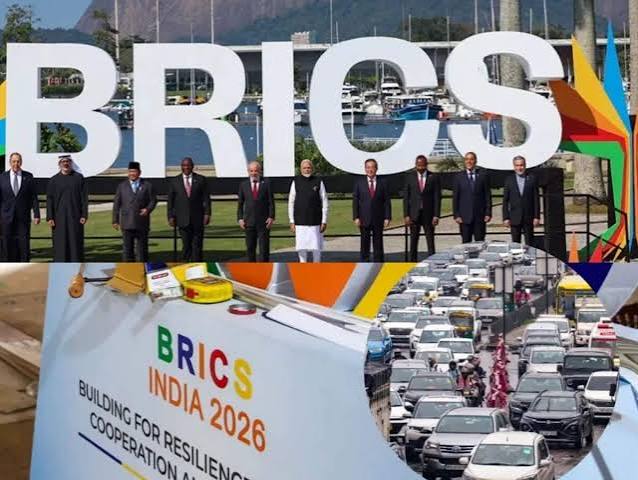
The 12th Annual BRICS Astronomy Working Group Meeting will bring together researchers, government representatives and scientific institutions in Pune, India, from 26 to 30 October 2026, as member countries seek to strengthen collaboration in astronomy, expand scientific skills and advance shared research priorities.
Hosted by the Inter-University Centre for Astronomy and Astrophysics in collaboration with India’s Department of Science and Technology, the five-day meeting will focus on multi-messenger and multi-wavelength transients, areas of astronomy that combine observations across different parts of the electromagnetic spectrum and signals such as gravitational waves to improve understanding of energetic cosmic events.
The gathering comes as scientific cooperation increasingly depends on international research networks, shared infrastructure, advanced data analysis and the development of specialised technical skills. For BRICS countries, collaboration in astronomy provides a platform to pool scientific expertise, coordinate research priorities and strengthen participation in fields requiring substantial investment in technology, computing and long-term research capacity.

South Africa will send a 17-member delegation led by Takalani Nemaungani, chief director of astronomy at the Department of Science, Technology and Innovation. The delegation includes representatives from the South African Astronomical Observatory, the South African Radio Astronomy Observatory, the University of Cape Town, the University of the Western Cape, the Inter-University Institute for Data Intensive Astronomy and the University of Johannesburg.
Their participation reflects the role of South African research institutions and universities in regional and international astronomy networks. South Africa has established significant research capacity in optical and radio astronomy, supported by specialised observatories, university programmes and investments in data-intensive research. Its involvement in BRICS cooperation offers opportunities to connect these capabilities with complementary expertise and scientific infrastructure in other member countries.
During the meeting, participating countries will present updates on their national astronomy programmes, outlining recent scientific developments, policy priorities and institutional progress. The presentations are expected to inform discussions on shared challenges, identify opportunities for joint research and help establish priorities for future collaboration.
The annual business meeting will form a central part of the programme, bringing together ministry representatives and national focal points to review progress against previous resolutions, assess ongoing collaborative activities and agree on new strategic priorities. Discussions will cover research, technology development, education, data science and public engagement, providing a framework for coordinating activities across the participating countries.
A key focus will be the use of data science in astronomical research. Modern astronomy generates large volumes of data from telescopes and observatories, requiring advanced computational tools and skilled researchers to identify patterns, analyse transient events and interpret observations. Collaborative initiatives in this area can help participating institutions share methods, develop technical expertise and expose early-career researchers to complex scientific challenges.
The programme will include the BRICS Astronomy Data Science Hackathon, organised in collaboration with India’s Aryabhatta Research Institute of Observational Sciences and the Indian Space Research Organisation. The hackathon is intended to bring participants together around data-driven research challenges, supporting practical experience in computational methods and collaborative problem-solving.
Education and human capital development will also feature prominently. The meeting will include science communication training and the launch of the BRICS Astronomy Robotics and Coding Training initiative. These activities are intended to extend astronomy cooperation beyond established researchers by supporting technical learning, encouraging engagement with science and creating opportunities to develop skills relevant to emerging research and technology fields.
Public engagement will provide another dimension to the gathering. An exhibition of astronomy facilities across BRICS countries will offer participants and audiences an opportunity to learn about national research infrastructure and scientific capabilities. Such activities can help communicate the value of astronomy to wider audiences and strengthen connections between scientific institutions, educators and the public.
For South Africa, these engagements have implications for the development of scientific talent and the continued integration of domestic research into international networks. Cooperation can support knowledge exchange, strengthen institutional relationships and create opportunities for students and researchers to work with new datasets, technologies and research approaches. It can also help align scientific priorities with broader objectives in education, innovation and public understanding of science.
However, sustained benefits will depend on how commitments made through the Working Group translate into practical programmes. Joint research requires reliable funding, access to infrastructure, effective data-sharing arrangements and continued support for researchers. Training initiatives will also need to connect with universities, research institutions and wider education systems to ensure that skills development reaches beyond individual events.

The meeting’s emphasis on multi-messenger and multi-wavelength transients places scientific collaboration at the centre of its research agenda. Observing cosmic events through different instruments and detection methods can provide a more complete picture of their origins and behaviour. Coordinating research across countries can broaden access to expertise and improve the ability of scientific teams to interpret observations that would be difficult to investigate through a single instrument or institution.
As BRICS astronomy cooperation develops, the Pune meeting provides an opportunity to consolidate existing partnerships while identifying new areas for joint work. Its combination of scientific presentations, data science, technical training, public engagement and policy discussions reflects an effort to connect research excellence with capacity development and broader societal benefits.
The outcomes will ultimately be measured by the collaborations established, the skills developed and the research initiatives advanced beyond the five-day programme. For participating countries, the Working Group offers a mechanism to strengthen scientific links and coordinate priorities in a field where international cooperation is increasingly important to expanding knowledge and technological capability.