


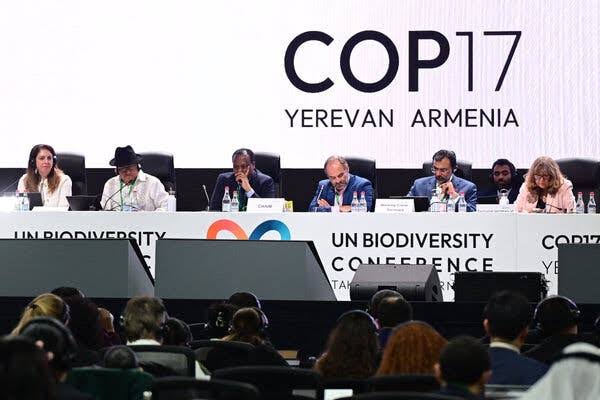
Governments have agreed to accelerate global biodiversity protection efforts under a new framework adopted at the 17th Conference of the Parties to the UN Convention on Biological Diversity (COP17) in Yerevan, Armenia, but persistent financing constraints threaten implementation, particularly in developing countries where natural resources underpin livelihoods, economic activity and public revenue. The agreement, reached on 31 October 2026 after two weeks of negotiations, sets out priorities for accelerating action towards the 2030 biodiversity targets, including reducing environmentally harmful subsidies, increasing finance for developing countries and aligning national spending with conservation objectives.
The decision, known as the Yerevan Pathway, follows the first global review of the Kunming-Montreal Global Biodiversity Framework, adopted in 2022. The assessment found that although countries had made progress in setting national targets and developing biodiversity policies, the world remained off track on almost all agreed goals. According to the United Nations, nearly 90% of parties to the biodiversity convention had established national targets, but fewer than half of those assessed were on course to achieve them.

The framework includes commitments to conserve at least 30% of the world’s land, inland waters, coastal and marine areas by 2030, restore 30% of degraded ecosystems, reform harmful subsidies and mobilise $200 billion annually for biodiversity protection. The Yerevan agreement seeks to accelerate implementation of these commitments, but it does not resolve the central question of how the required funding will be raised and distributed.
Organisers said more than $1.8 billion in financing from governments, philanthropic organisations and investors had been announced during COP17. However, delegates continued to express concern that available resources remain insufficient to meet the scale of global biodiversity needs. Governments agreed to accelerate efforts towards the existing target of reducing harmful incentives by at least $500 billion annually by 2030. They also committed to reviewing existing funding arrangements, establishing criteria for a future permanent financing mechanism and voluntarily broadening the pool of contributors.
For African countries, the financing question has direct economic and fiscal implications. The continent holds globally significant forests, wetlands, grasslands, freshwater systems and marine ecosystems that support agriculture, fisheries, tourism, energy production and water security. These natural assets also contribute to employment and foreign exchange earnings in countries where public finances are already constrained by debt servicing, infrastructure requirements and competing development priorities.
The funding gap is particularly consequential because biodiversity protection requires more than establishing conservation targets or designating protected areas. Governments need resources for ecological monitoring, enforcement, restoration, land management and community participation. Without sustained funding, protected areas can remain exposed to illegal logging, poaching, mining, agricultural expansion and other activities that undermine conservation objectives.
The challenge is visible across several African economies. In the Congo Basin, forests in countries including the Democratic Republic of Congo, Cameroon, Gabon and the Republic of Congo play an important role in regulating regional rainfall, storing carbon and supporting rural livelihoods. Protecting these ecosystems requires financing that can sustain forest governance while providing communities with viable economic alternatives to activities that contribute to forest degradation.
In East Africa, wetlands, forests and freshwater ecosystems support agricultural production, livestock systems and urban water supplies. Their degradation can increase pressure on food systems, water infrastructure and public spending, particularly as climate variability intensifies. Coastal and marine ecosystems in countries such as Kenya, Tanzania and Mozambique also support fisheries and tourism, making conservation relevant to local employment, export earnings and the resilience of coastal economies.
The financing debate also raises questions about the role of international development institutions and private capital. Although biodiversity projects can generate economic returns through tourism, sustainable agriculture, ecosystem services and carbon markets, many conservation activities do not produce predictable cash flows that attract conventional commercial investment. This leaves governments and development finance institutions with an important role in absorbing early-stage risks, providing concessional capital and establishing regulatory frameworks that can support longer-term investment.
According to Daudi Sumba, Chief Conservation Officer at WWF International, the global review sent a strong signal on the need to accelerate biodiversity action, but progress must be backed by finance. His assessment reflects a broader concern among conservation organisations that international commitments will have limited impact unless funding reaches the institutions responsible for implementation.
The question of harmful subsidies is also significant for African fiscal policy. Government incentives supporting activities such as fossil fuel production, unsustainable agriculture and resource extraction can create economic pressures on ecosystems when environmental costs are not adequately reflected in investment decisions. Reforming such incentives could help redirect public resources towards more sustainable economic activities, although governments will need to consider the effects on employment, household costs, energy access and industrial competitiveness.
For countries dependent on mining, agriculture and hydrocarbons, this transition will require careful policy design. Mineral extraction remains important to export revenues and industrial development, while agricultural expansion supports food security and rural incomes. Biodiversity policy that does not account for these economic realities risks creating conflicts between conservation objectives and national development plans. Integrating biodiversity considerations into infrastructure planning, mining approvals, agricultural investment and public procurement could help governments manage these competing priorities more effectively.
The agreement’s emphasis on aligning national spending with biodiversity goals is therefore particularly relevant to African finance ministries. National biodiversity strategies will need to be reflected in budget allocations, public investment frameworks and sector policies if governments are to move beyond environmental commitments towards implementation. This also creates an opportunity to improve coordination between environment ministries, finance ministries, planning agencies and local authorities.
Private finance is expected to contribute to the wider funding effort, but its role will depend on credible standards, transparent measurement and safeguards against misleading environmental claims. Biodiversity credits, conservation finance vehicles and payments for ecosystem services have attracted growing interest, yet questions remain over how ecological outcomes are measured, how benefits are distributed and whether local communities receive a fair share of the economic value generated.
For African countries, these arrangements will need to recognise customary land rights, community resource governance and the dependence of rural households on forests, fisheries and grazing areas. Conservation financing that excludes local communities from decision making or restricts access to essential resources without providing alternatives could undermine the long-term effectiveness of projects. Equitable benefit sharing and transparent governance will therefore remain central to attracting credible investment.
The pressure to deliver is also increasing as governments prepare for the next stage of international climate negotiations. The biodiversity agreement comes ahead of COP31, scheduled to begin in Türkiye on 9 November 2026, where climate finance, adaptation and the relationship between climate action and nature are expected to remain important issues. For African countries, these discussions are closely connected because climate resilience often depends on healthy ecosystems, while biodiversity loss can increase exposure to droughts, floods, soil degradation and declining agricultural productivity.
Anita de Horde, Executive Director of the Finance for Biodiversity Foundation, said the effectiveness of COP17 would ultimately be measured by what governments implement before the next biodiversity conference, scheduled for Quito, Ecuador, in 2028. That assessment places responsibility on national governments to translate the Yerevan commitments into funded programmes, regulatory changes and measurable conservation outcomes.

For Africa, the agreement provides renewed political direction but does not remove the financial constraints facing conservation institutions. The continent’s ability to protect ecosystems while expanding agriculture, infrastructure, energy and industrial activity will depend on whether biodiversity becomes part of mainstream economic planning and whether international finance is delivered at a scale and on terms that support implementation. As the 2030 deadline approaches, the distinction between commitments announced and resources actually deployed will increasingly determine the credibility of global biodiversity action.


