


Ghana has adopted a National Communiqué on climate change and environmental, social and governance (ESG) policy that seeks to move climate planning and investment closer to district authorities, while establishing a framework for corporate disclosure, carbon market transparency and the country’s response to emerging international trade regulations. Signed in Accra on 27 October at the close of the Ghana National Climate and ESG Policy Summit 2026, the document places Metropolitan, Municipal and District Assemblies (MMDAs) at the centre of efforts to translate national climate commitments into local development priorities.
The communiqué was signed under the leadership of Seidu Issifu, Minister of State for Climate Change and Sustainability, and co-signed by Mahama Ayariga, Minister for Local Government, Chieftaincy and Religious Affairs. The Association of Ghana Industries and the National Association of Local Authorities of Ghana witnessed the signing. Its three resolutions cover local climate governance, corporate ESG disclosure and climate finance, as well as Ghana’s preparedness for changing international trade requirements. The Ghana News Agency reported that the summit brought together policymakers, regulators, financial institutions, businesses and development partners to agree on a common direction for climate and ESG policy.
The first resolution calls on district assemblies to integrate climate and ESG considerations into their development planning, budgeting and coordination processes, supported by sustained investment in institutional capacity. The approach places responsibility closer to the authorities that oversee local infrastructure and essential services, including roads, drainage, water supply and sanitation. These are also among the areas where climate-related pressures, particularly flooding, coastal erosion and changing rainfall patterns, have direct consequences for communities and local economies.

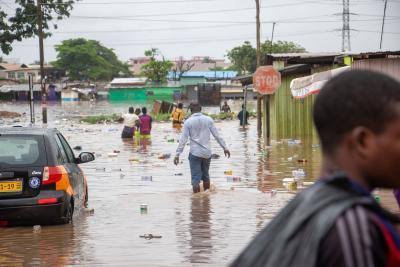
For residents, the district-level focus is significant because the effects of climate change are often experienced through local infrastructure failures and disruptions to livelihoods. Flooding can damage homes, submerge roads, interrupt business activity and compromise access to essential services. Yet the ability of local governments to respond depends on whether they can identify risks, prepare technically sound projects and secure the financing needed to implement them.
The urgency is illustrated by commitments made in July 2026 by eight Ghanaian assemblies: Tema, Sekondi-Takoradi, Cape Coast, Keta, Akatsi North, Nanumba South, Kumbungu and Mion. Following recent flooding in Greater Accra that claimed lives, displaced hundreds of families and submerged roads, homes and businesses, the assemblies pledged to accelerate implementation of their local climate adaptation plans. All eight had completed climate change risk and vulnerability assessments and prepared local adaptation plans, but mobilising finance remained the next major task, according to the Ghana News Agency.
Ebi Bright, Tema Metropolitan Chief Executive, said climate funding would increasingly be directed towards assemblies able to submit well-prepared, evidence-based proposals. This points to a growing relationship between local technical capacity and access to climate finance. Districts may have a clear understanding of their exposure to flooding, heat or coastal erosion, but without reliable data, project designs, cost estimates and implementation plans, those needs can be difficult to translate into proposals that meet the requirements of public and international financiers.
The communiqué’s emphasis on institutional capacity therefore has practical implications. Dedicated climate units, trained technical personnel and stronger coordination between local and national institutions could help assemblies move from identifying vulnerabilities to preparing investable adaptation projects. However, the document does not specify how many assemblies will receive such support, the amount of funding required or the timetable for establishing the proposed capacity.
The financing question is also tied to Ghana’s existing system of fiscal transfers to local government. Parliament approved a 2026 formula allocating approximately GH¢8.77 billion to the District Assemblies Common Fund (DACF), equivalent to five per cent of projected national revenue and representing a 16.78 per cent increase from the GH¢7.51 billion allocated in 2025. The distribution formula considers factors including population, education, health, water coverage and road infrastructure. The Fund’s secretariat also identified GH¢7.33 billion in arrears from 2024 that it sought to have verified and recovered.
The size of the Common Fund provides an established channel through which resources reach district authorities, but the relationship between those transfers and the new climate policy priorities remains unclear. The communiqué, as described in the published accounts, does not specify whether a portion of DACF allocations will be ring-fenced for climate adaptation or whether assemblies will be required to demonstrate climate-related spending. That distinction matters because incorporating climate priorities into local budgets will require more than policy recognition; it will depend on predictable funding and clear spending responsibilities.
The second resolution of the communiqué addresses the financial and corporate reporting systems needed to support climate investment. It calls for a phased timetable for climate and ESG disclosures, greater transparency and accountability in carbon markets, and the mobilisation of blended finance for bankable climate projects. The summit’s wider policy framework also covers ESG reporting requirements, climate risk in financial services and sector-specific transition obligations, with institutions including the Securities and Exchange Commission, the Environmental Protection Authority and the International Finance Corporation involved in the discussions.
For businesses and financial institutions, clearer disclosure requirements could influence how climate-related risks are identified, reported and incorporated into investment decisions. More consistent information can help lenders and investors assess exposure to environmental risks and evaluate the credibility of sustainability claims. However, the communiqué does not yet set out the commencement dates, reporting thresholds or enforcement arrangements for the proposed disclosure timetable. Those details will determine how the framework affects companies of different sizes and across different sectors.
The call for greater carbon market transparency also raises questions about how revenues and benefits from carbon projects will be distributed. Carbon finance can provide an additional source of investment for conservation, restoration and emissions-reduction activities, but the economic value generated by projects does not automatically reach the communities hosting them. The reports reviewed do not specify how Ghana intends to strengthen benefit-sharing arrangements or what safeguards will ensure that local communities participate in decisions affecting carbon projects in their areas.
The third resolution brings international trade considerations into the country’s climate policy agenda. It calls for a coordinated national response to the European Union’s Carbon Border Adjustment Mechanism (CBAM), clearer green taxes, fees and levies, and the use of the African Continental Free Trade Area (AfCFTA) to position Ghanaian businesses in emerging green markets.
CBAM entered its definitive regime on 1 January 2026 and covers imports of cement, iron and steel, aluminium, fertilisers, electricity and hydrogen into the European Union. The mechanism requires importers to account for the embedded emissions of covered products, creating an additional consideration for exporters whose production processes rely on carbon-intensive energy or industrial systems. For Ghanaian businesses supplying affected markets, emissions measurement, reporting and access to lower-carbon production technologies could become increasingly important to maintaining competitiveness.
Issifu told the summit that the implications of CBAM extend beyond environmental policy into industrial development, export competitiveness, trade relations, investment planning and access to international markets. The potential exposure of Ghana’s aluminium industry illustrates the domestic economic dimension. The Terawatt Times Institute estimates that Ghana’s direct exposure is concentrated largely in unwrought aluminium exports from the Volta Aluminium Company in Tema, at approximately 50,000 tonnes annually, with an estimated cost of around €1.9 million in 2026. These are independent estimates rather than official government figures, but they indicate how external carbon regulations could affect industrial exporters and their investment decisions.
Ghana’s response will therefore require coordination between climate authorities, trade and industry institutions, regulators and businesses. Companies may need support to measure emissions, improve energy efficiency and assess the carbon intensity of their production processes. At the same time, the proposed use of AfCFTA points to an opportunity to strengthen regional trade in lower-carbon goods and services, provided that common standards and the necessary industrial capacity develop alongside the policy framework.
Public accountability will also influence whether the communiqué produces visible changes. Ghana’s District Assemblies Common Fund public portal allows citizens to identify assembly-funded projects, follow implementation progress and submit comments. Whether climate-related investments will be separately identifiable through the platform has not been specified. Greater visibility of climate spending could help residents assess whether resources are reaching drainage, flood protection, water infrastructure and other locally identified priorities.

The communiqué is ultimately a statement of policy direction rather than a fully costed implementation plan. It does not publish specific funding allocations, implementation deadlines or enforcement mechanisms for its proposed measures. Its delivery will depend on whether district assemblies receive the technical personnel and financial resources needed to prepare projects, whether national institutions coordinate their responsibilities and whether businesses are given clear and workable disclosure requirements.
For Ghana’s flood-prone and heat-exposed communities, the test will be whether the new framework translates into practical investment in infrastructure, early-warning systems and local adaptation. For businesses, it will be whether climate disclosure and trade preparedness become sufficiently clear to guide investment and production decisions. The wider significance for other African economies lies in whether national climate strategies can be connected to decentralised budgets, local implementation capacity and changing international market requirements.
The next phase will require institutions to demonstrate progress beyond the signing of the document. As Issifu stated at the summit, the task is to deliver the commitments institution by institution and report on progress. Whether that process results in better-prepared district projects, more transparent climate finance and stronger export readiness will determine the communiqué’s contribution to Ghana’s climate resilience and economic competitiveness.


