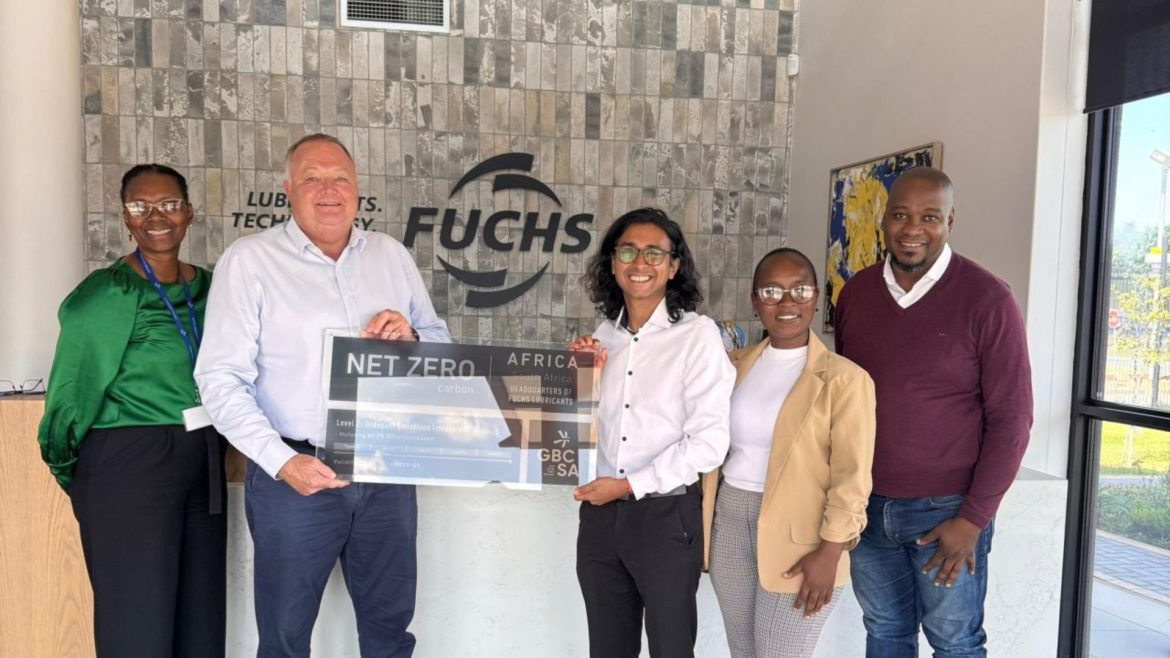
FUCHS LUBRICANTS SOUTH AFRICA has achieved Net Zero Carbon Level 2 certification from the Green Building Council South Africa (GBCSA) for its headquarters in Isando, Gauteng, marking a further step in the company’s efforts to integrate energy efficiency and emissions management into its operations. The certification recognises the building’s approach to reducing carbon emissions through efficient design, electrification, energy monitoring and the use of renewable energy, highlighting how commercial infrastructure can contribute to corporate decarbonisation goals.
The achievement was commemorated through a plaque handover ceremony involving the project team and the GBCSA. The headquarters forms part of a wider industrial campus that includes FUCHS’ production facilities, linking the building’s environmental performance to a broader operational setting. Sustainability consultancy Solid Green Consulting served as the project’s Accredited Professional, while Brundtland Consulting provided carbon credit expertise.
The building’s design incorporates high-performance double glazing, passive design principles and intelligent fresh-air ventilation systems intended to reduce energy demand while maintaining indoor comfort. Comprehensive energy monitoring provides visibility into consumption, while a 100% electrification approach removes the need for fossil-fuel combustion within the building’s relevant energy systems and creates opportunities to meet electricity demand through renewable sources, including solar photovoltaic power.

These measures reflect a shift in how building performance is assessed. Rather than relying solely on the energy efficiency of individual technologies, the approach considers how the building envelope, ventilation, electricity systems and operational practices work together to reduce emissions. For businesses, this can affect both environmental performance and operating costs, although the financial benefits depend on factors such as energy prices, building use, maintenance and the performance of installed systems.
According to the GBCSA, its Net Zero Carbon rating framework distinguishes between the emissions boundary covered by different certification levels. Level 2 extends beyond base-building emissions to include the operational energy used by occupants. This broader boundary places greater emphasis on how a building performs in everyday use, rather than focusing only on the infrastructure and systems under the building owner’s direct control. The council’s framework also distinguishes between modelled ratings, based on predicted performance, and measured ratings, which rely on actual operational data.
For the FUCHS headquarters, the distinction matters because energy performance is influenced by both building design and the way occupants use the facility. Lighting, ventilation, cooling, equipment and day-to-day energy management can all affect consumption. Monitoring systems can help identify inefficiencies, but sustained performance also depends on how consistently the building is managed and whether its energy data is used to inform operational decisions.
Esther Seabi, Sustainability Director at FUCHS LUBRICANTS SOUTH AFRICA, said the certification demonstrates how sustainability can be incorporated into routine business operations and infrastructure decisions. She said the company continues to pursue practical measures to reduce environmental impact while supporting operational excellence and long-term resilience.
Managing Director Paul Deppe said the recognition aligns with the sustainability objectives of both the South African business and the wider FUCHS Group. He added that environmental considerations are becoming increasingly important across the sectors the company serves, and that integrating them into strategic planning can support progress towards a lower-carbon operating model.
The local certification also sits within the wider group’s climate commitments. In 2024, FUCHS LUBRICANTS SOUTH AFRICA announced a power purchase agreement with Solareff intended to increase renewable electricity use across its warehouse, headquarters and manufacturing facilities. At the time, the company said the agreement was expected to raise renewable electricity’s share of total consumption from about 11% to 30%. That announcement illustrates how building-level interventions can form part of a wider energy transition strategy across industrial operations. The projected increase should not, however, be interpreted as confirmation of the company’s current renewable electricity share without updated performance data.
The distinction between design improvements and measured results is particularly important as companies increasingly communicate sustainability performance to investors, customers, employees and business partners. A certification provides a recognised framework for assessing a building against specified criteria, but it does not automatically establish the emissions performance of every activity at a company’s wider site or across its supply chain. Building energy use is only one part of a manufacturer’s environmental footprint, which may also include production processes, purchased materials, product distribution and the use and disposal of products.
For lubricant manufacturers and other industrial businesses, decarbonisation therefore involves decisions extending beyond offices and administrative facilities. Investments in renewable electricity, efficient production equipment, heat recovery, energy management and lower-impact materials can affect emissions across operations. FUCHS has previously identified energy efficiency and renewable energy as priorities in its local investment plans, including plans for a manufacturing and warehouse expansion. The scale of the overall impact will depend on implementation and transparent reporting of actual performance.
The project also highlights the role of specialised technical expertise in translating climate objectives into building design. Solid Green Consulting’s work covers green-building certification, energy modelling and the optimisation of building systems, while the GBCSA provides a framework through which projects can be assessed against defined environmental performance criteria. Carbon credit expertise can also support the treatment of residual emissions where applicable, although the use of offsets should be distinguished from direct reductions in energy demand and emissions.

Across South Africa, the performance of commercial and industrial buildings is becoming an increasingly relevant part of the energy transition. Efficient building envelopes, electrification, renewable electricity and consumption monitoring can help businesses manage exposure to energy costs while reducing emissions associated with building operations. The extent of these benefits varies by site, electricity supply, technology choices and the quality of ongoing performance management.
The GBCSA has set out an ambition for all new buildings to achieve net zero carbon operation by 2030 and for the wider building stock to reach that objective by 2050. Achieving these goals will require investment, technical capacity and greater attention to the performance of existing as well as new buildings. Certification can help establish common expectations, but wider progress will depend on the ability of building owners and occupiers to finance improvements, track results and maintain performance over time.
FUCHS LUBRICANTS SOUTH AFRICA’s Level 2 certification places its Isando headquarters within this wider shift towards more energy-efficient commercial infrastructure. Its longer-term significance will depend not only on the building’s certification status but also on continued monitoring, the management of energy demand and the extent to which similar measures are adopted across the company’s industrial operations. As businesses face growing expectations to demonstrate credible climate performance, the project illustrates how infrastructure decisions can become part of a broader approach to operational resilience and emissions reduction.