
Ghana’s standing as the world’s second-largest cocoa producer is under pressure as declining harvests, financial strain at the sector regulator and rising competition from Ecuador, Indonesia and Nigeria converge to reshape the global cocoa market.
An emergency Cabinet meeting convened in Accra early this February (2026) by President John Dramani Mahama underscored the scale of the challenge, with officials confronting delayed farmer payments, unsold stocks and a production outlook well below historical norms.
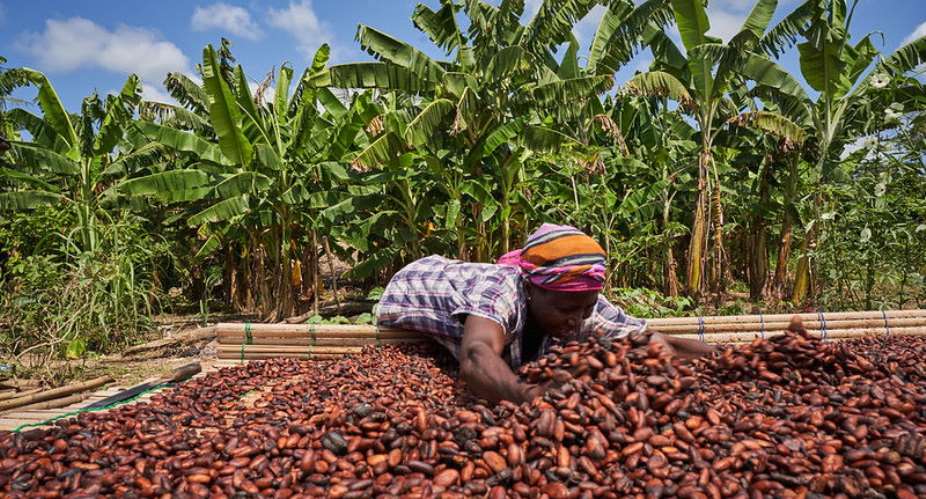
Cocoa underpins rural livelihoods and foreign exchange earnings in Ghana. The crop supports more than 800,000 households and has long ranked just behind neighbouring Côte d’Ivoire in global supply. Yet output has fallen sharply over the past two seasons.
The Ghana Cocoa Board (COCOBOD) reduced its 2024/25 crop forecast from 650,000 tonnes to 617,500 tonnes in late 2024 and subsequently indicated that harvests may struggle to exceed 600,000 tonnes. By June 2025, around 590,000 tonnes had been collected with only months remaining in the season. This compares with a historical average near 800,000 tonnes and the bumper crop of more than 1 million tonnes recorded in 2020/21.
COCOBOD has sold more than 530,000 tonnes in the current season but around 50,000 tonnes remain with farmers. Officials attribute weak off-take partly to a farmgate price structure that has rendered Ghanaian beans less competitive at a time of elevated global volatility. The regulator is also grappling with liquidity constraints that have delayed payments, straining trust within the value chain.

Production setbacks are structural as well as cyclical. Ageing tree stock, the spread of Cocoa Swollen Shoot Virus Disease, illegal small-scale mining known locally as galamsey, and erratic rainfall linked to climate variability have eroded yields.
Average productivity in West Africa remains below 500 kilograms per hectare, well under levels achieved in parts of Latin America. Replanting and rehabilitation programmes have struggled to keep pace with farm-level losses.
While Ghana contends with these headwinds, competitors are expanding. Ecuador is projected to surpass 650,000 tonnes in the 2025/26 season and is targeting 800,000 tonnes before the end of the decade. Industry data indicate Ecuadorian yields average close to 800 kilograms per hectare, supported by hybrid varieties and stronger farm-level price transmission, with producers reportedly receiving a higher share of international prices than their West African counterparts.
Indonesia, which produced more than 600,000 tonnes in recent seasons, is also scaling output through replanting initiatives and quality improvement programmes. Nigerian authorities have set a target of lifting production from roughly 340,000 tonnes to 500,000 tonnes over the medium term, backed by state-level interventions and private investment in processing capacity. Although structural constraints persist, incremental gains could shift relative rankings if Ghana’s recovery remains slow.
Global market dynamics add complexity. Cocoa futures, which reached record highs above $10,000 per tonne in 2024 amid supply shocks in West Africa, have since corrected but remain historically elevated, trading in the mid-$3,000 to $4,000 range on ICE. Price volatility has tightened hedging conditions and raised financing costs for regulators that pre-sell crops to secure syndicated loans, as COCOBOD does annually. Higher borrowing costs feed into public balance sheets, given the state’s backing of cocoa marketing operations.
Read also: Africa’s Cocoa, Coffee and Timber exports face new EU timeline under EU Deforestation Rules
The implications extend beyond Ghana. West Africa accounts for roughly 70 per cent of global cocoa supply, making regional stability central to confectionery supply chains and to export revenues across Côte d’Ivoire, Nigeria and Cameroon. A sustained decline in Ghanaian output would alter trade flows, foreign exchange receipts and rural incomes, with knock-on effects for fiscal revenues and creditworthiness.
It also sharpens questions about farmgate pricing models and governance structures in state-controlled marketing systems. If competing origins continue to offer stronger yield performance and more flexible price transmission, buyers may diversify sourcing strategies, reshaping long-term investment patterns.
A new International Cocoa Agreement is set to be inaugurated under United Nations auspices this February 2026, with an emphasis on sustainability and market stability. Domestic reforms and the alignment of financing with on-farm rehabilitation will determine whether such frameworks can address productivity, disease control and income distribution challenges in producer countries.
Engage with us on LinkedIn: Africa Sustainability Matters