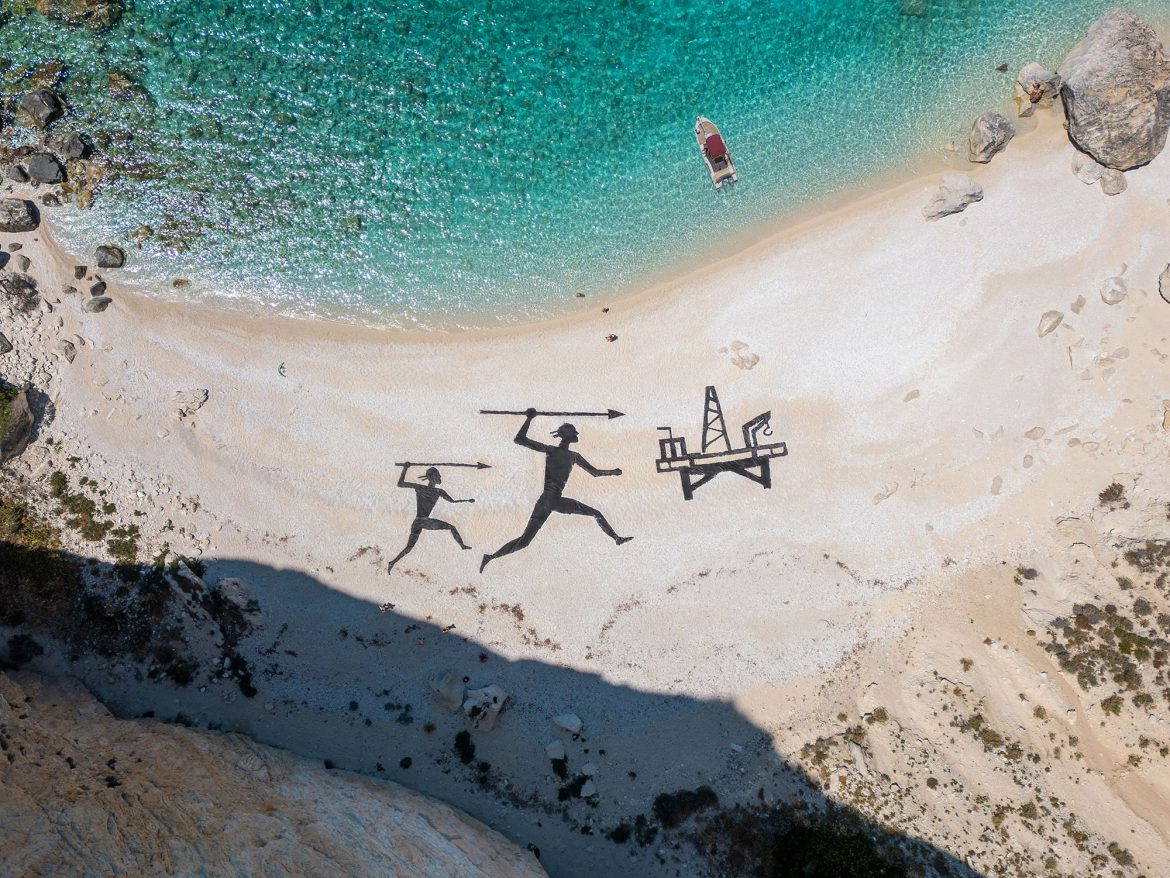
A temporary 500-square-metre land art installation on Greece’s westernmost inhabited island of Othonoi is bringing the country’s offshore energy debate into direct contact with the landscape it could eventually transform. Created by artist The Krank during the Ionian Lab residency by Space52 & Kalogerou 1844, The Hunt depicts two prehistoric hunters facing the silhouette of an offshore oil platform on Aspri Ammos Beach, around 10 kilometres from the boundary of Block 2, an offshore hydrocarbon exploration area in the northern Ionian Sea.
The work comes as Greece seeks to balance energy security, investment in domestic hydrocarbon resources and its wider transition towards a lower-carbon energy system. Rather than presenting the issue through technical maps or policy documents, The Hunt uses the physical landscape to explore what resource extraction can mean for communities whose lives and economies are closely connected to the sea.
The installation draws on the visual language of prehistoric cave paintings. Two human figures appear to confront an industrial structure that does not yet exist in the surrounding landscape. At ground level, visitors see fragments of black lines, stones and figures against the horizon. From above, those elements form the complete image of hunters facing an offshore platform.
That aerial perspective is central to the work. The platform depicted in the installation is not a representation of infrastructure already operating in the Ionian Sea, but a visualisation of a possible future. By placing it temporarily on the beach, the artist creates an image of industrialisation before such infrastructure physically appears on the horizon.
The approach reflects a wider challenge surrounding energy development: the gap between how projects are represented in investment and regulatory documents and how they may ultimately be experienced by communities living near them. Offshore exploration is generally discussed through licensing areas, geological surveys, investment requirements, production forecasts and environmental assessments. For island communities, however, the implications can also involve changes to seascapes, tourism, fisheries and perceptions of place.
Othonoi provides a particularly direct setting for that discussion. The small island sits at Greece’s western edge, where the sea forms a central part of the community’s physical and economic environment. The prospect of offshore exploration therefore intersects with questions about how local communities perceive their surroundings and how future infrastructure could alter established relationships with the marine environment.
The artwork’s temporary character is also significant. The Hunt remained on the beach for documentation rather than permanently modifying the site. Its temporary presence allowed the landscape to function simultaneously as subject, setting and participant in the work.
One resident quoted in material associated with the project recalled earlier survey activity in distinctly physical terms, saying that vibrations could be felt inside the house at night. Such accounts illustrate why offshore resource development can be experienced differently at community level than in national energy strategies, where projects are primarily evaluated through reserves, investment, energy supply and economic returns.
For Greece, the wider issue is tied to the country’s changing energy position. The government has expanded renewable energy rapidly while continuing to consider domestic natural gas resources as part of its energy-security strategy. Offshore exploration can potentially contribute to domestic supply and investment, but it also requires careful consideration of environmental risks, marine ecosystems and the interests of coastal and island economies.
The debate has implications beyond Greece. Across the Mediterranean and Africa, offshore hydrocarbons remain an important source of government revenue, foreign investment and energy supply, even as countries face growing pressure to decarbonise. Governments must increasingly weigh the potential economic value of new extraction against climate commitments, environmental risks and the possibility that large-scale fossil-fuel infrastructure could become less economically attractive as clean-energy technologies expand.
For African economies, where oil and gas revenues finance substantial portions of public budgets in several producing states, the Greek debate offers a useful parallel. Resource development is not simply an engineering or financing decision. It can reshape landscapes, coastal economies and public expectations over decades. The challenge is to ensure that investment decisions incorporate environmental safeguards, transparent consultation and realistic assessments of long-term economic value.
The significance of The Hunt ultimately lies less in whether it argues for or against offshore drilling than in the question it places physically in front of its audience: how does a community perceive a landscape when its possible industrial future has already become imaginable?
By introducing an image of an offshore platform into a landscape where one is not yet physically present, the installation makes an uncertain future visible. It turns an energy-policy question into a conversation about memory, place, resources and the relationship between economic development and the environments in which communities live.
For Africa, where the next generation of energy projects will increasingly involve choices between hydrocarbons, renewable power and new industrial systems, that distinction matters. The success of energy development will ultimately be measured not only by barrels produced or megawatts installed, but also by how effectively governments and investors manage the economic, environmental and social consequences of transforming places that communities already call home.