


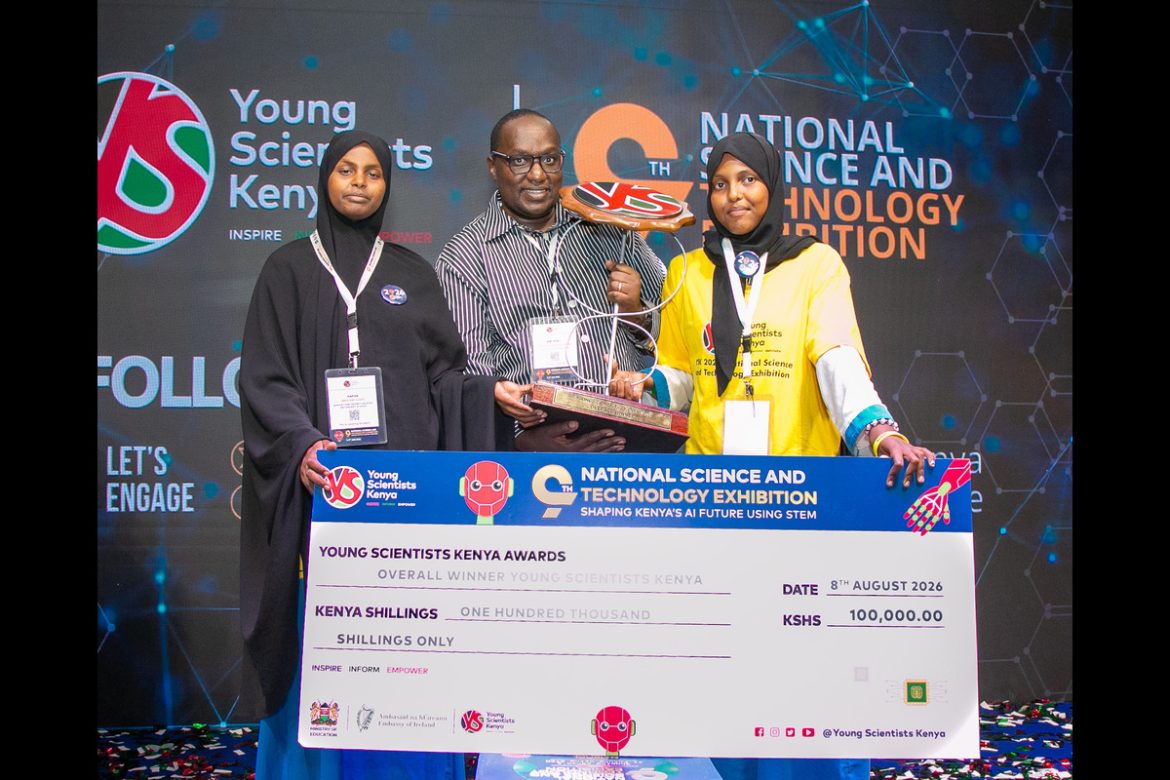
Two student teams from Kenya’s drought-prone northern counties of Wajir and Marsabit have emerged among the top performers at the 2026 Young Scientists Kenya National Science and Technology Exhibition, using artificial intelligence, sensors and automation to address drought, water scarcity and food insecurity. Their projects highlight how locally developed technology can be applied to some of the country’s most persistent climate and agricultural challenges, while demonstrating the growing role of young people in Kenya’s innovation ecosystem.
The overall award went to Hafsa Ibrahim Adan and Asha Harun Yarow of Senior Chief Adano Girls Day Secondary School in Wajir County for an artificial intelligence-based environmental monitoring system designed to identify drought risks before conditions become critical. The system collects information on soil moisture, temperature, humidity and rainfall through sensors, with an AI model processing the data to produce a drought-risk score and estimate the time remaining before drought conditions are expected to emerge.
The project is particularly relevant to northern Kenya, where recurrent droughts have placed sustained pressure on livestock, agriculture, water resources and household livelihoods. By converting environmental observations into early-warning information, the students’ system could potentially help farmers and communities make decisions about irrigation, water allocation, crop protection and livestock management before conditions deteriorate.
The second-place award went to Halima Aila Mohamed, Sake Hussein Tadicha and Manal Mohamed of Zad Muslim School in Marsabit County for Eco-Guard, an automated garden system designed to improve water efficiency and crop protection under dry conditions.
The system combines greenhouse technology with automated irrigation and temperature management. A soil-moisture sensor activates a water pump when moisture levels fall below a defined threshold and stops the system once sufficient moisture has been restored. A temperature sensor controls an automated roof, opening it when internal temperatures become too high.
Together, the two projects demonstrate a shift in how climate challenges are being approached in Kenya’s education system. Rather than treating drought and food insecurity solely as environmental or agricultural problems, the students have applied engineering, data and digital technologies to develop practical responses.
The results also align closely with the theme of this year’s Young Scientists Kenya exhibition, “Shaping Kenya’s AI Future Using STEM.” The official Young Scientists Kenya programme describes the exhibition as a platform for secondary school students to develop and showcase practical solutions through science, technology, engineering and mathematics. The 2026 programme received more than 1,500 abstracts, with hundreds of projects advancing through the competition.
For Kenya, the significance extends beyond the competition itself. The country is increasingly looking to digital technologies, climate information and innovation to strengthen resilience in agriculture and water management. Yet technologies developed in universities, research institutions and companies do not always reach communities facing the greatest climate risks. Student-led projects such as those from Wajir and Marsabit illustrate the potential of connecting STEM education with problems experienced directly in local communities.
The geographical origin of the winning teams is also significant. Wajir and Marsabit are among the areas where climate variability, water scarcity and limited agricultural productivity create particularly difficult conditions for communities. Innovations developed by students who understand these environments can provide a different starting point for technological development because the problems being addressed are not theoretical.
The competition also points to the importance of expanding access to STEM education beyond Kenya’s major urban centres. Young Scientists Kenya says its programmes provide students from all 47 counties with opportunities to showcase scientific talent, while its outreach and mentoring activities are intended to encourage participation in STEM careers.
The strong participation of girls is another notable feature. The Wajir team that won the overall award consisted of two female students, while the Marsabit team also included female students. Their performance comes as Kenya continues to seek greater participation by women and girls in science, technology and engineering fields.
The wider innovation ecosystem will determine whether such ideas progress beyond school exhibitions. Young Scientists Kenya’s programme includes a business bootcamp where winners receive mentorship and training related to commercialisation, enterprise development and intellectual property, with the aim of connecting promising student innovations to public and private-sector opportunities.
That next stage is important because an effective drought-warning system must eventually be tested against real environmental conditions, validated using reliable datasets and adapted to the needs of farmers and local institutions. Similarly, automated irrigation technologies need to demonstrate that they can reduce water consumption while remaining affordable and maintainable in rural settings.

The projects also demonstrate why climate adaptation increasingly depends on more than large infrastructure. Sensors, automated systems and predictive models can complement investments in dams, irrigation networks, water infrastructure and agricultural extension. When appropriately designed, digital tools can provide more timely information and enable scarce resources to be allocated more efficiently.
For Africa, this represents a broader development opportunity. The continent faces substantial climate adaptation and food-security challenges, but it also has a rapidly expanding population of young people entering technology and STEM fields. Building pathways that connect young innovators with universities, research institutions, investors, government agencies and industry could help convert school-level experimentation into locally relevant enterprises and technologies.
The Young Scientists Kenya model provides one such pathway. The organisation’s programme combines competition, mentoring and innovation development, while students can also gain international exposure through opportunities to participate in the BT Young Scientist and Technology Exhibition in Ireland.
The 2026 exhibition therefore offers more than a showcase of academic achievement. The Wajir and Marsabit projects illustrate how climate vulnerability can become a starting point for innovation, particularly when young people are given the tools to investigate problems in their own communities.
The longer-term test will be whether these prototypes can move from exhibition halls into fields, farms and water systems, where reliability, affordability and measurable impact will determine their value. If that transition can be supported, Kenya’s investment in STEM education could generate not only future scientists and engineers, but also a new generation of innovators capable of designing technologies for the environmental and economic realities facing African communities.


