


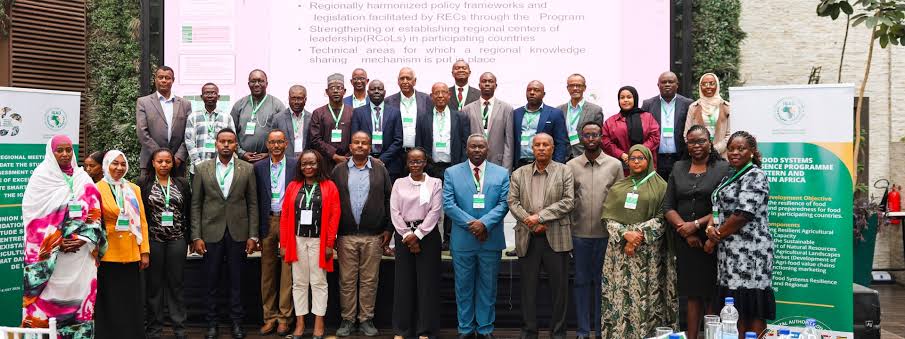
The Intergovernmental Authority on Development (IGAD) has launched a regional effort to strengthen climate-smart agriculture by validating an assessment of Regional Centres of Excellence designed to accelerate agricultural innovation, improve food system resilience and enhance climate adaptation across Eastern Africa. The two-day meeting, held in Addis Ababa on 8 July under the World Bank-supported Food Systems Resilience Program (FSRP), brought together representatives from IGAD Member States, research institutions, Centres of Excellence and technical partners to review recommendations for a more sustainable regional architecture capable of responding to the region’s escalating climate and food security challenges.
The assessment seeks to determine how existing Regional Centres of Excellence can be better positioned to support climate-smart agriculture through stronger institutional coordination, improved knowledge sharing and more sustainable financing models. According to IGAD, participants are reviewing lessons learned from existing initiatives, identifying operational gaps and validating proposals for a regional business model that would allow the centres to provide long-term technical support to governments, research institutions and farming communities across the Horn of Africa.
 The initiative comes as Eastern Africa faces mounting pressure from increasingly frequent climate shocks that continue to undermine agricultural productivity and rural livelihoods. Successive droughts, flooding, erratic rainfall and rising temperatures have disrupted food production across several IGAD Member States in recent years, contributing to higher food prices, declining household incomes and increased humanitarian needs. These climate-related disruptions have reinforced the need for agricultural systems capable of maintaining productivity while adapting to increasingly volatile environmental conditions.
Climate-smart agriculture has become a central pillar of regional food security strategies because it combines improved agricultural productivity with climate adaptation and emissions reduction. Rather than relying solely on expanding cultivated land, the approach promotes technologies and practices such as drought-tolerant crop varieties, climate-informed extension services, sustainable soil management, efficient irrigation systems and improved livestock management. According to agricultural development experts, scaling these practices requires stronger research institutions capable of generating locally relevant knowledge and transferring innovation across national borders.
Opening the meeting on behalf of the Director of IGAD’s Agriculture and Environment Division, Dr. Sylvia Henga, Policy Officer and Food Security Expert, emphasised that strengthening regional cooperation would be essential for building institutions capable of supporting long-term agricultural transformation. She noted that establishing effective regional mechanisms today would position Eastern Africa to respond more effectively to future climate and food security risks while accelerating innovation and collaboration among Member States.
The review of Regional Centres of Excellence also reflects broader efforts to strengthen regional integration through shared technical capacity. Many agricultural challenges facing Eastern Africa, including transboundary pests, livestock diseases, water scarcity and climate variability, extend beyond national borders. Regional research institutions therefore play an increasingly important role by coordinating scientific research, standardising best practices and reducing duplication of investment across countries facing similar environmental and agricultural conditions.
The Food Systems Resilience Program provides the framework through which this collaboration is taking place. Supported by the World Bank, the programme seeks to strengthen food systems across Eastern and Southern Africa by improving agricultural productivity, expanding regional trade in agricultural products and increasing resilience to climate-related shocks. By integrating national efforts within a regional platform, the programme aims to improve efficiency while strengthening the capacity of countries to respond collectively to emerging risks.
For Africa, strengthening regional agricultural research institutions carries implications beyond food production alone. Agriculture remains one of the continent’s largest employers and contributes significantly to gross domestic product across many economies. Improvements in agricultural productivity influence export earnings, inflation, rural employment, fiscal stability and poverty reduction. More resilient farming systems also reduce the frequency and scale of humanitarian interventions triggered by climate-related crop failures, easing pressure on public finances and development budgets.
Investment in regional Centres of Excellence may also improve Africa’s ability to attract climate finance. International climate adaptation funding increasingly prioritises programmes capable of delivering measurable regional impact, supported by strong governance, technical expertise and institutional coordination. Well-functioning regional research networks provide a stronger platform for developing bankable adaptation projects while supporting the implementation of national climate commitments under the Paris Agreement.
 The validation exercise in Addis Ababa represents an early but significant step in determining how regional agricultural institutions can better support long-term resilience. While the assessment itself does not create new centres or financing mechanisms, its recommendations are expected to shape future investments, governance structures and technical cooperation under IGAD’s agricultural agenda.
As climate change continues to reshape agricultural production across Eastern Africa, regional cooperation is becoming an increasingly important component of food security policy. For IGAD Member States, building stronger research institutions capable of accelerating climate-smart agriculture may determine not only how effectively the region adapts to future climate risks, but also how successfully it transforms agriculture into a more productive, resilient and economically competitive sector capable of supporting long-term development.


