

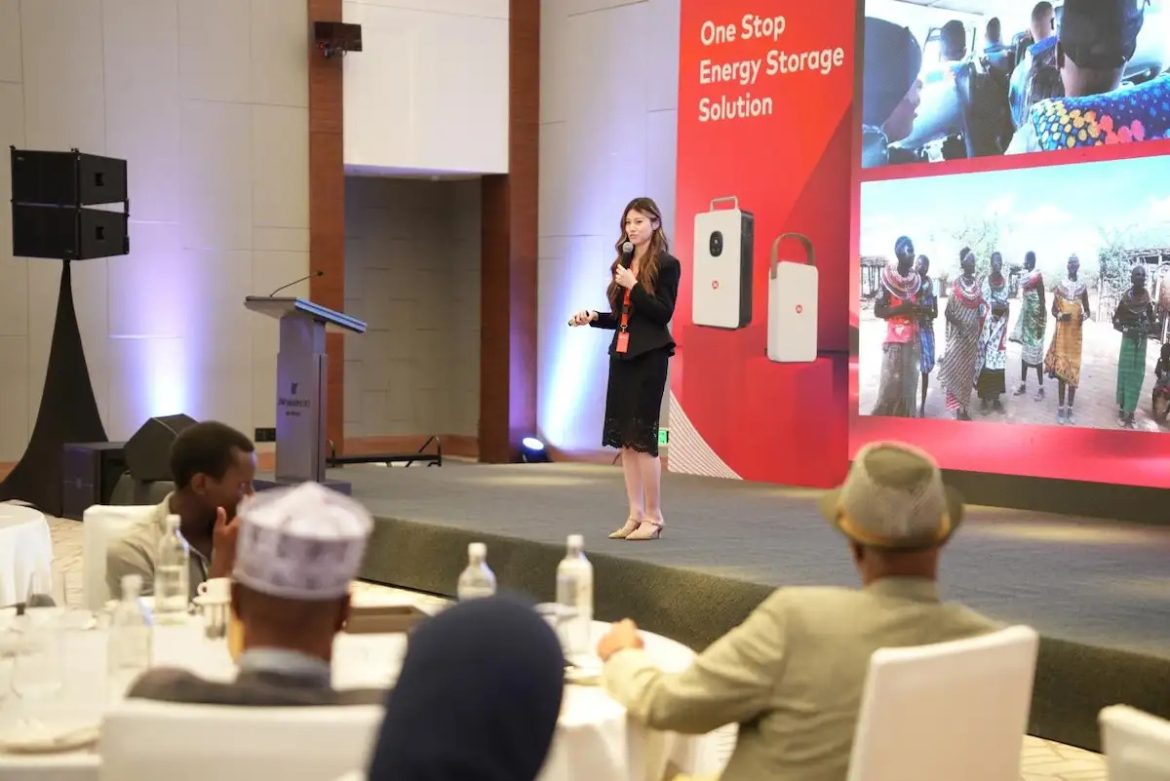
Chinese solar and energy storage company Itel Energy has entered Kenya’s power backup market with two portable battery stations, targeting households, remote workers and small businesses seeking alternatives to grid interruptions and conventional backup systems. The company introduced the Power Go and Power Tank, two portable energy storage products designed for different electricity needs, as it expands its renewable energy business in Kenya and positions the country as a gateway to neighbouring markets, including Somalia and South Sudan.
Itel Energy’s Kenya country manager, Wang Zhuoyu, said the market entry forms part of the company’s broader strategy to develop renewable energy and integrated power solutions for emerging economies. The company is seeking to build its presence through product distribution, service infrastructure and partnerships with local businesses.
The Power Go is designed for smaller electrical loads, including smartphones, laptops, Wi-Fi routers, LED lights and CCTV systems. Its 100,000mAh battery capacity is intended to support essential electronics during power interruptions, with actual operating time depending on the equipment connected and energy conversion losses.

The smaller unit targets households, students and remote workers who need portable electricity for basic devices rather than a full household power supply. It can also be charged through compatible solar panels, with a maximum solar input of 100 watts, allowing users to recharge without depending entirely on the grid.
The larger Power Tank is designed for users requiring greater storage capacity and a wider range of appliances. It has a 1-kilowatt-hour battery and a nominal AC output of 500 watts, allowing it to power televisions, fans, laptops, routers and LED lighting, provided the combined electrical demand remains within its rated output.
Its 500W output limit, however, restricts the appliances it can support. Electric kettles, microwaves, irons and other high-power equipment generally exceed its capacity. Refrigerators also require consideration of startup power requirements, as compressor-based appliances can draw more electricity during startup than during normal operation.
The Power Tank supports solar charging of up to 400 watts, providing an option for users to replenish the battery using compatible photovoltaic panels. Solar charging capacity, however, depends on panel availability, weather conditions, installation and the actual charging performance of the system. The two products enter a Kenyan market where portable power stations are increasingly being positioned as alternatives to petrol generators and fixed inverter systems. Their portability, battery storage capability and compatibility with solar panels make them suitable for users seeking backup power without installing a larger household energy system.
However, portable units remain constrained by battery capacity and inverter output. They are designed to support selected loads and short-duration backup rather than replace a household’s entire electricity supply or serve as substitutes for larger commercial energy systems. Pricing and product specifications will influence how Itel Energy competes with established portable energy storage brands in Kenya. EcoFlow’s River 2, with a 256Wh battery and 300W output, has been advertised locally at approximately KSh26,650, while the River 3, rated at 245Wh and 300W, has been listed at about KSh31,370.
Bluetti’s Premium 30 V2, offering 320Wh of storage and 600W output, has been listed at approximately KSh34,000. In the larger 1kWh segment, comparable products include a YACHU model listed at around KSh45,000 and EcoFlow’s E980, with 980Wh capacity and 500W output, listed at approximately KSh62,380.
The pricing comparisons provide a reference point for the market, although actual retail prices, warranties, battery chemistry, charging speed, usable capacity and service arrangements remain important considerations for buyers evaluating portable energy systems. Beyond its portable power stations, Itel Energy sells hybrid and on-grid inverters, batteries, integrated energy systems, energy storage cabinets and photovoltaic modules. The company says it operates in more than 20 countries, including 11 African markets, and has established a presence in Pakistan’s solar solutions market.
Wang said the company had taken approximately two years to become a market leader in Nigeria, attributing its growth to its distribution network and product quality. The company is now seeking to establish a comparable presence in Kenya, where it says it has more than 100 distributors across over 20 towns and seven official service centres.
Its service network covers Nairobi, Mombasa, Kiambu, Nakuru, Meru, Uasin Gishu and Kisumu counties, providing a local support structure as the company expands its product sales. The Kenyan expansion also extends beyond household backup systems. A local business partner said the company is working with Itel Energy on solar installations for shopping malls and other commercial properties, combining equipment supply with local market knowledge, installation capabilities and technical support.
Commercial solar and battery systems are increasingly being considered by businesses seeking to reduce exposure to grid interruptions and electricity costs. The integration of solar generation, storage and energy management systems can allow commercial properties to use stored energy during periods when grid supply is unavailable or when electricity consumption patterns make alternative supply arrangements attractive.
However, financing remains a constraint for businesses considering larger installations. The upfront cost of solar panels, batteries, inverters and installation can limit adoption, particularly among small and medium-sized enterprises and property owners with competing investment requirements. The company’s local partner said financing arrangements would be important in making solar and storage solutions more accessible, particularly for commercial customers considering larger installations. The partner also said the systems are intended to complement Kenya’s electricity grid rather than compete directly with Kenya Power, the country’s main electricity distributor.
Itel Energy’s Kenya country manager said the company’s expansion is part of a broader effort to build a business around renewable energy and integrated power solutions in emerging markets, with an emphasis on products adapted to local customer requirements. As the company expands its distribution and service network, its position in Kenya will depend on product affordability, technical performance, warranty support, access to compatible solar equipment and the ability to serve customers beyond the initial sales market.
The launch reflects a broader expansion of portable energy storage products in Kenya, where households and businesses are increasingly exploring options for managing electricity interruptions. Itel Energy’s entry adds another supplier to a market that includes established international brands and locally distributed solar and inverter systems, with the company seeking to combine portable products, larger storage solutions and commercial solar installations within a single regional business platform.