


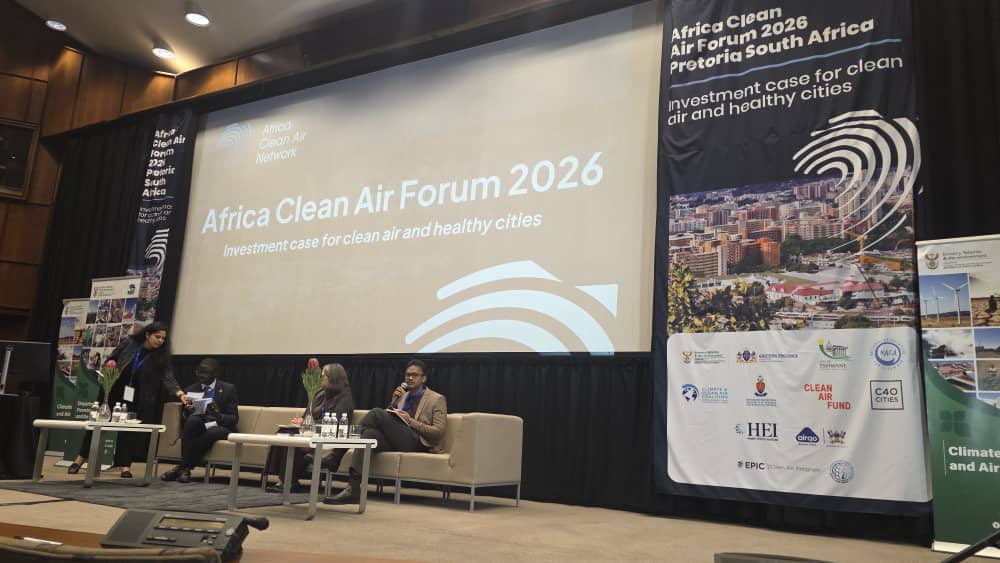
Kampala has positioned itself among Africa’s emerging leaders in urban air quality management after presenting significant progress in tackling air pollution at the Africa Clean Air Forum 2026, demonstrating how community participation, digital monitoring technologies and sustainable urban planning can improve public health while supporting climate resilience and economic development. The Ugandan capital’s experience, presented before policymakers, scientists and environmental practitioners from across the continent in Pretoria, South Africa, reflects a growing shift among African cities towards evidence-based environmental governance as rapid urbanisation intensifies pressure on transport systems, waste management infrastructure and public health.
The Africa Clean Air Forum 2026, hosted at the University of Pretoria and the Council for Scientific and Industrial Research (CSIR) Convention Centre under the theme “Investment Case for Clean Air and Healthy Cities,” brought together governments, researchers, development agencies and civil society organisations to examine practical solutions for reducing air pollution across rapidly expanding African cities.
Speaking during the forum, Kampala Capital City Authority (KCCA) Executive Director Sharifah Buzeki outlined the city’s progress in transforming its air quality management system over the past eight years. According to Buzeki, Kampala has expanded its air quality monitoring network from a single monitoring station established in 2018 to 134 real-time monitoring stations, providing continuous public access to air quality information across the metropolitan area.
The expanded monitoring network forms a central component of the Kampala Clean Air Action Plan 2025–2030, which seeks to reduce average urban air pollution levels by 50% by 2030. The initiative is supported by Uganda’s national environmental legislation and the proposed Kampala Air Quality Management Bill, both of which aim to strengthen environmental regulation while enabling policymakers to make decisions based on scientifically verified air quality data.
According to the World Health Organization (WHO), air pollution remains one of the world’s leading environmental health risks, contributing to approximately seven million premature deaths annually through respiratory diseases, cardiovascular illnesses and cancers. In Africa, rapid urbanisation, ageing vehicle fleets, industrial emissions, open waste burning and the widespread use of biomass fuels continue to worsen air quality in many cities, placing increasing pressure on already stretched healthcare systems.
The United Nations Environment Programme (UNEP) estimates that Africa’s urban population is expected to more than double by 2050, making effective air quality management increasingly important for protecting public health while supporting sustainable economic growth.
Kampala’s strategy reflects an understanding that environmental monitoring alone is insufficient without public participation.
According to Buzeki, one of the city’s most important achievements has been the active involvement of local communities in environmental stewardship. Residents have organised regular neighbourhood clean-up campaigns, journalists have been trained as clean air champions to improve public awareness, while Uganda’s Village Health Teams have taken on expanded responsibilities in educating communities about pollution prevention and environmental health.
This collaborative approach illustrates a broader evolution in urban environmental governance across Africa, where governments are increasingly recognising that lasting improvements require partnerships between public institutions, civil society, academia, media and local communities. According to UN-Habitat, citizen engagement strengthens environmental policies by improving accountability, increasing public awareness and encouraging behavioural changes that complement regulatory interventions. Community participation also helps local authorities identify pollution hotspots and develop locally appropriate solutions that reflect residents’ everyday experiences.
Alongside community engagement, Kampala is investing heavily in sustainable urban mobility as part of efforts to reduce transport-related emissions.
The transport sector remains one of the largest contributors to urban air pollution across Africa. According to the International Energy Agency (IEA), transport accounts for nearly one-quarter of global energy-related carbon dioxide emissions, with rapidly growing vehicle ownership in developing economies increasing pressure on urban air quality. To address these challenges, Kampala is expanding cycling infrastructure, constructing additional pedestrian walkways and introducing electric buses into the city’s public transport system. Authorities are also promoting the adoption of electric vehicles and motorcycles through fiscal incentives designed to accelerate the transition towards lower-emission mobility.
The city is simultaneously establishing a modern traffic management centre capable of improving traffic flow at signalised intersections. By reducing congestion and vehicle idling times, officials expect the system to lower fuel consumption, reduce greenhouse gas emissions and improve overall transport efficiency. According to the World Bank, investments in sustainable urban mobility generate multiple development benefits extending beyond environmental protection. Improved public transport and non-motorised mobility contribute to reduced congestion, lower household transport costs, enhanced productivity and improved public health through increased physical activity and cleaner air.
Kampala’s environmental initiatives have also attracted growing international recognition.
In June 2026, the city received Uganda’s National Environment Sustainability Award, became a finalist for the prestigious Guangzhou International Award for Urban Innovation and made history as the first African city to join the International Network of Tree Cities. These achievements highlight Kampala’s growing profile as a regional leader in sustainable urban development while demonstrating that African cities are increasingly contributing practical innovations to global discussions on climate resilience and environmental governance.
The forum itself reinforced the importance of locally driven solutions. Organised by the Africa Clean Air Network, the conference emphasised that technological innovation and regulatory reform must be complemented by community-centred approaches capable of sustaining behavioural change over the long term. Delegates highlighted the value of transparent environmental data, strengthened local institutional capacity and greater citizen participation in achieving cleaner urban environments.
According to participants, improving public access to real-time environmental information not only strengthens accountability but also empowers residents to make informed decisions that reduce pollution exposure while supporting environmental advocacy. Municipal waste management emerged as another critical area of discussion. Environmental experts argued that many African cities continue to rely heavily on waste disposal methods that contribute significantly to air pollution, including uncontrolled burning and poorly managed landfill operations. Forum participants encouraged local governments to adopt circular economy approaches that maximise resource recovery while minimising emissions.
Recommendations included integrating informal waste collectors into formal municipal waste systems, expanding decentralised composting facilities and promoting household waste separation to reduce open burning. According to the African Development Bank (AfDB), improving municipal waste management offers significant opportunities to create employment while reducing greenhouse gas emissions and improving urban sanitation. Circular economy models can simultaneously strengthen local recycling industries, reduce landfill volumes and generate new economic opportunities for informal workers.
The World Bank similarly estimates that better waste management could significantly reduce methane emissions while supporting broader climate mitigation objectives across rapidly urbanising economies. Buzeki concluded her presentation by calling for stronger regional cooperation on air quality management, describing pollution as a transboundary challenge that cannot be effectively addressed by individual cities acting independently. She urged African governments to strengthen collaboration through knowledge sharing, expanded access to environmental monitoring technologies and coordinated policy development capable of integrating clean air strategies into wider urban planning frameworks.
This emphasis reflects growing recognition that environmental challenges increasingly transcend administrative boundaries. Air pollution generated in one urban area frequently affects neighbouring regions through atmospheric transport, making regional cooperation essential for achieving sustained improvements.
For Africa, Kampala’s experience demonstrates how investments in environmental monitoring, sustainable transport, community participation and evidence-based policymaking can contribute simultaneously to public health, climate resilience and urban economic competitiveness.
As African cities continue to expand rapidly over the coming decades, the lessons emerging from Kampala suggest that successful urban sustainability will depend not solely on infrastructure investment but equally on institutional capacity, technological innovation and active citizen engagement. Clean air is increasingly being recognised not simply as an environmental objective but as a fundamental component of resilient cities capable of supporting healthier populations, stronger economies and more sustainable patterns of urban development across the continent.


