


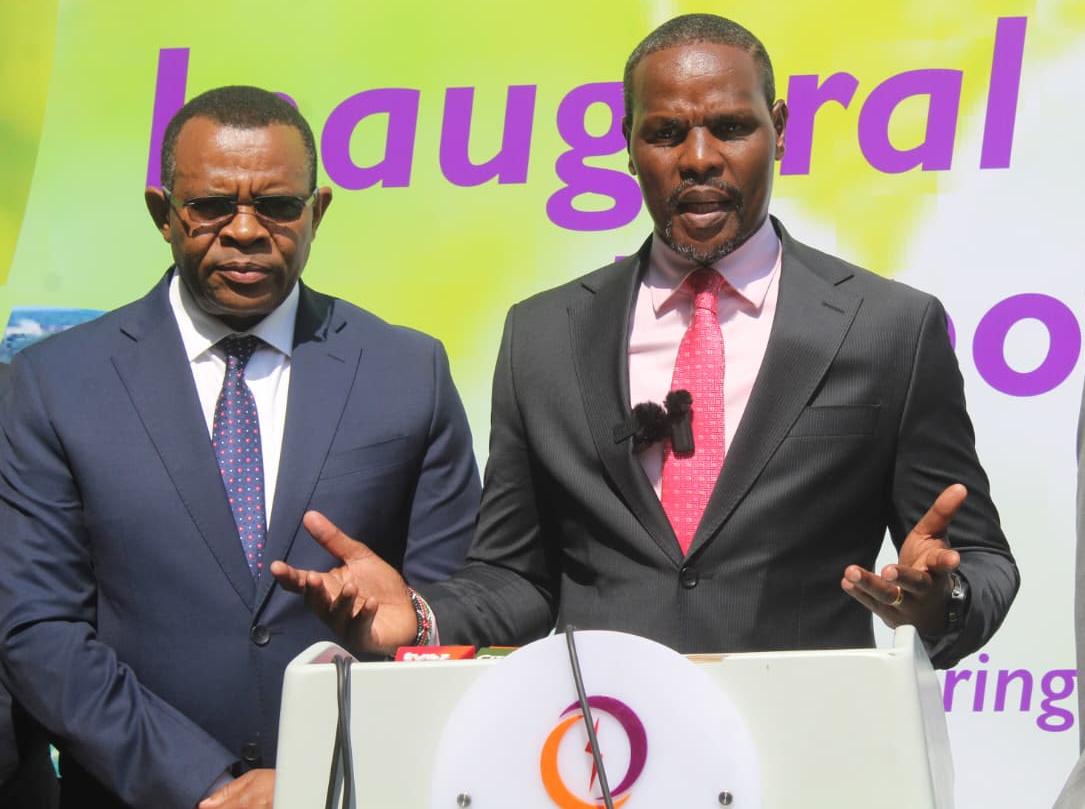
Kenya Electricity Generating Company (KenGen) has expanded its long-term renewable energy development pipeline to 5,500MW while launching its inaugural Sustainability Report, marking a significant shift in the country’s clean energy ambitions as Kenya seeks to strengthen its position as East Africa’s leading renewable energy and green industrialisation hub.
The state-owned power producer announced the revised target during the release of its Environmental, Social and Governance (ESG) report for the 2024/25 financial year, increasing its planned generation capacity from the 1,500MW outlined under its G2G 2034 Corporate Strategy. According to the company, the expanded pipeline reflects evolving investment opportunities, stronger regional electricity demand, growing investor confidence in renewable energy and the emergence of additional generation sources, including nuclear, geothermal and hydropower.
The revised strategy comes as Kenya accelerates efforts to position itself as a regional exporter of clean electricity while supporting industrial development under its long-term economic transformation agenda. The additional capacity is expected to comprise approximately 2,000MW of planned nuclear generation, more than 700MW of hydropower expansion and increased geothermal development, alongside other renewable energy projects.
Speaking during the launch in Nairobi, Principal Secretary for Energy Alex Wachira said Kenya’s renewable energy investments are increasingly creating an ecosystem that extends beyond electricity generation to support industrial competitiveness and sustainable investment.
According to Wachira, investors are increasingly seeking destinations that can provide competitively priced renewable electricity alongside supporting infrastructure, including geothermal steam resources, serviced industrial land and reliable transmission systems. He noted that these advantages strengthen Kenya’s attractiveness as a manufacturing and investment destination while supporting broader economic diversification.
The announcement reflects a broader shift occurring across Africa’s energy sector as governments seek to leverage renewable energy resources not only to improve electricity access but also to attract green manufacturing industries, data centres, electric mobility investments and low-carbon industrial production.
KenGen Managing Director Peter Njenga said the company’s inaugural Sustainability Report represents both a disclosure framework and a strategic roadmap for long-term value creation, institutionalising sustainability reporting while reinforcing the company’s commitment to responsible energy development.
According to Njenga, the revised generation ambitions demonstrate the company’s response to a rapidly changing energy landscape where new investment opportunities continue to emerge across multiple renewable technologies.
The report highlights KenGen’s strong operational performance during the reporting period, with renewable sources accounting for 94.4 percent of total electricity dispatch. The company also reported generating 6.9 million carbon credits while maintaining a carbon intensity of 0.06089 tonnes of carbon dioxide equivalent per megawatt hour, positioning it among Africa’s lowest-emitting electricity producers.
These metrics are becoming increasingly important as governments and investors place greater emphasis on ESG performance and climate disclosure standards when allocating capital to infrastructure projects. International development finance institutions have also strengthened requirements for climate resilience and sustainability reporting, making transparent ESG performance an increasingly important factor in accessing concessional finance.
Environmental stewardship formed another key component of the report. KenGen produced more than 887,000 tree seedlings during the financial year, exceeding its annual target, while restoring approximately 850 hectares of degraded land around its operational sites. The company has now planted more than four million trees and intends to reach nine million by 2034, supporting Kenya’s wider national landscape restoration targets.
The report also documents the company’s social investment initiatives, including scholarship programmes supporting more than 230 students through the KenGen Foundation, improved access to clean water for over 42,000 households and procurement opportunities worth KSh10.01 billion awarded to local suppliers, representing 69 percent of total procurement expenditure.
Principal Secretary for Environment and Climate Change Festus Ng’eno said the Sustainability Report demonstrates how state-owned enterprises can contribute to Kenya’s climate commitments while maintaining transparency and accountability. According to Ng’eno, expanding renewable energy generation alongside stronger environmental governance will be essential to achieving both national development priorities and international climate obligations.
The report further records full compliance across governance and transparency indicators relating to complaints management and public access to information, reinforcing the company’s broader commitment to responsible corporate governance.
Prepared in accordance with the Global Reporting Initiative (GRI) Standards, the United Nations Global Compact principles and the Nairobi Securities Exchange (NSE) ESG Disclosure Guidelines, the report establishes a baseline for annual sustainability reporting while aligning KenGen with globally recognised disclosure frameworks.
KenGen’s expansion reflects wider momentum across Africa’s renewable energy sector as countries increasingly seek to convert abundant geothermal, solar, wind and hydropower resources into engines of industrialisation, export competitiveness and economic resilience. Kenya already generates the vast majority of its electricity from renewable sources, making it one of the continent’s cleanest electricity systems.
 As electricity demand continues to grow across East Africa and regional power interconnection expands under initiatives such as the Eastern Africa Power Pool (EAPP), additional renewable generation capacity could strengthen cross-border electricity trade while supporting regional energy security. The strategy also aligns with Kenya’s ambitions to become a leading producer of green industrial products, where access to affordable low-carbon electricity is expected to become a decisive competitive advantage.
The company’s revised 5,500MW development pipeline therefore represents more than an increase in installed capacity. It signals Kenya’s intention to leverage renewable energy as a foundation for long-term industrial growth, climate resilience and sustainable economic development, reinforcing the increasingly central role of clean energy infrastructure in Africa’s wider green transition.


