


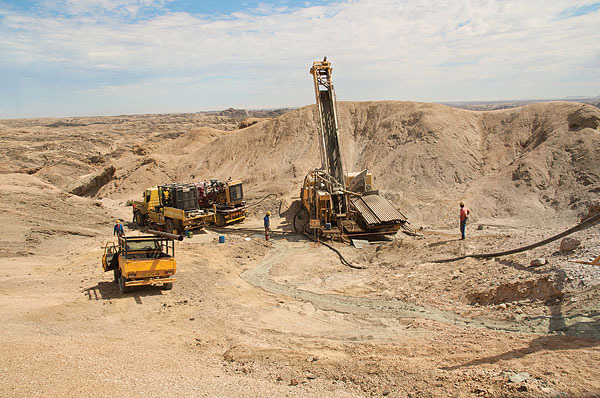
Namibia is seeking to expand its mining sector as global demand for uranium, lithium, rare earth elements, copper and graphite intensifies, but the country faces a difficult policy challenge: attracting the capital needed to develop its mineral resources while ensuring that extraction delivers jobs, industrial capacity and local economic benefits without increasing environmental and social risks. The mining industry sustained 166,384 jobs in 2025, including 20,798 direct positions, and contributed about 14% of Namibia’s gross domestic product, giving the sector an economic weight that makes the balance between investment and sustainability central to the country’s development strategy.
The opportunity is being shaped by a broader restructuring of global mineral supply chains. The European Union, United States and Asian economies are competing to secure supplies of minerals considered essential to electric vehicles, renewable energy systems, advanced manufacturing and other technologies associated with the energy transition. Namibia’s political stability, established mining industry and mineral endowment have consequently increased its relevance to investors seeking alternatives to more concentrated sources of critical minerals.
For Namibia, the challenge is to convert this interest into longer-term economic value rather than simply increase exports of unprocessed commodities. The government’s first dedicated Mineral Beneficiation Policy reflects this objective, with greater emphasis on value addition, local procurement and the development of domestic industrial capabilities. If implemented effectively, such measures could allow more mining-related activity to remain within the country through processing, manufacturing, logistics and specialised services.
That agenda also carries a tension. Namibia needs foreign capital and technical expertise to develop capital-intensive mining projects, particularly in emerging mineral categories, while simultaneously seeking greater local ownership, procurement and participation. Policies that impose significant costs without sufficient infrastructure or skills could affect the commercial viability of projects, while insufficient local participation could limit the contribution of mining to wider economic transformation.
The question of ESG sits at the centre of that tension. Environmental, social and governance requirements are increasingly incorporated into investment decisions, financing agreements and supply-chain standards, particularly in markets such as Europe. But the operating conditions of an emerging African mining economy differ from those of mature industrialised jurisdictions. Namibia must therefore determine how international sustainability expectations can be applied without losing sight of the country’s infrastructure constraints, employment needs and industrialisation objectives.
Read also: https://observer24.com.na/balancing-growth-and-sustainability-in-namibias-mining-sector/
This does not imply that environmental or social standards should be weakened. Rather, the challenge is to make them relevant to the economic and institutional realities of the country. In Namibia, mining policy cannot be separated from questions of employment, local procurement, infrastructure, skills development, water security and energy supply. Environmental management is therefore not simply a compliance issue; it is part of the broader question of whether mineral development contributes to durable economic capacity.
The distinction matters as the composition of Namibia’s mining opportunity changes. Uranium has long been an important part of the country’s mineral economy, while growing interest in lithium, copper, rare earth elements and graphite reflects the strategic importance of minerals required by the global energy and technology transition. These projects could attract new investment and create additional economic activity, but their contribution will depend on how much value is generated locally and how effectively environmental and social risks are managed.
Infrastructure could become a decisive constraint. Mining operations require reliable electricity, substantial water resources, transport infrastructure and technical services. Namibia’s arid climate makes water availability particularly important, while expanding energy-intensive industrial activity could place additional pressure on the power system. The development of new mines therefore has implications beyond individual project sites, potentially requiring investment in transmission, renewable generation, water infrastructure, roads and logistics.
These requirements also illustrate why beneficiation cannot be pursued in isolation. Processing minerals locally can create more economic value and employment, but it generally requires reliable and competitively priced energy, appropriate infrastructure, technical expertise and access to markets. Without those foundations, policies aimed at increasing domestic processing could raise project costs without generating the intended industrial benefits.
The volatility of commodity markets presents another risk. Namibia’s diamond industry, for example, has faced weaker international demand, demonstrating how quickly changes in global markets can affect production and revenues in resource-dependent economies. Expanding into critical minerals may diversify the country’s mining base, but it does not eliminate exposure to commodity cycles. Lithium, copper and other minerals associated with the energy transition remain subject to changes in technology, prices, demand and supply.
For African economies, this is an increasingly important consideration. The global energy transition is creating new opportunities for mineral-rich countries, but it does not automatically translate into industrialisation. Across the continent, governments are seeking to move beyond the historical model of exporting raw materials while importing higher-value manufactured products. The effectiveness of that transition will depend on whether mineral policy is connected to industrial policy, infrastructure development, skills formation and stronger domestic supply chains.
Namibia’s local-content agenda is therefore significant beyond the mining sector itself. Greater use of domestic suppliers can create opportunities for small and medium-sized businesses, while skills-transfer requirements can strengthen the local workforce. At the same time, international mining companies bring capital, technology and access to global markets that may be difficult to replicate domestically. The policy challenge is to create conditions in which these capabilities reinforce rather than displace local economic development.
Community participation is equally important. Mining projects can generate employment and infrastructure but can also affect land, water resources and existing livelihoods. Meaningful engagement therefore needs to extend beyond formal consultation at the approval stage. Communities have an economic interest in how mining revenues, employment opportunities, procurement contracts and environmental liabilities are managed over the life of a project.
Rehabilitation is another area where the financial and environmental dimensions of mining intersect. A mine has a finite operating life, while the environmental liabilities associated with extraction can persist for decades. Credible closure and rehabilitation plans, supported by appropriate financial provisions and transparent oversight, can reduce the risk of these costs ultimately being transferred to communities or the public sector.
For investors, regulatory predictability will remain a critical consideration. Namibia’s ambition to increase local ownership, beneficiation and economic participation needs to operate alongside clear licensing rules, transparent fiscal arrangements and consistent environmental requirements. A policy environment that changes unpredictably can increase investment risk, while a framework that provides clarity can allow companies and financiers to incorporate local-development requirements into project economics from the outset.
The broader issue is whether Namibia can use the current critical-minerals cycle to strengthen its economic foundations rather than simply increase extraction. The country has an opportunity to link mineral development with renewable energy, industrial processing, logistics, technical training and domestic enterprise development. That would make mining a platform for diversification rather than an isolated source of export revenue.
 For Africa, Namibia’s experience reflects a wider policy dilemma. Countries with significant mineral resources are being courted by competing global powers seeking secure supplies for the energy transition. The strategic value of those resources gives African governments greater negotiating leverage, but that leverage will have limited developmental impact unless contracts, institutions and infrastructure are capable of converting mineral wealth into broad-based economic gains.
Namibia’s next phase will therefore be measured less by the number of mining projects announced than by the quality of their economic and environmental outcomes. Maintaining investor confidence, strengthening local participation, improving infrastructure and enforcing credible environmental safeguards will need to advance together. The central challenge is not whether Namibia can mine more minerals, but whether it can ensure that the minerals beneath its soil contribute to productive capacity, resilient communities and a more diversified economy while preserving the environmental assets on which future growth also depends.


