


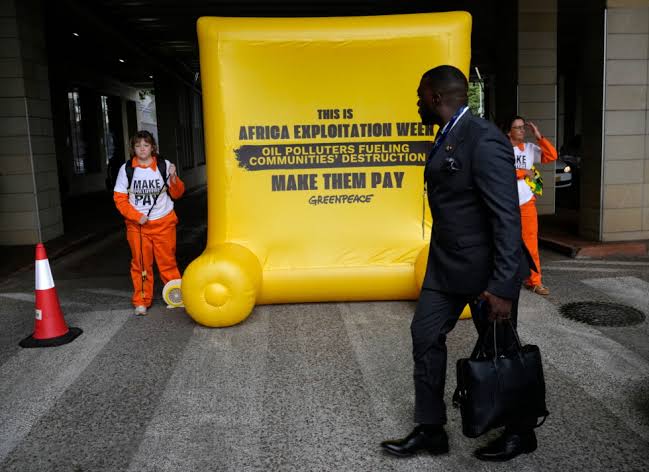
Climate activists protesting outside the African Energy Week conference in Cape Town on October 13 called for an end to new oil and gas exploration across Africa, bringing renewed scrutiny to the continent’s strategy for attracting energy investment while meeting climate commitments. The demonstration by Greenpeace Africa and Extinction Rebellion comes as South Africa seeks to expand oil and gas development to strengthen energy security and attract investment, highlighting a growing policy tension over how African economies should finance development without creating deeper long-term dependence on fossil fuels.
According to the Associated Press, protesters challenged efforts to position Africa as a new frontier for fossil fuel development, arguing that expanded exploration could intensify climate risks for communities already facing their effects. Police removed demonstrators wearing shirts bearing the slogan “Make polluters pay” after they staged the protest outside the conference.

The demonstration reflects a broader dispute over the economic role of the continent’s oil and gas resources. For governments, new exploration can offer the prospect of investment, export earnings, employment and additional energy supplies. For campaigners, the concern is that these potential benefits may be outweighed by environmental damage, continued emissions and the risk that infrastructure built today could constrain future energy choices.
South Africa’s position illustrates the difficulty of balancing these competing priorities. According to the AP report, the government presents natural gas as a complement to renewable energy, arguing that gas-fired power plants could supply electricity when wind and solar generation declines. The approach reflects a wider debate over whether gas can support electricity reliability as renewable capacity grows, or whether new gas infrastructure could prolong dependence on fossil fuels.
The distinction matters because energy investment involves long-lived assets. Exploration, pipelines, processing facilities and power plants require substantial capital and depend on future demand, fuel prices and regulatory conditions. If the energy system shifts more quickly towards lower-carbon alternatives, some fossil fuel investments could face reduced utilisation or financial pressure. Conversely, where electricity supply remains unreliable, governments may view dispatchable generation as necessary to support households, industry and economic growth.
South Africa’s offshore exploration plans are one point of contention. Despite legal setbacks, British energy company Shell plans to drill up to five deepwater wells in the Northern Cape Ultra Deep block off the country’s West Coast to explore for and assess oil and gas deposits. The project’s environmental approval has faced appeals, according to the AP. The dispute places environmental assessment and regulatory decisions at the centre of the country’s effort to establish whether further offshore exploration can proceed.
For investors, such cases underline the importance of predictable regulation, credible environmental review and clarity over the conditions attached to energy projects. Delays and legal challenges can affect project costs and timelines, while inadequate environmental safeguards can expose companies, public institutions and coastal communities to additional risks. The financial viability of a project therefore depends not only on the resource potentially available, but also on permitting, infrastructure requirements, market demand and the costs of managing environmental impacts.
The African Energy Week protest also raises questions about how the benefits of fossil fuel development are distributed. New projects can generate tax revenues, royalties, foreign exchange and local business opportunities, but these outcomes depend on fiscal terms, domestic participation, infrastructure and the ability of public institutions to manage revenues effectively. Without transparent agreements and credible oversight, resource development may deliver less lasting value to host economies than headline investment figures suggest.
These questions extend beyond South Africa. Across Africa, governments are weighing the potential contribution of oil and gas to industrialisation and public finances against the cost of climate-related damage and the demands of a changing global energy market. The choices differ by country: some have established hydrocarbon industries, while others are seeking to develop newly discovered resources or expand access to modern energy. A single approach cannot account for differences in electricity access, industrial capacity, fiscal needs and available renewable resources.
Read also: https://apnews.com/article/south-africa-climate-change-protest-d545a8457f4c4cbbdd45757baa8d133a
However, the economic implications of climate change make the debate more immediate. Fires, floods and rising food prices were among the risks highlighted by Extinction Rebellion representative Judy Scott-Goldman in comments reported by the AP. Such pressures can affect agricultural output, transport networks, household spending and public expenditure. In countries where governments already face constrained budgets, climate-related losses can increase demands for emergency response and reconstruction, potentially reducing funds available for infrastructure and social services.
At the same time, limiting fossil fuel development without credible alternatives would leave unresolved the practical energy needs facing many African economies. Reliable and affordable electricity is essential for manufacturing, mineral processing, healthcare, digital services and small businesses. For countries considering new gas projects, the central questions include whether the fuel will improve domestic energy access, how its cost compares with alternatives, what infrastructure is required and whether investment could divert capital from renewable generation, storage and transmission networks.
A durable energy strategy will therefore depend on more than the choice between oil and gas on one side and renewables on the other. Governments need to assess projects against electricity demand, affordability, emissions, environmental liabilities and the capacity to deliver reliable power. They must also consider whether infrastructure can adapt as technology, financing conditions and international energy markets change.
For African public finances, the quality of project agreements and the management of future revenues will be as important as the volume of investment attracted. For communities, the relevant measures include access to reliable electricity, employment, environmental protection and whether economic gains reach areas affected by extraction. For investors, clear policy signals and robust environmental governance can help reduce uncertainty over the life of energy assets.
The protest at African Energy Week does not resolve these competing demands, but it highlights the scrutiny surrounding decisions that could shape Africa’s energy systems for decades. As governments pursue investment and energy security, the challenge is to demonstrate that new projects can deliver measurable domestic economic value while accounting for environmental costs and the risks of a changing global energy system. The credibility of that balance will depend on transparent decision-making, enforceable safeguards and evidence that energy development serves broader economic needs rather than resource production alone.


