


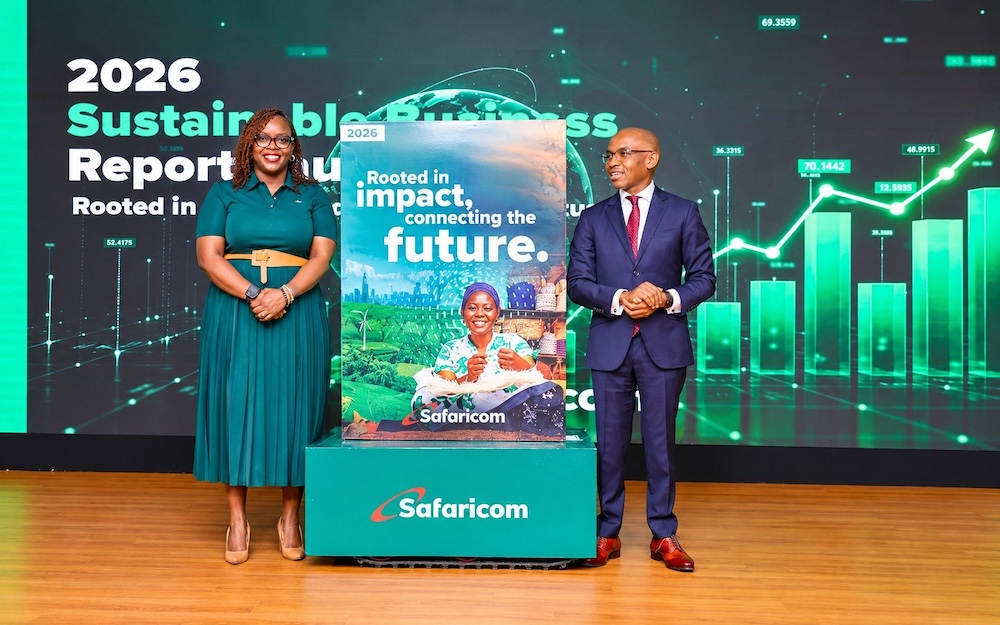
Safaricom reported KSh10.2 billion in investment through its Safaricom and M-PESA Foundations during the financial year ended 31 March 2026, with programmes reaching 4.4 million people across all 47 counties, according to the company’s FY2026 Sustainable Business Report. The disclosure provides a measure of the telecommunications company’s reported social investment and the national reach of its community programmes, placing its foundations’ activities within a wider account of corporate sustainability and economic participation in Kenya.
The figures, released as part of Safaricom’s 15th Sustainable Business Report, offer two distinct indicators of the company’s social investment. The KSh10.2 billion represents financial investment channelled through the Foundations, while the 4.4 million figure records the people the company says its programmes reached during the year. The measures provide an indication of the scale and geographical coverage of the interventions, although reach alone does not establish the depth or long-term effects of the benefits received.
The reported investment covers programmes associated with the Foundations’ work in areas including health, education, economic empowerment, environmental conservation, water access and humanitarian response. These areas reflect the Foundations’ role in supporting community initiatives alongside Safaricom’s commercial operations and wider sustainability commitments.

Safaricom’s Foundations operate as channels for community investment, supporting interventions that address social and economic needs beyond the company’s direct provision of telecommunications and financial services. Their activities include partnerships with communities, public institutions and implementing organisations, with programmes designed to improve access to essential services and opportunities.
The national reach reported for FY2026 is significant in geographical terms because it covers all 47 counties. However, the aggregate figure does not indicate how beneficiaries were distributed between counties, how many people received support from more than one programme or the proportion of beneficiaries who experienced sustained improvements. Those details are important when assessing the effectiveness of social investment beyond the headline number of people reached.
The distinction between expenditure and outcomes is also relevant to corporate sustainability reporting. Investment records the resources committed to programmes, while reach indicates the reported scale of participation or coverage. Assessing longer-term impact requires additional information on programme results, such as improvements in health access, educational attainment, household incomes, employment opportunities and environmental conditions.
Safaricom’s community investment includes initiatives in education and skills development. Among the programmes highlighted in its wider reporting is Citizens of the Future, a five-year initiative aimed at supporting 500 learning institutions, awarding 10,000 scholarships and equipping 56,000 teachers with digital skills. The programme reflects the company’s emphasis on education infrastructure and digital inclusion, although its targets should be distinguished from achievements recorded during the reporting period.
In healthcare, the Foundations have supported medical camps, maternal and child health interventions and specialist treatment programmes. The company’s FY2026 reporting also identifies environmental conservation and livelihoods as areas of intervention, including support for communities linked to conservation initiatives and water, sanitation and hygiene programmes.
Economic empowerment forms another part of the Foundations’ work, with interventions directed towards young people, women and community groups. These programmes are intended to strengthen access to skills, livelihoods and economic opportunities. Their longer-term contribution will depend on whether beneficiaries can translate the support received into sustained income, employment or improved access to markets and services.
The KSh10.2 billion disclosure also needs to be considered separately from other financial and impact measures contained in the same sustainability report. Safaricom reported KSh6 billion in spending with special-interest groups, representing 5% of spending in the relevant supplier category. That figure relates to procurement and supplier participation rather than expenditure through the Foundations. It therefore measures a different aspect of the company’s economic and social contribution.
The company also reported a modelled estimate of its wider societal value, which attempts to quantify the economic, social and environmental effects associated with its operations and ecosystem. This is distinct from direct Foundation investment. The three measures—community investment, procurement spending and modelled societal value should not be combined as though they represent the same form of expenditure or impact.
This distinction is increasingly important as companies face greater expectations to provide transparent and comparable sustainability disclosures. Corporate social investment figures can demonstrate the resources directed towards communities, but stakeholders also need information about how programmes are selected, how results are monitored and whether benefits continue after funding ends.
Safaricom’s FY2026 report was launched in Nairobi on 27 October 2026, with Dr Festus K. Ng’eno, Principal Secretary in Kenya’s State Department for Environment and Climate Change, calling for stronger public-private partnerships to accelerate the country’s green transition. He highlighted the role of businesses in supporting environmental action and the importance of credible sustainability data in informing investment and climate-related decisions.
The report’s wider sustainability disclosures also cover business operations, employee safety, supplier participation and environmental performance. This broader reporting context places community investment alongside the company’s responsibilities to manage its own operational and environmental impacts. The scale of Foundation spending, while an important indicator of social investment, does not in itself establish the sustainability performance of the company’s entire business.

For Kenya’s corporate sector, the figures illustrate how large businesses can use foundations and community partnerships to direct resources towards social development across different regions. They also raise questions about how companies measure the effectiveness of such spending and demonstrate the connection between financial commitments and outcomes for communities.
The next stage of accountability will depend on more detailed reporting of programme-level results, including the distribution of investment, the number and profile of beneficiaries, and evidence of sustained changes in the sectors targeted. Such information would help communities, investors and other stakeholders understand not only how much companies invest, but also what that investment achieves.
For the year ended March 2026, Safaricom reported KSh10.2 billion in Foundation investment and 4.4 million people reached across all 47 counties. These figures establish the reported financial scale and national coverage of its social programmes. Their longer-term significance, however, will depend on the outcomes delivered and the extent to which the interventions contribute to lasting improvements in the communities they are intended to serve.


