


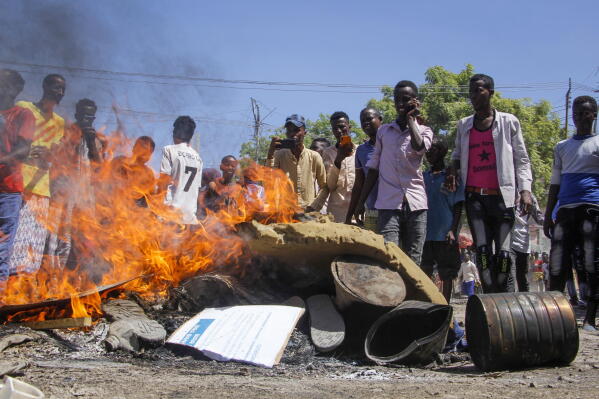
Heavy gunfire erupted in Central Mogadishu on Wednesday, prompting residents to flee parts of the Somali capital as tensions escalated between the government and opposition figures over a disputed extension of President Hassan Sheikh Mohamud’s mandate. The violence occurred near the residence of former Prime Minister Hassan Ali Khaire, who alleged that government forces attacked his convoy as opposition groups prepared for planned demonstrations against the extension of presidential authority.
The incident marks a significant escalation in Somalia’s latest political crisis, highlighting the fragility of the country’s governance institutions at a time when it continues to confront security threats, economic vulnerabilities and complex state-building challenges. Witnesses reported exchanges of gunfire involving armed opposition supporters and security forces in Mogadishu’s Howl Wadaag district, while residents described scenes of panic as explosions and sustained shooting echoed across surrounding neighbourhoods.
Khaire, a prominent opposition figure and former Prime Minister, said in a social media statement that forces loyal to the president targeted his group while preparations were underway for what he described as a peaceful protest. Local residents and journalists on the scene reported hearing heavy weapons fire, including rocket-propelled grenades, before the confrontation subsided.
The unrest follows President Mohamud’s announcement that his tenure would be extended by one year beyond its scheduled expiration in May. The President argues that the extension is linked to constitutional changes approved by parliament earlier this year, which establish a framework for future democratic elections and seek to replace Somalia’s long-standing clan-based political model with a broader electoral system.
Opposition leaders and several regional administrations have rejected that interpretation, arguing that the move risks concentrating political power and undermining constitutional legitimacy. The disagreement has intensified existing political divisions and raised concerns about the stability of the transition process.
Somalia’s efforts to reform its electoral system have unfolded against a backdrop of persistent insecurity and institutional fragility. Large parts of the country remain affected by the activities of Al-Shabaab, the Islamist insurgent group that continues to launch attacks against government targets and civilian infrastructure. Security concerns, combined with administrative and logistical challenges, have complicated efforts to organize nationwide elections and strengthen state institutions.
According to governance analysts, the latest confrontation underscores the difficulty of balancing political reform with consensus-building in a country where power-sharing arrangements remain closely linked to clan structures and regional interests. Electoral reforms intended to strengthen democratic representation can face resistance when key stakeholders perceive changes as altering existing political balances without sufficient consultation.
The political uncertainty also carries economic implications. Somalia has made gradual progress in recent years toward fiscal reform, debt relief and engagement with international financial institutions. Political instability risks disrupting that momentum by affecting investor confidence, delaying development programmes and diverting government attention away from economic priorities.
For a country heavily reliant on external support, maintaining political stability remains critical to sustaining international partnerships and development financing. Governance disputes can influence donor confidence, particularly as Somalia continues efforts to strengthen public financial management, expand infrastructure and improve basic service delivery.
 The consequences extend beyond public finances. Political uncertainty can affect private sector activity, trade flows and urban livelihoods, particularly in Mogadishu, which serves as the country’s economic and administrative centre. Periods of unrest often disrupt business operations, increase security costs and create uncertainty for local entrepreneurs and investors.
The developments also carry wider significance for Africa. Across several countries on the continent, debates over constitutional mandates, electoral reforms and political transitions continue to shape governance outcomes and economic prospects. Somalia’s experience illustrates how questions of political legitimacy and institutional design remain closely linked to broader development objectives, including security, economic resilience and public trust.
Former President Sharif Sheikh Ahmed, another leading opposition figure, condemned the reported attack and accused the administration of escalating tensions. He maintained that planned demonstrations would proceed despite the confrontation. The government has not publicly responded to the specific allegations regarding the incident near Khaire’s residence.
 Somalia has experienced similar political disputes in the past. In 2021, disagreements over electoral timelines and presidential mandates triggered armed confrontations in Mogadishu and drew concern from regional and international partners. Those events highlighted the risks associated with unresolved constitutional and electoral disputes in a country still navigating a complex transition from conflict toward institutional stability.
While the immediate situation in Mogadishu remains fluid, the latest violence underscores the importance of dialogue and political consensus in managing contested transitions. The coming weeks are likely to be closely watched by domestic stakeholders, regional partners and international institutions as Somalia seeks to balance political reform ambitions with the need to preserve stability and maintain progress toward long-term state-building and economic development objectives.


